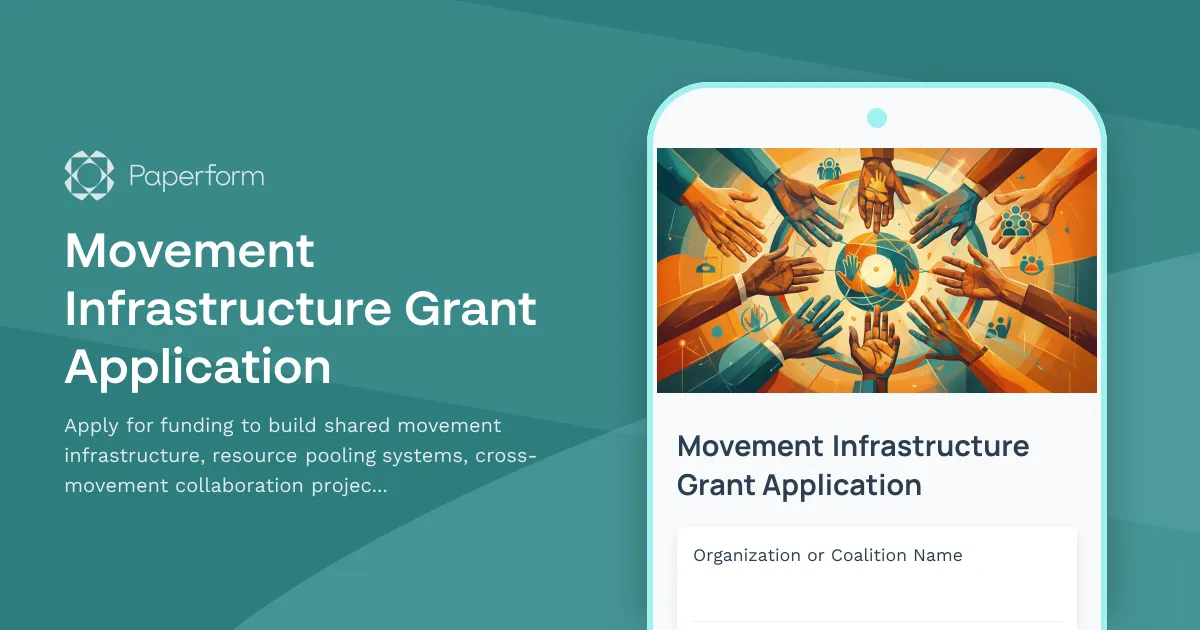
Movement Infrastructure Grant Application: Build Collaborative Ecosystems with Paperform
Social movements, advocacy networks, and community organizations increasingly recognize that shared infrastructure strengthens the entire ecosystem. Rather than duplicating resources across isolated groups, movement infrastructure grants fund the creation of shared spaces, resource pools, collaborative platforms, and mapping tools that serve multiple organizations and causes simultaneously.
This Movement Infrastructure Grant Application template helps grantmakers evaluate proposals for projects that build bridges between movements, create shared resources, and strengthen the collaborative capacity of entire ecosystems. Built with Paperform, this template streamlines the application process while gathering the rich, nuanced information needed to assess infrastructure projects.
Why Movement Infrastructure Grants Matter
Traditional grant programs often fund individual organizations working in isolation. Movement infrastructure grants take a different approach by supporting:
- Shared physical spaces like co-working hubs, community centers, and event venues that multiple organizations can use
- Resource pooling systems including shared equipment, staff expertise, technology platforms, and knowledge repositories
- Cross-movement collaboration that connects environmental, racial justice, economic, and other movements around common goals
- Ecosystem mapping that visualizes relationships, identifies gaps, and reveals opportunities for strategic coordination
These infrastructure investments create multiplier effects—every dollar spent on shared resources serves multiple organizations and amplifies collective impact.
How This Template Streamlines Infrastructure Grant Applications
This Paperform template is designed specifically for the unique requirements of movement infrastructure funding:
Comprehensive project assessment with questions about shared resource models, collaboration structures, and ecosystem impact that go beyond traditional grant applications. The form captures not just what you'll build, but who will benefit and how it strengthens the broader movement ecosystem.
Partnership and collaboration mapping through questions that identify key partners, describe collaboration models, and articulate how the infrastructure will serve diverse groups. This helps grantmakers understand the collaborative nature and reach of your proposal.
Financial planning for shared models with sections for budget breakdowns that account for shared costs, resource pooling arrangements, and sustainability plans that involve multiple stakeholders.
Impact measurement focused on ecosystem health rather than just individual organization metrics. Questions explore how success will be measured across multiple groups and movements.
Perfect for Multiple Stakeholder Types
This template serves various organizations and coalitions:
- Movement coalitions applying to build shared platforms or spaces
- Community foundations and grantmakers designing infrastructure funding programs
- Nonprofit collaboratives seeking funding for resource pooling initiatives
- Social entrepreneurs building tools and spaces for movement use
- Advocacy networks mapping ecosystems and building collaborative capacity
Customization That Matches Your Values
Because movement work is diverse and contextual, this template is fully customizable in Paperform's document-style editor. You can:
- Add questions specific to your focus area (climate, justice, democracy, etc.)
- Include fields for specific collaboration models or shared resource types
- Adjust budget categories to match your funding structure
- Incorporate conditional logic that shows different questions based on project type
- Add your organization's branding, values statements, and community agreements
Automation That Respects Your Workflow
Use Stepper (stepper.io) to automate what happens after applications are submitted:
- Route applications to review committees based on project type or geographic focus
- Create evaluation scorecards automatically populated with applicant responses
- Send acknowledgment emails that set clear expectations about timelines
- Update project tracking systems in Airtable or Notion
- Trigger background research workflows for due diligence
These automations free up program staff to focus on relationship-building and strategic advising rather than administrative tasks.
Security and Trust for Sensitive Work
Movement work often involves sensitive information about strategies, partnerships, and communities. Paperform provides SOC 2 Type II compliance, data encryption, and access controls so applicants can trust that their information is protected. Set up role-based permissions so review committees only see the applications assigned to them.
From Application to Partnership
The best infrastructure grants are relationship-driven, not just transactional. This Paperform template helps you gather the information needed for sound decisions while maintaining the human, collaborative spirit of movement work. After reviewing applications, you can use Papersign (papersign.com) to handle grant agreements electronically, keeping everything connected to the original application.
Built for Impact, Designed for Ease
Whether you're a movement coalition seeking infrastructure funding or a foundation designing a collaborative grants program, this template provides a professional, accessible way to manage applications. With Paperform's intuitive interface, you can launch your grant program quickly, collect structured data, and focus on what matters most—building the infrastructure that strengthens movements and creates lasting change.
Trusted by nonprofits, foundations, and social impact organizations worldwide, Paperform combines enterprise-grade security with the flexibility and ease of use that mission-driven teams need.



More templates like this
Community Health Worker Grant Application
A comprehensive grant application for community health worker programs focused on health equity, care coordination, and addressing social determinants of health.
Community Autonomy Grant Application
Apply for funding to support community self-governance experiments, participatory democracy projects, and collective decision-making infrastructure that builds community power and autonomy.
Grassroots Organizing Grant Application
A comprehensive grant application form for community-based organizations seeking funding for grassroots organizing, base-building campaigns, leadership development programs, and movement ecosystem support initiatives.
Nonprofit General Operating Support Grant Application
A comprehensive grant application form for nonprofits seeking general operating support, including 501(c)(3) verification, detailed budget breakdown, program impact metrics, and board diversity information.
Abolitionist Grant Application Form
A comprehensive grant application form for organizations working toward decarceration, prison abolition, community-based accountability systems, and reinvestment in community resources.
Cash Transfer Program Grant Application
A comprehensive application form for unconditional cash transfer programs, designed to collect applicant information, verify eligibility criteria, and establish payment preferences for direct financial assistance.
Civic Engagement Grant Application
Apply for funding to support civic engagement initiatives including voter registration, community organizing, civic education, and language access programs in your community.
Climate Adaptation Grant Application
Apply for climate adaptation funding with comprehensive vulnerability assessment, resilience strategies, stakeholder consultation records, and monitoring framework documentation.
Climate Justice Grant Application
A comprehensive grant application form for climate justice initiatives focused on frontline community leadership, environmental health, just transition planning, and policy advocacy.
Community Economics Grant Application
A comprehensive grant application form for community-led economic initiatives including alternative currencies, local exchange systems, community development financial institutions, and cooperative finance projects.
Community Healing Grant Application
Apply for funding to support community healing initiatives including collective trauma processing, cultural healing practices, storytelling circles, and intergenerational healing spaces.
Community Knowledge Grant Application
Application form for community-led research grants supporting knowledge justice, participatory action research, and grassroots intellectual production through community-university partnerships.