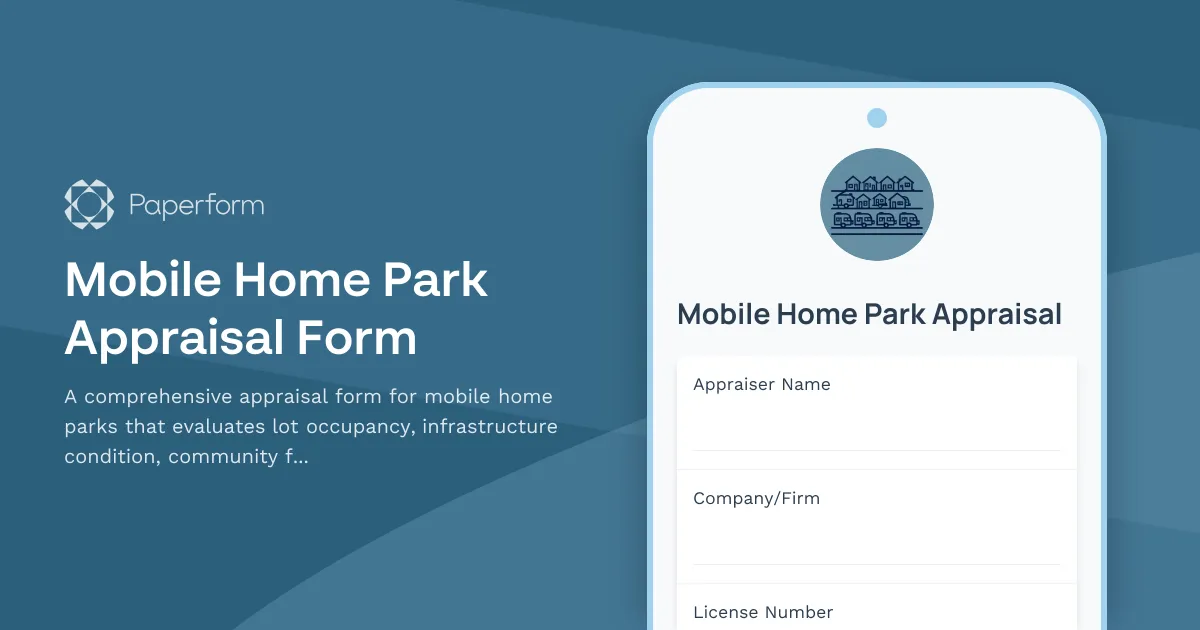
Professional Mobile Home Park Appraisal Made Simple
Valuing a mobile home park requires far more than standard residential property appraisals. You need to analyze lot occupancy rates, assess aging infrastructure, evaluate community amenities, document pad rental income streams, and measure resident stability—all factors that directly impact cash flow and long-term investment value.
This Mobile Home Park Appraisal Form gives property appraisers, real estate investors, lenders, and park owners a structured way to capture the detailed information that drives accurate mobile home community valuations. Instead of juggling spreadsheets, clipboards, and disconnected notes during site visits, you can complete the entire assessment in one professional, mobile-friendly form.
Why mobile home park appraisals need a specialized approach
Mobile home parks operate as income-producing properties where land is leased to residents who own (or rent) the homes themselves. This creates a unique valuation model based on:
- Occupancy rates and pad count: The percentage of occupied lots directly impacts gross income potential
- Infrastructure condition: Water, sewer, electrical, roads, and drainage systems that require significant capital investment
- Community facilities: Clubhouses, playgrounds, laundry facilities, and amenities that affect marketability
- Rental income documentation: Current pad rents, utilities billing, and ancillary income streams
- Resident stability: Turnover rates, lease terms, and tenant tenure that indicate cash flow predictability
Traditional property appraisal forms don't capture these nuances. This template is purpose-built for the mobile home park asset class, letting you document every factor that institutional lenders, investors, and park operators need to make informed decisions.
What this form includes
The template walks through a complete mobile home park appraisal workflow:
Property & park overview: Basic property details, total pad count, park classification, zoning, and ownership structure
Lot occupancy analysis: Occupied vs. vacant pads, occupancy percentage, turnover trends, and waitlist status
Infrastructure condition assessment: Detailed evaluation of water/sewer systems, electrical service, roads, drainage, lighting, and any deferred maintenance issues
Community facility evaluation: Assessment of shared amenities including clubhouses, recreation areas, laundry facilities, storage, and landscaping
Pad rental income documentation: Current rent roll data, average pad rent, utility billing structure, late fees, and other income sources
Resident stability metrics: Average resident tenure, lease types, turnover rates, and community demographics
Market positioning: Competitive analysis, local demand factors, and expansion potential
Appraiser notes & recommendations: Space for narrative observations, comparable sales, and final valuation conclusions
Each section uses conditional logic to show follow-up questions only when relevant, keeping the form streamlined while capturing comprehensive detail. You can complete inspections on-site via mobile device, with photo uploads for documenting facility conditions and infrastructure concerns.
Who benefits from this template
Real estate appraisers can standardize their mobile home park evaluation process, ensuring they capture all income approach variables and comply with lender requirements for specialized property types.
Property investors and buyers conducting due diligence can use the form to systematically evaluate acquisition targets, identify value-add opportunities, and spot red flags before closing.
Lenders and financial institutions can require this appraisal format from borrowers or third-party appraisers to ensure consistent, complete documentation for underwriting mobile home park loans.
Mobile home park owners and operators can conduct regular internal valuations, track property improvements over time, and prepare for refinancing or sale with organized documentation.
Asset managers overseeing mobile home park portfolios can use the template for annual valuations, budget planning, and capital improvement prioritization across multiple properties.
Automate your appraisal workflow with Stepper
Once your mobile home park appraisal is submitted, you shouldn't have to manually copy data into valuation models, send reports to stakeholders, or chase down follow-up questions. With Stepper, Paperform's AI-native workflow builder, you can automate everything that happens after "Submit."
For example, your workflow could:
- Automatically populate a valuation spreadsheet template with all income and expense data
- Calculate key metrics like capitalization rate, gross rent multiplier, and net operating income
- Generate a formatted PDF appraisal report and send it to the client or lender
- Create a task in your project management system for any infrastructure items flagged as needing immediate attention
- Send different follow-up emails based on whether the appraisal indicates strong, moderate, or weak investment fundamentals
- Log the completed appraisal in your CRM or Airtable database with all relevant property details
This means appraisers can spend time on analysis and site visits instead of administrative busywork, while clients get faster turnaround on critical financing and investment decisions.
Built for real estate professionals who need accurate data
Mobile home park valuations carry significant financial consequences. Whether you're advising a seller on asking price, underwriting a $2M acquisition loan, or deciding whether to invest in infrastructure upgrades, you need reliable, standardized data you can defend.
This Paperform template gives you a professional foundation that works on any device, integrates with your existing tools via Stepper, and creates a clear audit trail for every appraisal. With support for file uploads, conditional sections, and calculation fields, you can handle even complex park configurations while maintaining consistent quality across your appraisal practice.
Over 500,000 teams trust Paperform for professional forms and workflows. The platform is SOC 2 Type II and GDPR compliant, giving you the security and reliability that real estate transactions demand. Start with this mobile home park appraisal template and customize it to match your specific valuation methodology, reporting requirements, or lending standards—no coding required.



More templates like this
Rental Property Investment Analysis Form
Comprehensive investment analysis tool for evaluating rental property opportunities with purchase price assessment, financing scenarios, cash flow projections, cap rate calculations, and market appreciation forecasts.

1031 Exchange Property Identification Form
Streamline your 1031 like-kind exchange process with this comprehensive form for real estate investors. Identify replacement properties, designate qualified intermediaries, and track critical tax deferral timelines.
Commercial Lease Cost Calculator
Calculate total commercial lease costs including base rent, CAM charges, utilities, and tenant improvement allowances. Get an accurate estimate of your occupancy expenses.

Commercial Real Estate Investor Credit Application
A comprehensive credit application designed for commercial real estate investors seeking financing, capturing portfolio details, property management experience, and business entity structure.

German Commercial Property Due Diligence Checklist
Comprehensive due diligence checklist for German commercial property acquisitions, covering title verification, environmental assessments, tenant status reviews, and regulatory compliance requirements.

Property Investment Readiness Quiz
Assess your readiness to invest in real estate with this comprehensive quiz covering financial capacity, risk tolerance, investment goals, and strategy alignment to determine the best path forward.
Real Estate Appraisal RFP Response Form
A comprehensive RFP response form for real estate appraisal firms to submit proposals for portfolio valuation services, including methodology, credentials, pricing, and service details.

Retail Strip Mall Inspection Form
A comprehensive inspection form for retail strip malls covering tenant mix analysis, common area maintenance, parking facilities, signage compliance, and anchor tenant lease verification.
Self-Storage Facility Appraisal Form
A comprehensive appraisal form for self-storage facilities that evaluates occupancy trends, unit mix, security systems, climate control capabilities, and automated access technology to determine property value and operational efficiency.
Tax Assessment Dispute Form
Challenge your property tax assessment with a comprehensive dispute form that documents property valuation, comparable sales, and assessment methodology for tax appeals board hearings.

Commercial Appraisal Focus Group Recruitment Form
Screen and recruit commercial real estate appraisers for lender focus group research on property valuation, turnaround times, report quality, and professional qualifications.

Commercial Appraisal Service Newsletter
Stay informed with expert commercial real estate appraisal insights, market trends, and property valuation updates tailored to your interests.