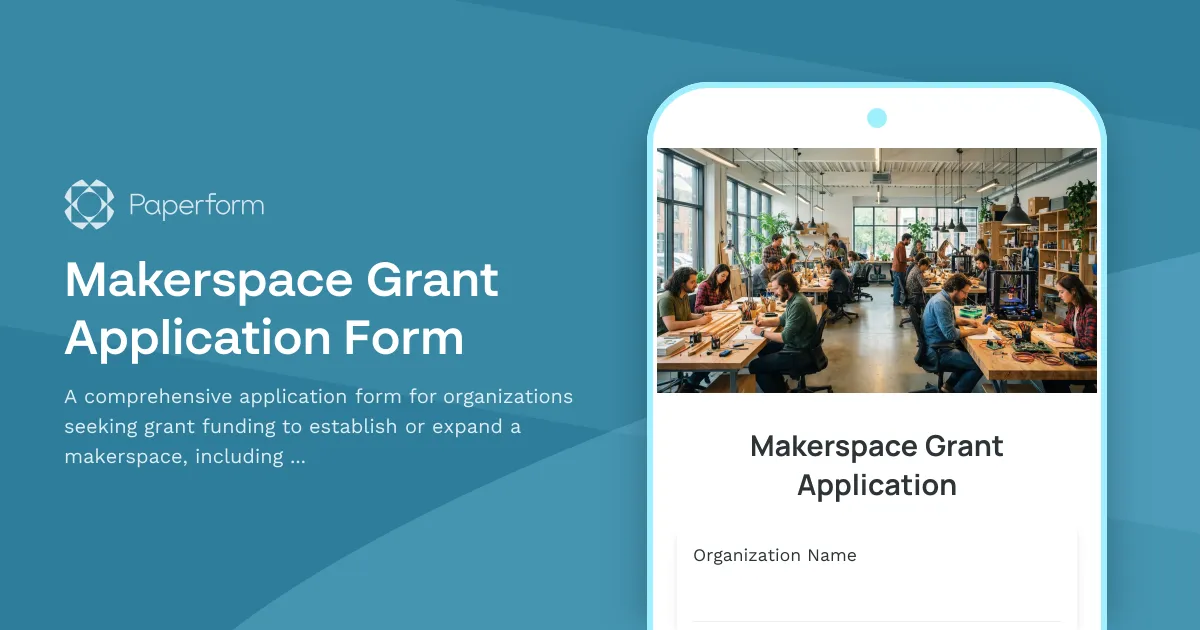
Transform Your Community with a Makerspace Grant Application
Building a makerspace that inspires creativity, innovation, and hands-on learning requires more than just tools and workspace—it demands a clear vision, solid safety protocols, and sustainable community engagement. Whether you're a nonprofit organization, educational institution, library, or community center seeking funding to launch or expand a makerspace, having a professional grant application process is essential to securing the resources you need.
This Makerspace Grant Application Form template helps you collect comprehensive information from applicant organizations while demonstrating program viability, community impact, and operational readiness to funders and grant committees.
Why Paperform is Perfect for Grant Applications
Grant applications often involve complex, multi-section forms that need to feel professional yet accessible. With Paperform's document-style editor, you can create an application that guides applicants through equipment requirements, safety protocols, membership structures, and community partnerships in a logical, easy-to-follow format.
Unlike rigid survey tools or PDF forms that force applicants into tiny text boxes, Paperform gives applicants room to tell their story while keeping all responses organized and searchable on your end. Conditional logic ensures applicants only see relevant sections based on their makerspace type and funding needs, while file upload fields make it simple to request supporting documents, floor plans, letters of support, and budget breakdowns.
Built for Nonprofits, Community Organizations, and Educational Institutions
This template is designed specifically for:
- Grant-making foundations funding STEM education, community development, and workforce training initiatives
- Nonprofit organizations managing community makerspace grant programs
- Government agencies supporting innovation hubs and entrepreneurship centers
- Corporate foundations investing in local maker education and economic development
- Educational institutions evaluating proposals for school or campus makerspaces
The form helps you evaluate not just the equipment wishlist, but the complete operational plan including safety training, insurance coverage, membership accessibility, community partnerships, and long-term sustainability.
Comprehensive Application Sections
This template covers all essential components of a strong makerspace grant application:
Organization & Project Overview – Capture applicant details, organization mission, makerspace vision, target community demographics, and alignment with your grant program goals.
Equipment & Infrastructure Needs – Detailed sections for requested tools, machinery, and technology with cost estimates, helping you understand both startup and ongoing equipment investment.
Safety Training & Protocols – Evaluate the applicant's commitment to member safety through documented training programs, certification requirements, emergency procedures, and insurance coverage.
Membership Structure & Accessibility – Understand how the makerspace will serve the community through membership tiers, pricing models, scholarships, accessibility accommodations, and outreach to underserved populations.
Community Partnerships – Assess collaborative relationships with schools, libraries, businesses, and other organizations that extend the makerspace's reach and impact.
Project Showcase & Impact Plans – Review how the organization will measure success, share member projects, demonstrate community benefit, and sustain operations beyond the grant period.
Streamline Your Grant Review Process
Once submissions come in, Paperform makes it easy to review, compare, and score applications. Export data to spreadsheets for committee review, filter by funding amount requested or makerspace focus area, and use Paperform's AI Insights to quickly identify common themes across applications or summarize an individual proposal's strengths.
For multi-stage review processes, you can use conditional notifications to alert different team members based on funding tier or application completeness, ensuring nothing falls through the cracks.
Automate Post-Submission Workflows with Stepper
After an application is submitted, there's typically a lot of administrative work—sending confirmation emails, scheduling review meetings, requesting additional documentation, and tracking decision timelines. With Stepper, Paperform's AI-native workflow automation platform, you can automate these entire processes without writing code.
Set up workflows that automatically:
- Send customized confirmation emails with application tracking numbers
- Add applications to your review dashboard in Airtable, Notion, or Google Sheets
- Notify grant committee members and assign reviewers based on expertise area
- Trigger follow-up requests for missing documentation
- Schedule site visits or applicant interviews for promising proposals
- Update applicant organizations on review milestones and decision dates
This means your grant program can operate more efficiently, giving you more time to support applicants and less time on administrative coordination.
Design That Reflects Your Grant Program
Paperform's theme customization lets you match the application form to your foundation's or organization's brand identity. Choose fonts, colors, and layouts that feel professional and trustworthy, add your logo and program imagery, and create custom success pages that set clear expectations about review timelines and next steps.
The form can live on your website via embed, as a standalone landing page with your custom domain, or be shared directly with invited applicants—giving you complete flexibility in how you run your grant program.
Secure, Compliant, and Trusted
Grant applications often contain sensitive organizational information, financial details, and strategic plans. Paperform is SOC 2 Type II compliant and offers robust security features including SSL encryption, data residency controls, and role-based permissions so only authorized team members can access applications.
You can confidently collect Letters of Determination (501c3 documentation), organizational budgets, partnership agreements, and other confidential materials knowing they're stored securely and accessible only to your review team.
Get Started Today
Whether you're launching a new grant program or improving an existing application process, this Makerspace Grant Application Form template gives you a professional, comprehensive starting point. Customize the questions to match your specific funding priorities, add scoring criteria for reviewers, and create a seamless experience for the innovators and community builders applying for your support.
Ready to take your grant program further? Paperform integrates seamlessly with your existing tools, scales as your program grows, and puts you in complete control of the application experience. With over 500,000 teams trusting Paperform worldwide and SOC 2 Type II compliance, you're choosing a platform built for organizations that take their mission seriously.
Start building stronger communities through maker education and innovation—one great application at a time.
More templates like this
Civic Engagement Grant Application
Apply for funding to support civic engagement initiatives including voter registration, community organizing, civic education, and language access programs in your community.
Workforce Development Grant Application
Comprehensive grant application form for workforce development programs including skills gap analysis, industry partnerships, job placement commitments, and apprenticeship pathway planning.
Accessible Playground Grant Application
Apply for funding to build or upgrade an accessible playground with universal design features, sensory equipment, and inclusive play spaces for children of all abilities.
After-School Program Grant Application
Apply for funding to launch or expand an after-school program with comprehensive activity schedules, academic support, STEM enrichment, and student care services.
Assistive Technology Grant Application
A comprehensive application form for individuals and organizations seeking funding for assistive technology devices, including needs assessment, device requests, training plans, and outcome measurement tools.
Community Autonomy Grant Application
Apply for funding to support community self-governance experiments, participatory democracy projects, and collective decision-making infrastructure that builds community power and autonomy.
Community Development Grant Application
A comprehensive grant application form for community development projects, capturing neighborhood demographics, stakeholder engagement, impact planning, and partnership documentation.
Cultural Exchange Grant Application Form
Comprehensive grant application for cultural exchange programs with program itinerary, participant selection, visa assistance, safety protocols, and reciprocal visit planning.
Decolonization Grant Application Form
Apply for funding to support decolonization initiatives including curriculum transformation, Indigenous knowledge systems integration, land acknowledgment implementation, and institutional policy reform.
Democratic Media Grant Application
Apply for grant funding to support democratic media initiatives including community radio, cooperative journalism, media literacy programs, and platform cooperative technology projects.
Farm-to-School Grant Application
Apply for farm-to-school funding to support local food procurement, nutrition education programs, school gardens, and cafeteria infrastructure improvements.
Indigenous Data Sovereignty Grant Application
A comprehensive grant application form for Indigenous communities seeking funding for data sovereignty initiatives, including tribal data governance, culturally appropriate research protocols, community data centers, and digital repatriation projects.