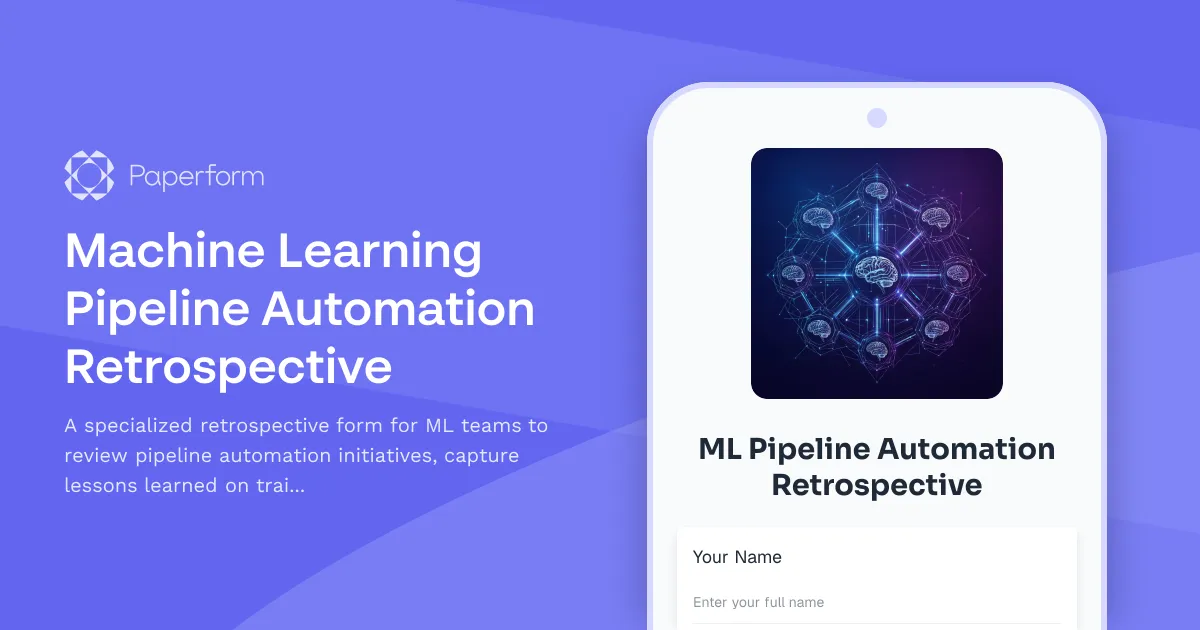
Running effective retrospectives for machine learning pipeline automation projects requires capturing both technical insights and team learnings in a structured way. This Machine Learning Pipeline Automation Retrospective template is designed specifically for ML engineering teams, data science teams, and MLOps professionals who need to document outcomes, identify improvements, and ensure continuous learning across AI/ML initiatives.
Whether you're reviewing a sprint focused on reducing training times, implementing better model versioning, achieving reproducibility standards, or automating deployment pipelines, this template helps your team capture what worked, what didn't, and what actions to take forward. It's built for the unique challenges of ML workflows—from experiment tracking and data drift to infrastructure scaling and model governance.
Perfect for AI/ML teams working on:
- Pipeline automation and orchestration improvements
- Training time optimization and resource efficiency
- Model versioning, lineage tracking, and registry implementations
- Reproducibility standards and experiment tracking
- CI/CD for ML and deployment automation
- Data quality, monitoring, and observability initiatives
The form guides your team through structured reflection on technical achievements, process improvements, team collaboration, and actionable next steps. With conditional logic, you can dive deeper into specific areas like infrastructure changes, tooling decisions, or blockers encountered during the sprint or project phase.
Streamline your ML retrospectives with Paperform's flexibility: customize questions to match your team's workflow, embed the form in your project wiki or Slack channel, and automatically send responses to your project management tools using Stepper workflows or native integrations with Jira, Linear, Notion, or Airtable.
For teams managing multiple ML projects or clients, Paperform's Agency+ plan makes it easy to create branded retrospective forms for each initiative while maintaining consistent learnings across your organization. All responses are SOC 2 Type II compliant and can be configured for specific data residency requirements—important for teams working with sensitive ML models or proprietary data.
Start capturing better insights from your ML pipeline automation projects and turn retrospective learnings into actionable improvements that accelerate your team's velocity and model quality.
More templates like this
AI/ML Sprint Planning Form
Plan AI/ML development sprints with model training tasks, data preparation workflows, experiment tracking, and deployment pipeline management for machine learning teams.
API Development Project Brief
A comprehensive project brief template for planning API development projects, covering endpoint specifications, authentication, rate limiting, documentation standards, and versioning strategies.
Incident Postmortem to Sprint Planning Form
Document incident retrospectives and automatically convert lessons learned into actionable sprint items, including preventive user stories, technical debt, and follow-up tasks for agile teams.
Agile Transformation Stakeholder Interview
Gather critical insights from development teams, product owners, and executives about current process pain points, collaboration challenges, and requirements for a successful agile transformation.
AI Model Deployment Approval Form
A comprehensive approval form for AI model deployments that evaluates training data, bias assessment, performance metrics, security controls, and ethical considerations before production release.
CI/CD Pipeline Access Request Form
Request access to CI/CD pipelines with build, deployment, and rollback permissions. Streamline DevOps workflows with this comprehensive access management form.
Iteration Zero Planning Form
A comprehensive iteration zero planning form for agile teams to set up technical infrastructure, CI/CD pipelines, development environments, and define initial architecture before starting sprint work.
Machine Learning Platform Support Request
Streamline technical support for ML platform issues including model training errors, deployment problems, and feature store troubleshooting with automated escalation to ML engineering teams.
Martech Integration Architecture Meeting Request
Schedule a strategic meeting to discuss martech integration architecture, system dependencies, data flows, API availability, and processing requirements for your technology stack.
Website Development Stage Gate Approval Form
A comprehensive milestone sign-off form for web development projects, featuring functionality testing checklists, design approval sections, browser compatibility verification, and go-live authorization controls.
Accessibility Compliance Project Brief
A comprehensive project brief template for managing accessibility compliance projects, including WCAG audit findings, remediation priorities, testing requirements, and training needs.
Agile Definition of Ready Checklist
Ensure user stories are fully prepared and ready for sprint planning with this comprehensive Definition of Ready checklist covering story completeness, dependencies, acceptance criteria, and team understanding.