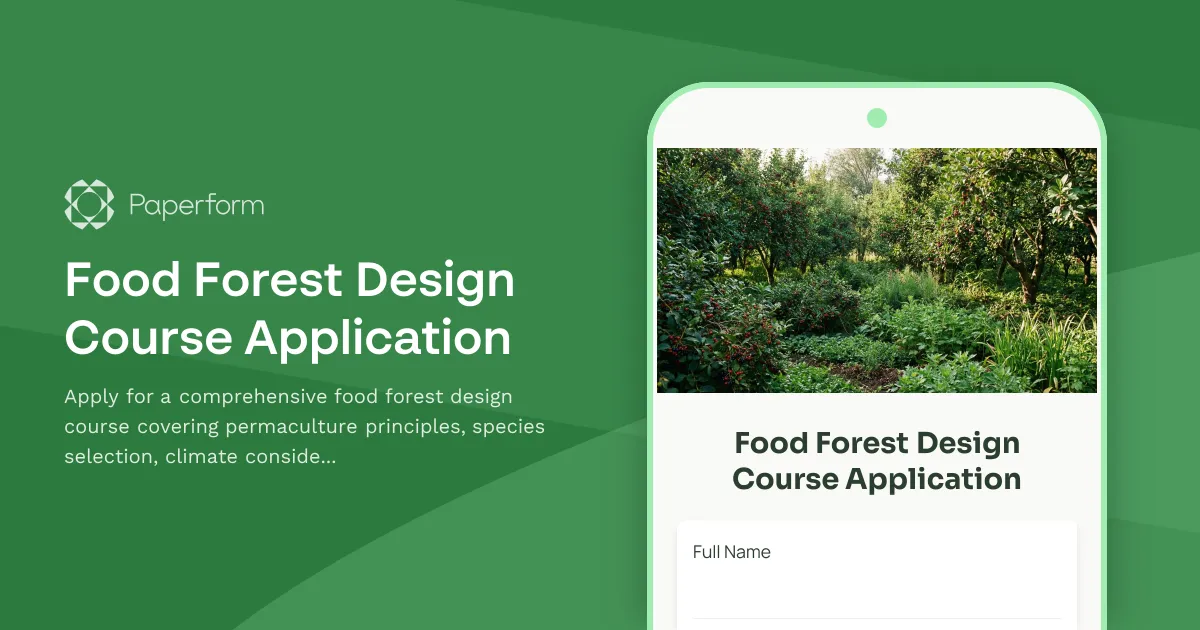
Transform Your Land into a Thriving Food Forest
Food forests represent one of the most exciting and regenerative approaches to sustainable agriculture and landscape design. Whether you're a homesteader looking to create abundance on your property, a farmer exploring regenerative practices, or a permaculture enthusiast ready to deepen your knowledge, a structured food forest design course can help you turn your vision into reality.
This Food Forest Design Course Application template helps course organizers efficiently collect detailed information from prospective students while creating a professional, engaging application experience that reflects the thoughtful, systems-based approach of permaculture education.
Why Food Forest Education Programs Need Purpose-Built Application Forms
Food forest design courses attract diverse learners—from complete beginners to experienced gardeners—each with unique goals, land contexts, and knowledge levels. A well-designed application form allows you to:
- Assess baseline knowledge in permaculture, ecology, and land management
- Understand participant goals and what they hope to achieve through the course
- Evaluate land access and site-specific conditions that will inform their project work
- Match students to appropriate cohorts based on experience and climate zones
- Collect implementation plans that demonstrate commitment and readiness
- Create diverse, engaged learning communities by selecting participants thoughtfully
Traditional paper applications or generic form tools don't capture the nuanced information needed to curate a meaningful learning experience. Paperform gives permaculture educators, regenerative agriculture organizations, and sustainability training programs a flexible platform to create application forms that feel as intentional as the practice itself.
Who This Template Is For
This food forest design course application template is ideal for:
- Permaculture training centers and institutes offering PDC courses with food forest modules
- Regenerative agriculture organizations teaching agroforestry and forest gardening
- Sustainability educators and eco-villages running residential or online food forest programs
- Farm schools and homesteading academies with specialized food forest curriculum
- Environmental nonprofits offering community education in edible landscaping
- Landscape designers and consultants who train others in ecological design
- Indigenous food sovereignty programs teaching traditional polyculture methods
What Makes This Application Form Effective
Assesses Permaculture Knowledge & Experience
The form gathers essential background on applicants' existing knowledge of permaculture ethics, design principles, guild planting, succession, and ecological observation. This helps instructors understand where students are starting from and tailor content accordingly.
Captures Land Access & Site Conditions
Food forest design is deeply contextual. The form collects detailed information about applicants' land access, property size, soil conditions, water availability, topography, and existing vegetation—all critical factors for meaningful project-based learning.
Evaluates Climate Zone & Bioregional Context
Understanding a student's climate zone, hardiness zone, annual rainfall, and bioregion allows for region-specific teaching and peer learning among students working in similar conditions.
Assesses Species Selection Knowledge
Questions about native plants, fruit and nut trees, nitrogen fixers, and understory species help gauge practical plant knowledge and identify learning gaps to address in the course.
Collects Implementation Project Plans
Serious applicants will have thought about how they plan to apply their learning. The form includes space for project goals, timeline, available resources, and potential challenges—demonstrating commitment and helping instructors provide targeted support.
Creates Community Connection Points
By asking about collaboration interests, community involvement, and what students hope to contribute, the form helps build cohesive, supportive cohorts where participants learn from each other.
How Paperform Elevates Food Forest Course Applications
Design That Reflects Your Values
Food forest education is about creating beautiful, abundant systems in harmony with nature. Your application form should embody those same principles. Paperform's document-style editor lets you weave together text, imagery, and questions to create an application experience that feels warm, grounded, and aligned with permaculture values—not like a sterile corporate form.
Add photos of thriving food forests, embed welcome videos from instructors, or include inspirational quotes from permaculture pioneers. Choose earthy color palettes and natural fonts that reflect your program's aesthetic. Whether you want a simple, minimalist layout or a rich, image-filled page, you can create an application that feels like an extension of your teaching philosophy.
Conditional Logic for Diverse Applicant Types
Food forest courses often serve everyone from absolute beginners to experienced permaculturists. Use Paperform's conditional logic to show different questions based on experience level—beginners might see foundational questions about permaculture ethics, while advanced applicants might be asked about specific design challenges they've encountered.
If someone indicates they don't have land access, you can show questions about community garden opportunities or future land plans. If they're in a tropical climate, questions about species selection can differ from those shown to temperate-zone applicants.
Payments & Deposits Made Simple
Many programs require application fees, course deposits, or full payment upon acceptance. Paperform's native payment integrations with Stripe, PayPal, and Square let you collect these directly within the application—no need to send invoices separately or use multiple tools.
You can offer payment plans, early-bird pricing, sliding scale options, or scholarship pricing tiers, all calculated automatically based on applicant responses. This creates a seamless experience from application to enrollment.
Scheduling for Follow-Up Interviews
For competitive programs or those requiring interviews, embed a scheduling field directly in the application. Applicants can book their interview time as part of submission, and appointments sync with your calendar automatically—eliminating the back-and-forth of scheduling emails.
Multi-Step Review & Acceptance Workflows
Once applications come in, use Stepper (Paperform's workflow automation platform) to create custom review processes. Route applications to instructors for assessment, send them through committee review, trigger acceptance or waitlist emails based on decisions, and automatically update your student management system.
For example, when an application is received, Stepper can:
- Send a confirmation email with next steps
- Add the applicant to your Airtable or Google Sheet for review
- Notify the admissions team in Slack
- Schedule a follow-up task if the application is incomplete
- Trigger acceptance emails and course materials when approved
This means less manual work for administrators and more time focused on creating exceptional learning experiences.
Build Your Alumni & Community Network
Applications are just the beginning of the relationship. Connect Paperform to your CRM, email marketing platform (like Mailchimp or ConvertKit), or community platform (like Circle or Mighty Networks) so accepted students are automatically added to the right lists, cohorts, and communication channels.
Stay connected with alumni, invite them to advanced courses or teaching assistant roles, and build a thriving community of food forest practitioners over time.
Integrate With Your Existing Tools
Paperform integrations and webhooks let your application data flow exactly where you need it:
- CRMs like HubSpot or Pipedrive for managing your admissions pipeline
- Spreadsheets like Google Sheets or Airtable for collaborative application review
- Email platforms like Mailchimp, ConvertKit, or ActiveCampaign for nurture sequences
- Project management tools like Notion, Asana, or Monday for tracking course preparation
- Communication platforms like Slack for team notifications
- Learning management systems to auto-enroll accepted students
And with Stepper, you can build multi-step workflows that connect all these tools without writing code—turning your application process into a well-oiled machine.
Trusted by Educators & Training Programs Worldwide
Whether you're running a small, local workshop or a globally-recognized permaculture institute, Paperform scales with your needs. SOC 2 Type II and GDPR compliance means you can trust the platform with applicant data, while features like custom domains, white-labeling, and advanced permissions support professional, branded experiences.
Over 500,000 teams worldwide use Paperform for applications, registrations, payments, and workflows—creating beautiful, functional forms without needing developers or designers.
Get Started With Your Food Forest Course Application
This template gives you a complete, ready-to-use application form that you can customize to match your specific program requirements. Adjust questions, add or remove sections, update the design to match your brand, and connect the integrations that matter to your workflow.
Whether you're teaching backyard food forest design, commercial agroforestry, or community-scale edible landscapes, Paperform helps you find the right students, gather the information you need, and create an application experience that reflects the care and attention you bring to your teaching.
Start building regenerative landscapes, one thoughtful application at a time.

More templates like this
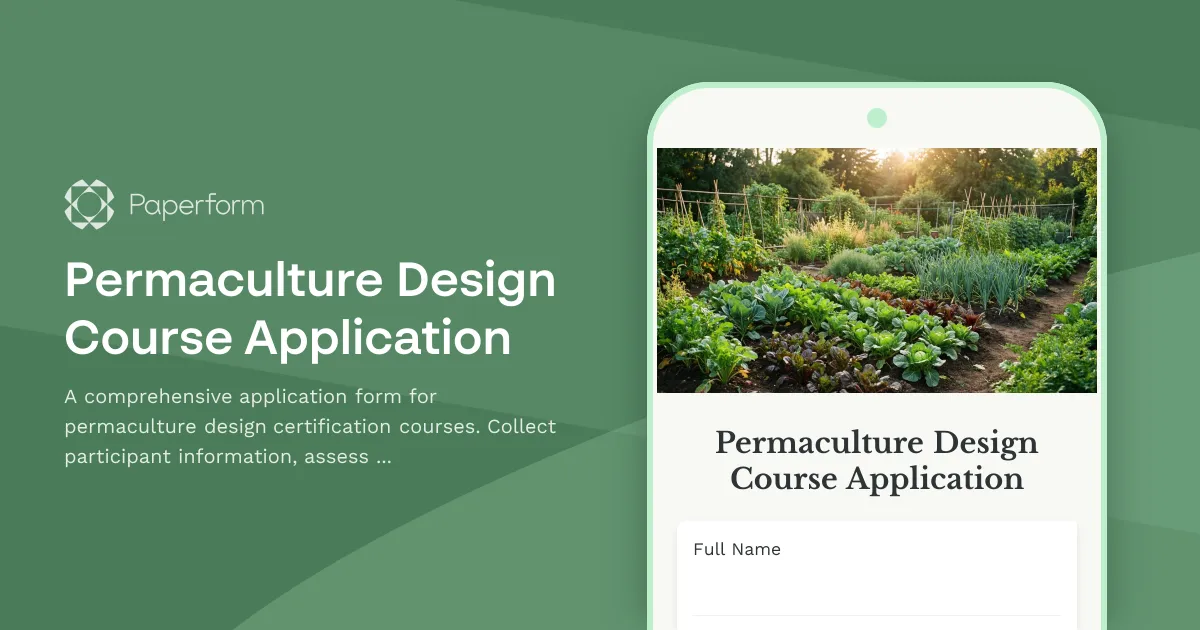
Permaculture Design Course Application
A comprehensive application form for permaculture design certification courses. Collect participant information, assess gardening experience, understand sustainability goals, and process course deposits.
Regenerative Agriculture Training Program Application
Apply for our comprehensive regenerative agriculture training program. Learn about soil health, carbon farming, grant writing, and connect with experienced mentors in sustainable land stewardship.
Agricultural Extension Agent Training Program Application
A comprehensive application form for aspiring agricultural extension agents to apply for training programs. Capture farming background, community outreach experience, research skills, and county placement preferences.
Farm Apprenticeship Agreement Form
A comprehensive farm apprenticeship agreement form that outlines mentorship structure, profit-sharing arrangements, land access terms, equipment use guidelines, and skill development milestones for agricultural training programs.
Cannabis Cultivation Certification Application
Professional certification application for cannabis cultivators covering horticulture experience, state compliance knowledge, facility operations, and business licensing plans.
Greenhouse Management Training Program Application
Apply for a comprehensive greenhouse management training program covering horticulture, organic certification, irrigation systems, and business planning with potential equipment grant opportunities.
Regenerative Agriculture Internship Application
Apply for a regenerative agriculture internship focused on soil health assessment, carbon sequestration, rotational grazing, and climate-resilient farming practices.
Restorative Agriculture Consultant Certification Application
Apply for professional certification as a restorative agriculture consultant. Demonstrate your expertise in regenerative practices, soil health, carbon credit programs, and farm business advising.
Sustainable Agriculture & Permaculture Scholarship Application
A comprehensive scholarship application for aspiring farmers pursuing sustainable agriculture, permaculture, and regenerative farming practices with sections for experience, soil science knowledge, and mentor references.
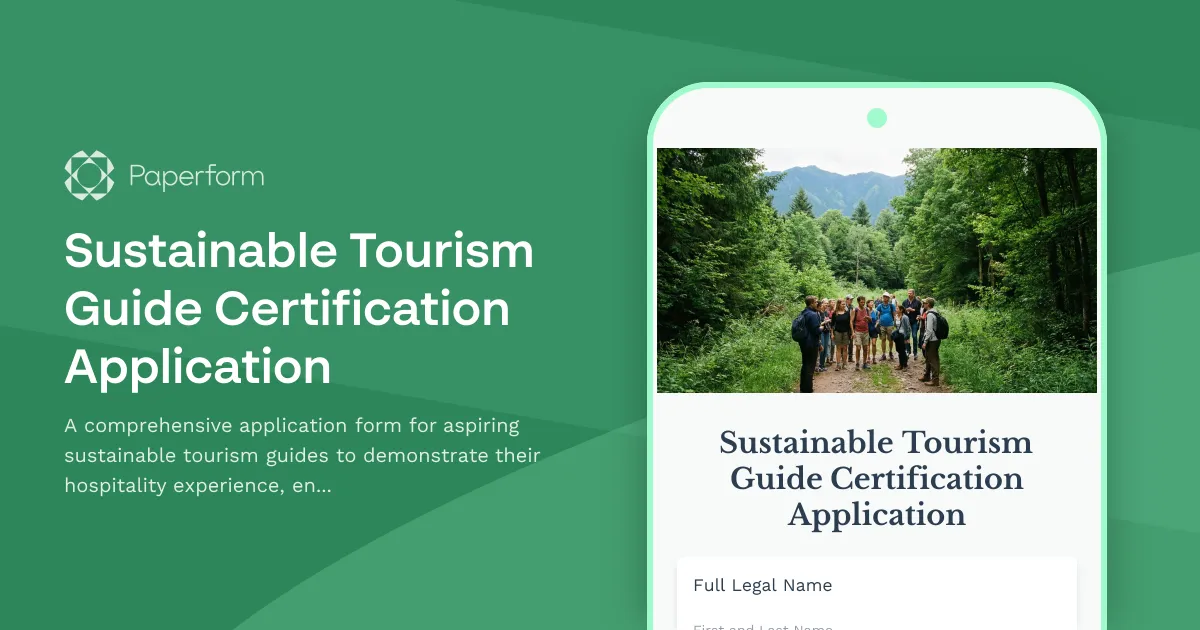
Sustainable Tourism Guide Certification Application
A comprehensive application form for aspiring sustainable tourism guides to demonstrate their hospitality experience, environmental knowledge, language proficiency, and commitment to responsible travel practices.
Agricultural Innovation Grant Application
Apply for agricultural innovation funding with this comprehensive grant application form. Capture farming techniques, yield projections, sustainability metrics, and cooperative membership details.
Agricultural Scholarship Application Form
Apply for an agricultural scholarship with comprehensive questions about farming experience, 4-H and FFA involvement, rural community engagement, and commitment to sustainable agriculture practices.