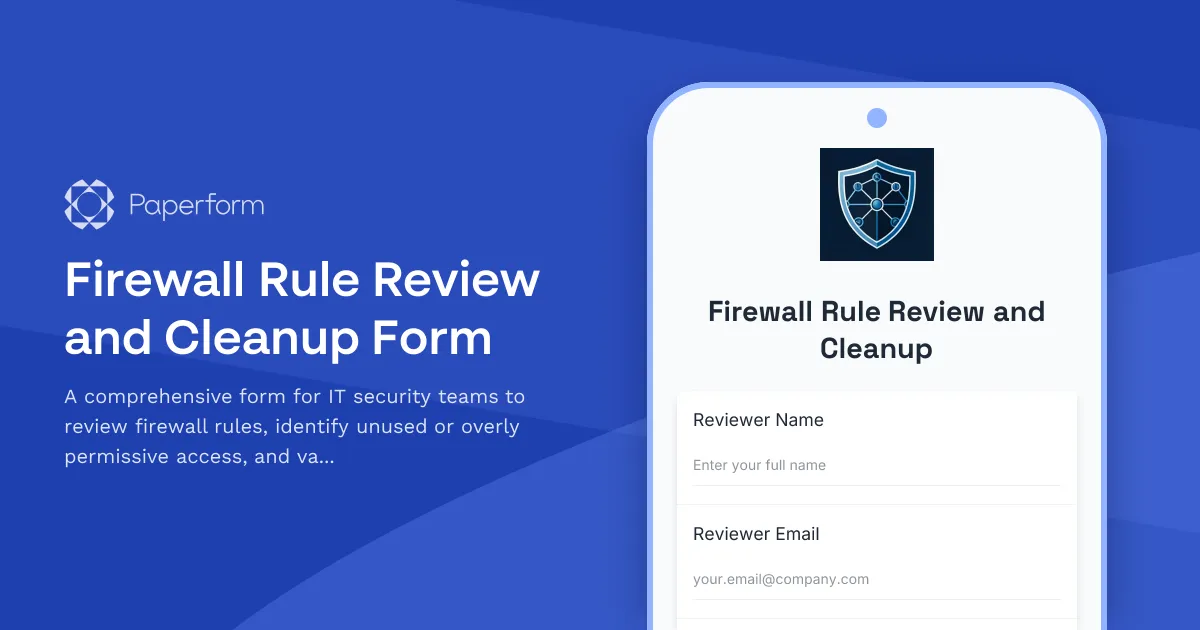
Streamline Your Firewall Security with Paperform
Maintaining a clean, secure firewall configuration is critical for any organization's cybersecurity posture. Over time, firewall rules accumulate—some become obsolete, others may be overly permissive, and many lack proper documentation. This Firewall Rule Review and Cleanup Form helps IT security teams systematically audit existing rules, identify security risks, and maintain compliance with security policies.
Built for IT professionals, security teams, network administrators, and compliance officers, this template makes it easy to document each rule's purpose, assess its current necessity, and flag potential security concerns. Whether you're conducting quarterly security audits, preparing for compliance reviews, or implementing zero-trust network principles, this form provides the structure you need.
How This Template Works
The form guides reviewers through a structured assessment of each firewall rule, capturing:
- Rule identification details (rule number, source/destination, ports, and protocols)
- Current usage status and last hit date
- Risk assessment for overly permissive configurations
- Business justification and stakeholder validation
- Recommended actions (keep, modify, or remove)
Conditional logic ensures that reviewers only see relevant questions based on their responses—for example, if a rule is flagged as unused or overly permissive, additional fields appear to document remediation steps.
Automate Your Security Workflow with Stepper
Take your firewall governance even further by connecting this form to Stepper, Paperform's AI-native workflow automation tool. When a submission identifies high-risk rules or recommends removal, Stepper can automatically:
- Create tickets in your IT service management system
- Notify network administrators and security stakeholders
- Update your asset management database or security documentation
- Route approvals to the appropriate business owners
- Schedule follow-up reviews for modified rules
This integration transforms your firewall review from a manual checklist into an automated, trackable security process—ensuring no high-risk rule slips through the cracks.
Built for Modern IT Security Operations
Paperform is trusted by IT departments and security teams worldwide for its flexibility, security, and integration capabilities. With SOC 2 Type II compliance, role-based permissions, and robust data controls, you can confidently collect and manage sensitive network security information. Plus, native integrations with tools like Slack, Microsoft Teams, Jira, and ServiceNow mean your firewall review process fits seamlessly into your existing security operations workflow.
Stop managing firewall audits through spreadsheets and email chains. Start using a purpose-built form that brings structure, accountability, and automation to your network security governance.



More templates like this
Cloud Workload Protection Platform Effectiveness Review
Comprehensive assessment form for evaluating cloud workload protection platform performance, including container runtime security, serverless coverage, and threat detection capabilities.
Endpoint Detection and Response Configuration Audit
Comprehensive EDR configuration audit form to assess threat hunting capabilities, analyze false positives, and provide tuning recommendations for optimal endpoint security performance.
Identity and Access Management Quarterly Review Form
Conduct comprehensive IAM quarterly reviews with user provisioning audits, role-based access validation, and orphaned account identification to maintain security compliance and minimize access risks.
ISO 27001 Internal Audit Checklist
A comprehensive ISO 27001 internal audit form for systematically testing information security controls, tracking non-conformities, and planning corrective actions across all Annex A domains.
IT Air-Gapped System Change Request Form
Secure change request form for air-gapped systems with data transfer procedures, security controls, and multi-level approval workflow for high-security IT environments.
Network Security Incident Log
A comprehensive form for logging network security incidents, intrusion detection alerts, firewall rule analysis, and threat intelligence correlation. Streamline your incident response process with structured data collection.
Privileged Session Monitoring Alert Investigation Form
Comprehensive investigation form for privileged session monitoring alerts, including suspicious command detection, data exfiltration analysis, and user interview scheduling to ensure rapid security incident response.
Quantum-Safe Cryptography Readiness Assessment
Evaluate your organization's preparedness for post-quantum cryptography threats with a comprehensive assessment of current cryptographic algorithms, migration planning, and implementation roadmap.
Security Awareness Phishing Simulation Results Report
Track and analyze phishing simulation performance across departments with detailed metrics on click-through rates, reporting rates, and automated training assignment recommendations.
Security Awareness Training Completion & Phishing Simulation Results Form
Track security training completion, phishing simulation performance, and assign follow-up training with automated department-level scoring and reporting.
Security Incident Severity Classification Form
A comprehensive form for classifying security incidents, assessing business impact, mapping data classifications, and defining escalation criteria to ensure rapid and appropriate incident response.
Security Operations Playbook Maintenance Schedule
A comprehensive form for managing security operations playbook reviews, measuring effectiveness, and tracking continuous improvements with quarterly review requirements.