Egyptian Import Duty Exemption Application for Raw Materials
Navigating Egypt's customs and regulatory requirements can be complex, especially when you're importing raw materials for manufacturing operations. This Egyptian Import Duty Exemption Application template streamlines the entire process, helping manufacturers secure duty exemptions while ensuring full compliance with Egyptian customs regulations.
Why use Paperform for your duty exemption applications?
Manufacturing businesses in Egypt often qualify for import duty exemptions when raw materials are used for export-oriented production. However, the application process involves detailed documentation, manufacturing plans, export commitments, and customs bond arrangements. This template brings all these requirements into one organized, professional form that guides applicants through every necessary detail.
With Paperform, you can create forms that look professional and match your company's branding—essential when submitting official applications to customs authorities. The conditional logic ensures applicants only see relevant questions based on their manufacturing category and export commitments, reducing confusion and improving completion rates.
Perfect for Egyptian manufacturers and importers
This template is designed specifically for:
- Manufacturing companies importing raw materials, components, or semi-finished goods for further processing and export
- Export-oriented businesses seeking to reduce import costs through duty exemption schemes
- Industrial free zone operators managing customs documentation and compliance
- Customs brokers and freight forwarders assisting clients with duty exemption applications
- Trade compliance officers managing regulatory submissions for multiple facilities
Whether you're a textile manufacturer importing cotton, a food processor bringing in ingredients, or an electronics assembler sourcing components, this form template adapts to your specific manufacturing scenario.
Comprehensive application workflow
The form captures all essential information required by Egyptian customs authorities:
Company registration details including commercial register number, tax card information, and industrial licensing documentation. The form validates these critical identifiers to ensure accuracy from the start.
Manufacturing plan documentation with detailed descriptions of production processes, capacity, equipment, and quality control measures. This section helps customs authorities understand how imported materials will be transformed into export-ready products.
Import specifications covering material descriptions, HS codes, quantities, countries of origin, and estimated values. Accurate classification ensures proper duty exemption calculation and compliance with trade agreements.
Export commitment declarations including target markets, projected export volumes, timelines, and supporting documentation. The form calculates compliance ratios and helps you demonstrate your export commitment.
Customs bond arrangements with bank guarantee details, bond amounts, validity periods, and financial institution information—ensuring you meet the security requirements for duty-deferred imports.
Automation that saves time and reduces errors
By building this application form in Paperform, you gain access to powerful features that traditional paper-based or PDF processes simply can't match:
Conditional logic shows or hides sections based on manufacturing type, material categories, and exemption schemes. Applicants working with strategic industries see different requirements than those in general manufacturing.
Calculation fields automatically compute duty exemption amounts, bond requirements, and compliance ratios based on import values and export commitments—reducing manual calculation errors.
File upload capabilities let applicants attach supporting documents like commercial register certificates, tax cards, manufacturing licenses, bank guarantees, and previous export records directly within the form.
Real-time validation ensures tax card numbers, commercial register numbers, and HS codes follow the correct format before submission, preventing rejections due to clerical errors.
Integrate with your compliance workflow using Stepper
For businesses processing multiple exemption applications or managing ongoing compliance monitoring, Stepper extends your form's capabilities into a complete workflow automation system.
After an application is submitted through Paperform, Stepper can automatically:
- Route applications to internal reviewers before customs submission
- Send notifications to customs brokers with all necessary documentation
- Track application status through customs processing stages
- Schedule follow-ups for bond renewals and export compliance reporting
- Update your ERP or compliance management system with application details
- Generate reminder workflows for export commitment deadlines
This integration ensures nothing falls through the cracks in the complex, multi-month process from application to final export compliance verification.
Built for Egyptian regulatory requirements
Egyptian customs regulations require precise documentation and adherence to specific formats and procedures. This template incorporates:
- Fields aligned with Egyptian Customs Authority requirements
- Support for Arabic and English data entry
- References to relevant ministerial decrees and customs circulars
- Compliance checkboxes for duty drawback versus temporary admission schemes
- Integration points for Nafeza (Egypt's single window system) reference numbers
The form's structure reflects real-world customs processing requirements, helping applicants provide complete information the first time and avoid costly delays or rejections.
Secure, compliant, and audit-ready
Paperform's SOC 2 Type II compliance ensures your sensitive business and financial information remains secure throughout the application process. All submissions are encrypted, and you maintain complete control over data access and retention.
For businesses managing applications across multiple facilities or product lines, Paperform's Agency+ plan offers role-based permissions, letting different team members handle specific applications while maintaining oversight and audit trails.
Get started in minutes
Whether you're applying for your first duty exemption or streamlining an existing process, this template gives you a professional, compliant solution that reflects well on your business and speeds up customs approvals.
Paperform's intuitive editor lets you customize the template to match your specific manufacturing operations, add your company branding, and adjust workflows as Egyptian regulations evolve. With over 500,000 teams trusting Paperform for critical business processes, you're in good company.
Ready to simplify your customs compliance? Start with this template and experience how the right form can transform a complex regulatory process into a smooth, efficient workflow that supports your manufacturing growth.



More templates like this
Australian Food Export Certification Application
Apply for Australian food export certification including health certificates, establishment approval verification, and importing country compliance requirements for international food trade.
Brazilian Product Testing & INMETRO Certification Request Form
Request INMETRO product certification for Brazilian market compliance. Submit manufacturer information, product details, and testing requirements for standardized certification procedures.

CNPJ Special Economic Zone Admission Application Form
Apply for admission to a Brazilian Special Economic Zone (ZPE) with this comprehensive CNPJ registration form covering investment commitments, employment targets, and customs facilitation benefits.

Company Patent and Intellectual Property Policy Survey
Assess employee understanding of IP ownership, invention disclosure processes, patent incentives, and innovation protection policies to improve clarity and engagement with intellectual property guidelines.
Czech Customs Duty Drawback Claim Form
A comprehensive form for Czech businesses to claim customs duty drawbacks on exported goods, meeting all Czech customs administration requirements and regulatory standards.
Czech Distribution Agreement Form
Professional distribution agreement form for Czech market partnerships, capturing company details, territory rights, pricing terms in CZK, and compliance information for exclusive distribution arrangements.
Czech Product Certification Application – CE Marking
Apply for CE marking certification through the Czech Standards Institute with this comprehensive product certification form for manufacturers and importers.
DTI Product Certification Application Form
Apply for DTI product certification and Philippine National Standards (PNS) compliance testing. Streamline your submission for product testing reports and regulatory approval.
Dutch Export Control License Application Form
Apply for an export control license for dual-use goods from the Netherlands. Complete classification assessment, end-user verification, and regulatory compliance documentation for controlled exports.
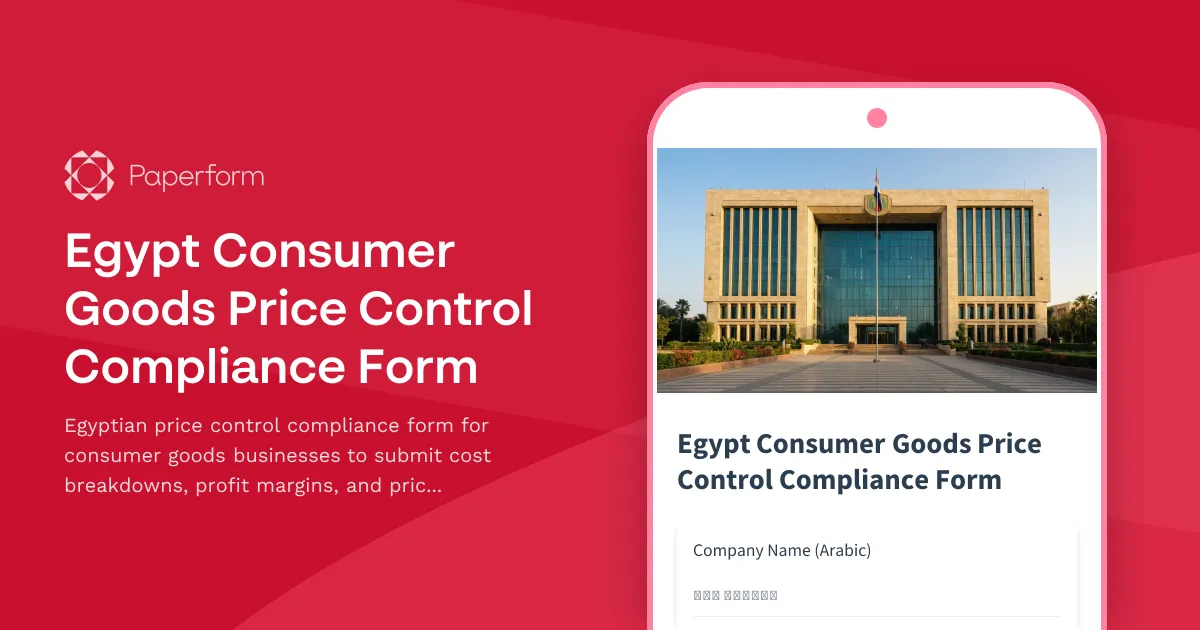
Egypt Consumer Goods Price Control Compliance Form
Egyptian price control compliance form for consumer goods businesses to submit cost breakdowns, profit margins, and pricing justifications to the Ministry of Supply and Internal Trade for regulatory approval.
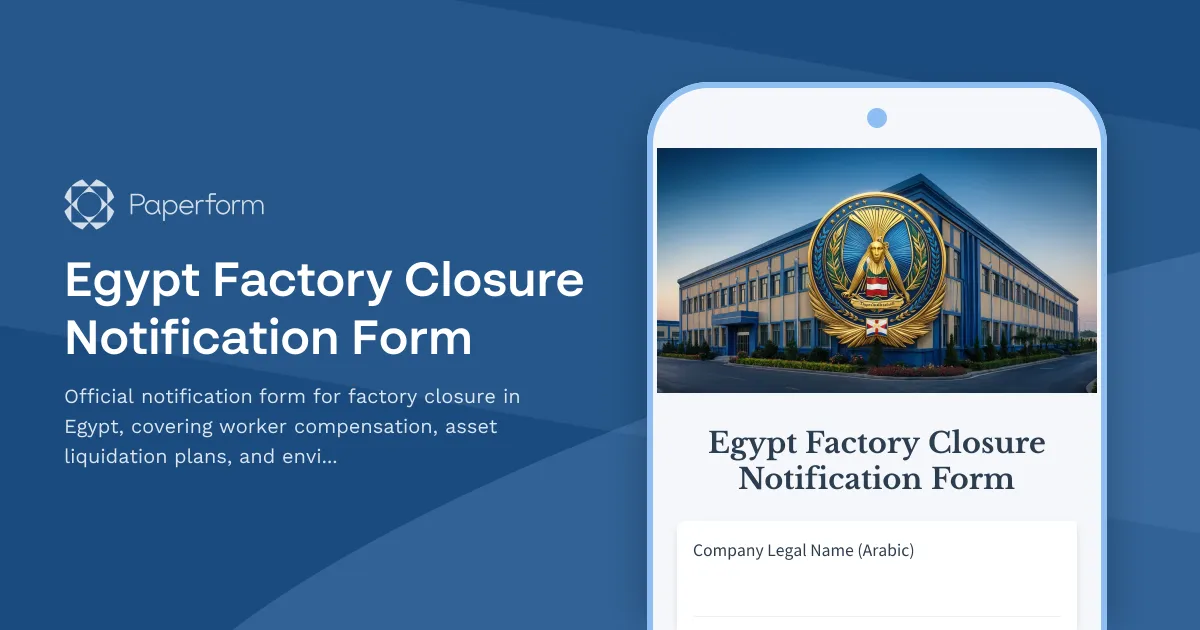
Egypt Factory Closure Notification Form
Official notification form for factory closure in Egypt, covering worker compensation, asset liquidation plans, and environmental decommissioning requirements for regulatory compliance.
Egypt Free Zone Customs Declaration Form
Complete customs declaration form for Egyptian free zone operations with inventory tracking, manufacturing logs, and re-export documentation compliance.