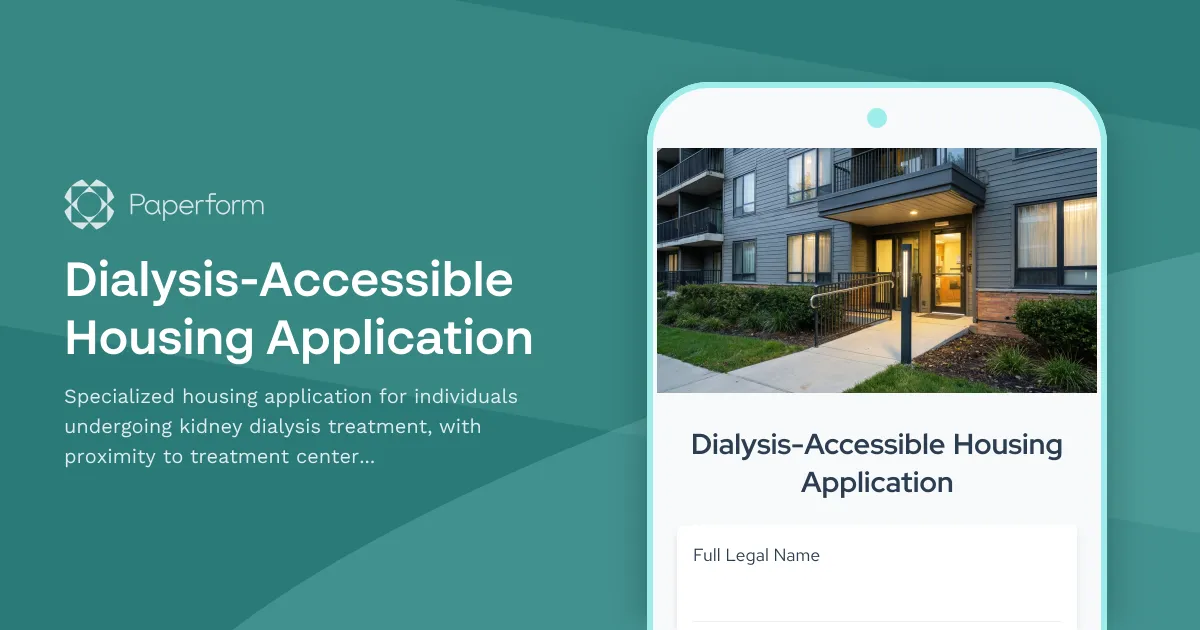
Accessible Housing for Dialysis Patients – A Specialized Application Form
Finding suitable housing while managing kidney disease and dialysis treatment presents unique challenges. Between treatment schedules, dietary requirements, proximity to dialysis centers, and the potential for transplant surgery, traditional rental applications often don't account for the specific needs of individuals with chronic kidney disease.
This Dialysis-Accessible Housing Application template is designed specifically for property managers, housing authorities, and specialized residential facilities that serve individuals undergoing regular dialysis treatment. It streamlines the application process while capturing essential medical, lifestyle, and support information needed to provide appropriate housing accommodations.
Why This Form Matters for Healthcare-Focused Housing Providers
Traditional rental applications focus on employment history, credit scores, and references—but for dialysis patients, housing decisions revolve around treatment access, health support systems, and flexible living arrangements. This form helps housing providers understand:
- Treatment proximity needs: How close applicants need to be to their dialysis center
- Schedule accommodations: The flexibility required for 3-4 dialysis sessions per week
- Dietary and storage requirements: Special kitchen needs for renal-friendly meal preparation
- Emergency protocols: Healthcare team contacts and transplant coordination
- Support systems: Caregivers, family members, and home health services
By capturing this information upfront, property managers can match applicants with units that truly support their health journey, reducing turnover and creating a supportive living environment.
Perfect for Specialized Housing Programs and Healthcare Partnerships
This template serves multiple types of housing providers:
Dialysis Center-Adjacent Properties: Residential buildings specifically located near treatment facilities can use this form to prioritize applicants based on medical need and treatment schedules.
Accessible Housing Programs: Non-profit housing organizations serving individuals with chronic illnesses can gather comprehensive information to support case management and wraparound services.
Senior Living Communities: Facilities that accommodate residents with kidney disease can assess compatibility and prepare appropriate support infrastructure.
Property Management Companies: Landlords offering medical accommodation programs can standardize their intake process while maintaining HIPAA-aware practices.
Comprehensive Application with Medical Accommodation Focus
The form captures all standard rental application elements—personal information, rental history, employment, and references—while adding specialized sections for:
- Dialysis treatment details: Center location, treatment schedule, transportation needs
- Dietary and kitchen requirements: Refrigeration for medical supplies, space for meal prep
- Accessibility needs: Physical accommodations, emergency access, grab bars
- Transplant status: Waiting list information and potential move-out planning
- Healthcare team contacts: Nephrologist, social worker, case manager information
- Emergency protocols: What to do if the tenant misses treatment or experiences a medical event
This comprehensive approach helps housing providers prepare units appropriately, coordinate with healthcare teams when needed, and create lease terms that accommodate the realities of chronic kidney disease management.
Streamlined Process with Paperform's Smart Features
Built with Paperform, this template takes advantage of powerful features that make complex applications manageable:
Conditional logic shows or hides questions based on previous answers—if an applicant is on the transplant waiting list, additional questions appear about their projected surgery timeline and post-transplant housing needs.
File uploads allow applicants to submit doctor's letters, proof of disability accommodation needs, income verification, and references all in one place, eliminating back-and-forth emails.
Calculation fields can automatically compute income-to-rent ratios, even when applicants receive disability payments or other non-traditional income sources.
Save and resume functionality (available through Paperform's native features) means applicants can complete the form at their own pace—important when managing energy levels around treatment schedules.
Automate Follow-Up and Coordination with Stepper
For housing organizations managing multiple applications and ongoing tenant support, connecting this form to Stepper creates powerful automation workflows:
- Automatically send welcome packets with dialysis center maps and emergency protocols after application approval
- Route applications to case managers for medical needs assessment
- Schedule property tours during non-treatment days based on the applicant's dialysis schedule
- Create tenant files in your property management system with medical accommodation flags
- Notify maintenance teams about specialized unit preparation needs (medical outlet placement, grab bar installation)
- Set up quarterly check-ins with tenants to assess ongoing accommodation needs
These automations reduce administrative burden while ensuring every applicant receives appropriate follow-up and support.
Privacy, Compliance, and Sensitive Data Handling
When collecting medical information in housing applications, privacy and compliance are paramount. While Paperform is SOC 2 Type II compliant and GDPR-ready, it's important to note that Paperform is not a HIPAA-compliant solution.
For housing providers who need to maintain HIPAA compliance, this form should focus on housing-related accommodation requests rather than detailed medical records. The form template asks for treatment schedules and accommodation needs rather than detailed diagnosis information, which strikes the right balance for most housing applications under Fair Housing Act requirements.
You can use Paperform's data residency controls to ensure responses are stored in appropriate geographic regions, and role-based permissions to limit who on your team can view sensitive medical accommodation requests.
Who Benefits Most from This Template
Non-Profit Housing Organizations serving chronically ill populations can standardize intake while gathering information needed for grant reporting and case management.
Dialysis Center Partnership Programs that have negotiated nearby housing options for their patients can streamline referrals and placement.
Disability Housing Specialists can use this template as a model for other condition-specific applications, customizing questions for different chronic illness populations.
Property Management Companies looking to participate in medical accommodation programs or Section 8/disability housing initiatives can demonstrate their commitment to serving this population professionally.
Healthcare Systems with care coordination programs can partner with housing providers using this standardized application to improve housing stability for their dialysis patients.
Compassionate, Efficient Housing Access
Managing kidney disease requires enormous physical, emotional, and logistical effort. Housing applications shouldn't add unnecessary stress to that burden. This template creates a respectful, thorough process that acknowledges the unique circumstances of dialysis patients while giving housing providers the information they need to offer appropriate, supportive living environments.
By using Paperform's flexible platform, you can customize this template to match your organization's specific programs, add your branding, integrate with your existing tenant management systems, and create a professional experience that serves both your operational needs and the dignity of your applicants.
Whether you're managing a single accessible property near a dialysis center or running a comprehensive medical housing program, this template provides the foundation for compassionate, efficient housing access for individuals managing kidney disease.



More templates like this
Accessible Housing Application for Adults with Autism Spectrum Disorder
A comprehensive, inclusive housing application designed specifically for adults with autism spectrum disorder, covering sensory needs, routine preferences, and communication support requirements.
Accessible Housing Application for Adults with Spinal Cord Injury
A comprehensive accessible housing application designed for adults with spinal cord injuries, featuring wheelchair accessibility requirements, adaptive equipment needs, and personal care assistance coordination.
Accessible Housing Application for Individuals with Lupus
A specialized rental application for individuals with lupus, designed to assess accommodation needs including sun exposure protection, fatigue management, and proximity to rheumatology care.
Accessible Housing Modification Application
A comprehensive application for accessible housing modifications, including occupational therapist evaluations, contractor approvals, and funding coordination.
ALS-Accessible Housing Application
A compassionate housing application designed specifically for adults living with ALS, featuring adaptive technology accommodations, caregiver space requirements, and optional support planning resources.
Supportive Housing Application for Individuals with Disabilities
A comprehensive housing application designed for individuals with disabilities seeking supportive housing, including detailed accessibility requirements and care coordination information.
Accessible Housing Application for Adults with Fibromyalgia
A specialized housing application designed for adults with fibromyalgia seeking low-stimulation living environments with access to pain management and rheumatology care.
Accessible Housing Application for Adults with Muscular Dystrophy
Comprehensive housing application designed for adults with muscular dystrophy, covering accessibility needs, medical equipment requirements, progressive disease planning, and care coordination.
Accessible Housing Application for Adults with Myasthenia Gravis
Specialized housing application for individuals with myasthenia gravis, featuring accessibility assessments, energy conservation needs, medication management support, and healthcare proximity requirements.
Accessible Housing Application for Individuals with Epilepsy
A comprehensive housing application designed for individuals with epilepsy, ensuring safe living environments with seizure-safety features, secure medication storage, and accessible transportation to medical appointments.
Cancer Survivor Housing Application - Follow-Up Care & Support Services
A compassionate housing application designed specifically for cancer survivors seeking accommodation near treatment facilities, with built-in support for fatigue management, emotional wellness, and survivorship care coordination.
Housing Application for Adults Aging with HIV
A comprehensive housing application designed for adults aging with HIV, featuring medication adherence support, stigma reduction, and medical care transportation assistance.