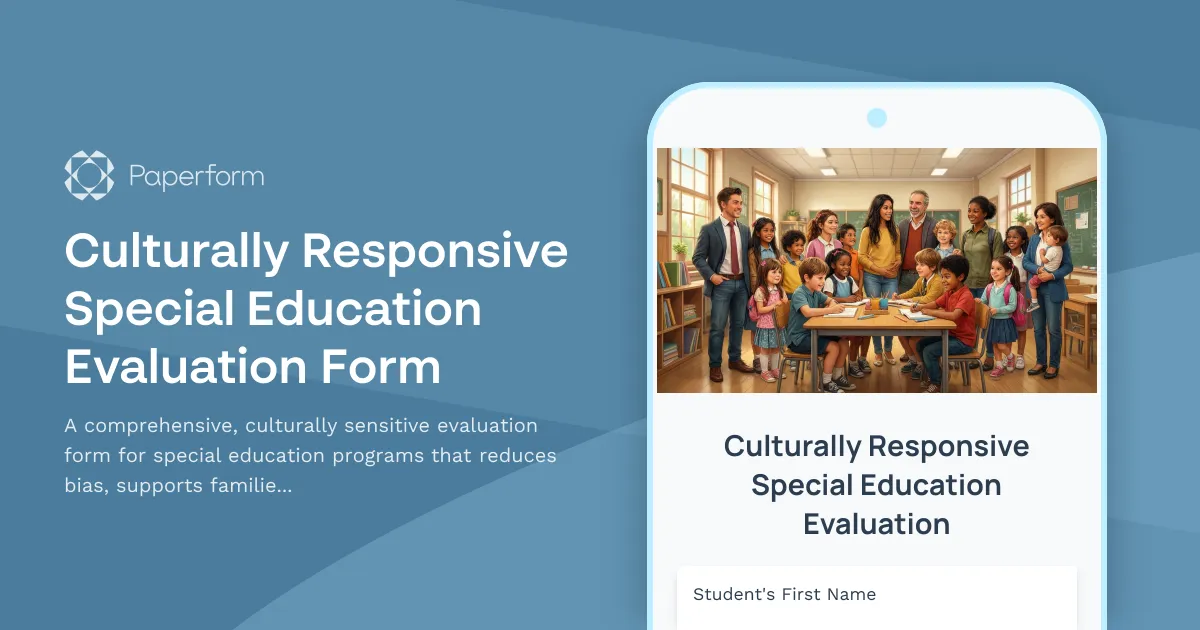
Creating fair and inclusive special education evaluations requires more than just standard assessments—it demands cultural responsiveness, family partnership, and a commitment to reducing systemic bias. This Culturally Responsive Special Education Evaluation Form is designed specifically for school districts, special education coordinators, and educational psychologists who recognize that every student's background, language, and cultural context matter when determining support needs.
Why culturally responsive evaluation matters
Traditional special education assessments can inadvertently disadvantage students from diverse cultural and linguistic backgrounds. This template helps education professionals conduct evaluations that account for cultural differences, language diversity, home environments, and family perspectives—ensuring that students receive appropriate support rather than being misidentified or underserved due to cultural misunderstandings.
How this template supports equitable assessment
This form streamlines the entire evaluation process while maintaining cultural sensitivity at every step. It includes sections for language preferences and interpreter needs, family input on cultural considerations, diverse assessment tool selection, bias reduction protocols, and collaborative decision-making spaces that honor family knowledge alongside professional expertise.
Built with Paperform, you can customize conditional logic to show relevant questions based on language needs, collect supporting documentation through secure file uploads, and integrate with your student information system through Stepper workflows that automatically route evaluations to the right team members and keep families informed throughout the process.
Whether you're conducting initial evaluations, re-evaluations, or developing culturally responsive IEPs, this template ensures that diverse student populations receive fair, comprehensive assessments that lead to appropriate educational support. Schools using culturally responsive practices see better family engagement, more accurate identification of student needs, and improved outcomes for students from all backgrounds.
More templates like this
Autism Spectrum Disorder Diagnostic Observation Consent Form
A comprehensive consent and information form for ASD diagnostic observation including ADOS-2 assessment, parent interview, school observation, and multidisciplinary team evaluation.
Autism Spectrum Support Services Intake Form
A comprehensive intake form for autism spectrum support services that captures sensory profiles, communication preferences, social skills assessments, and behavior patterns to create personalized support plans.
Functional Behavioral Assessment Parent Questionnaire
A comprehensive parent questionnaire for functional behavioral assessments (FBA) that helps educators understand student behavior patterns, environmental triggers, reinforcement factors, and communication methods to develop effective behavioral intervention plans.
Individual Counseling Services Request for Students with Emotional Disturbance
A comprehensive form for requesting and documenting intensive individual counseling services for students with emotional disturbance, including treatment planning, evidence-based interventions, crisis prevention strategies, and outcome measurement.
Selective Mutism Intervention Plan
A comprehensive assessment and planning tool for selective mutism intervention, including anxiety evaluation, graduated exposure strategies, safe person identification, and speech-language collaboration.
Social-Emotional Learning (SEL) Intervention Form for Students with Autism
A comprehensive assessment and intervention planning form for social-emotional learning programs supporting students with autism, covering perspective-taking, emotion regulation, friendship skills, and pragmatic language development.
Strengths-Based IEP Development Form
A comprehensive form for developing individualized education plans that focus on student strengths, interests, talents, and learning preferences while incorporating positive behavioral supports.
Bilingual Special Education Assessment Request Form
Request a comprehensive bilingual special education evaluation with language dominance testing, cultural considerations, and qualified evaluator assignment for students in multilingual households.
Community-Based Vocational Training Placement Form
A comprehensive placement form for community-based vocational training programs serving students aged 18-21, covering job coach support, work site agreements, transportation arrangements, and skill development goals.
Emotional Disturbance Eligibility Evaluation Form
Comprehensive assessment form for evaluating students for emotional disturbance eligibility under special education programs, documenting behavioral incidents, mental health diagnoses, educational impact, and therapeutic recommendations.
Extended School Year (ESY) Services Eligibility Form
A comprehensive eligibility assessment form for determining student qualification for Extended School Year services, including regression/recoupment analysis, IEP goals tracking, and summer program recommendations.
Extended School Year (ESY) Services Parental Consent Form
A comprehensive parental consent form for extended school year services, including summer programming, regression prevention strategies, recoupment periods, and individualized educational goals for students requiring continuous support.