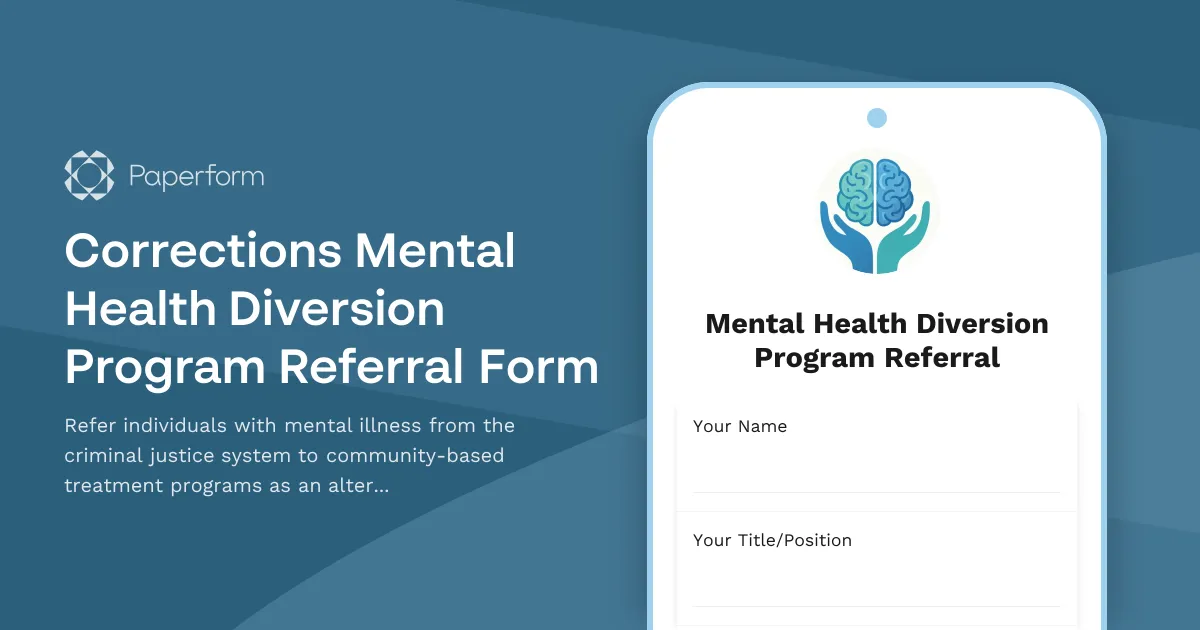
Support Better Outcomes with Mental Health Diversion Referrals
When mental illness drives criminal justice involvement, diversion programs offer a proven alternative to incarceration—connecting individuals with community-based treatment that addresses root causes while improving public safety and reducing recidivism.
This Corrections Mental Health Diversion Program Referral Form streamlines the referral process for law enforcement, court staff, probation officers, mental health professionals, and case managers working to redirect individuals from the criminal justice system into appropriate care.
Why Mental Health Diversion Programs Matter
Mental health diversion programs recognize that incarceration often fails to address the underlying psychiatric needs driving criminal behavior. Research consistently shows that connecting individuals to treatment in the community leads to better clinical outcomes, lower reoffense rates, and significant cost savings compared to continued cycling through jails and prisons.
Whether you're managing a pre-booking diversion program, post-booking jail diversion initiative, or specialty mental health court, having a clear and comprehensive referral process ensures eligible individuals receive timely access to services that can transform their trajectory.
What This Referral Form Captures
This template collects the essential information diversion program coordinators need to assess eligibility and match individuals with appropriate community resources:
- Referral source and urgency to prioritize cases and coordinate follow-up
- Demographic and contact information for case management and outreach
- Current legal status including charges, court dates, and custody status
- Mental health history covering diagnoses, medications, previous treatment, and hospitalizations
- Substance use assessment to identify co-occurring disorders
- Criminal justice history to evaluate program eligibility criteria
- Risk and safety factors including violence history, housing stability, and support systems
- Treatment readiness and willingness to participate in community-based alternatives
- Recommended treatment level and service needs
- Supporting documentation uploads for clinical records and assessments
The form uses conditional logic to reveal relevant follow-up questions based on mental health symptoms, substance use patterns, and risk factors, ensuring you gather complete information without overwhelming referral sources with unnecessary fields.
How Criminal Justice and Mental Health Teams Use This Form
Law Enforcement Diversion Officers use this form during crisis intervention contacts to quickly refer individuals to pre-booking diversion programs, avoiding arrest and jail booking entirely when appropriate.
Jail Mental Health Staff complete referrals for inmates identified during intake mental health screening, connecting them to post-booking diversion programs that can secure release with community treatment linkage.
Public Defenders and Court Staff submit referrals on behalf of clients with mental illness who may benefit from specialty mental health courts or other treatment-focused court programs.
Probation and Parole Officers refer supervisees whose mental health needs aren't being met through standard supervision, seeking diversion to intensive community treatment programs.
Community Mental Health Providers initiate referrals for clients currently involved in the criminal justice system who would benefit from coordinated diversion services and legal advocacy.
Case Managers and Social Workers working in emergency departments, homeless outreach programs, or crisis centers can refer individuals at high risk of justice involvement to preventive diversion services.
Streamline Diversion with Paperform and Stepper
This template helps mental health and criminal justice professionals move quickly when opportunities for diversion arise—often during narrow windows between arrest and court proceedings.
Paperform's conditional logic ensures referral sources only see questions relevant to each individual's situation, while required fields guarantee program coordinators receive the information needed for eligibility decisions.
File upload fields let referrers attach psychiatric evaluations, arrest reports, medication lists, and other supporting documentation that strengthens the case for community treatment alternatives.
Email notifications can alert diversion program staff immediately when urgent referrals are submitted, enabling rapid response during critical decision points like arraignment or bail hearings.
For programs managing complex intake and assessment workflows, Stepper can automate next steps after referral submission—assigning cases to specific clinicians, scheduling eligibility assessments, triggering background checks, updating case management systems, and coordinating with courts and treatment providers. This automation ensures no referral falls through the cracks during busy periods.
Supporting Justice-Involved Individuals with Dignity
Mental health diversion programs represent a critical shift toward treating mental illness as a health issue rather than a criminal justice problem. By using this structured referral form, your program can efficiently identify appropriate candidates, gather necessary clinical and legal information, and connect vulnerable individuals to treatment that can prevent further justice involvement while supporting recovery and community reintegration.
Whether you're launching a new diversion initiative or strengthening an established program, Paperform gives you a professional, secure, and mobile-friendly solution that works across law enforcement, courts, jails, and community providers—ensuring seamless referrals that keep people moving toward treatment instead of incarceration.
Trusted by healthcare and social services organizations requiring GDPR and SOC 2 Type II compliant solutions for sensitive case information, Paperform provides the security, conditional logic, and workflow automation diversion programs need to serve justice-involved individuals effectively.



More templates like this
Mental Health Parity Violation Whistleblower Form
Confidential reporting form for mental health parity violations with automated routing to state insurance departments and patient advocacy resources.
Mental Health Involuntary Commitment Emergency Petition
A comprehensive emergency petition form for mental health involuntary commitment proceedings, including judicial review requirements, law enforcement coordination, and patient rights notification for healthcare facilities and crisis response teams.
Community Mental Health Center Client Outcome Survey
A comprehensive mental health outcome survey designed to track symptom reduction, treatment effectiveness, housing stability, employment support, and peer recovery services for community mental health centers.
Crisis Youth Mobile Response Request Form
Request immediate crisis intervention for child behavioral emergencies. Connect with mobile response teams for in-home stabilization, safety assessment, and family support services.
Missing Psychiatric Hold Patient Report Form
A comprehensive form for healthcare facilities to report missing patients who left during an involuntary psychiatric hold period before their 72-hour evaluation, including danger assessment and legal authorization tracking.
Refugee Trauma Counseling Intake Form
A compassionate intake form for refugee trauma counseling services that assesses mental health needs, resettlement experiences, and matches clients with culturally responsive therapists.
Addiction Recovery Monitoring & Sobriety Tracker
Track sobriety milestones, identify relapse triggers, and monitor support group attendance for addiction recovery programs. A comprehensive check-in form for patients and counselors.
Animal-Assisted Therapy Program Consent Form
A comprehensive consent form for animal-assisted therapy programs that screens for allergies, addresses animal behavior risks, confirms handler supervision, and outlines therapeutic benefits for participants.
Anonymous Mental Health Court Diversion Protocol Violation Report
A confidential reporting form for documenting potential protocol violations in mental health court diversion programs while protecting participant rights and supporting therapeutic jurisprudence principles.
Anonymous Peer Support Specialist Boundary Violation Report
A confidential form for reporting boundary violations by peer support specialists, ensuring client safety and adherence to behavioral health certification standards.
Behavioral Health Crisis Intervention System Implementation Milestone Report
A comprehensive milestone tracking form for behavioral health crisis intervention systems, covering intake assessments, risk stratification, care coordination protocols, follow-ups, and outcome measurements to ensure effective implementation.
Child Protective Services Reporter Identity Verification Form
A secure identity verification form for individuals reporting concerns to child protective services, including reporter credentials, incident details, and mandatory reporter status confirmation.