Accelerate Your Circular Economy Initiative with Smart Grant Applications
The transition to a circular economy represents one of the most significant opportunities for businesses to reduce environmental impact while creating new revenue streams. Whether you're redesigning products for recyclability, developing take-back programs, or building local manufacturing partnerships, securing grant funding can accelerate your sustainability journey.
This Circular Economy Grant Application template helps organizations present comprehensive proposals for waste reduction, product lifecycle innovation, and circular business model development. Built with Paperform, it streamlines the complex process of applying for environmental grants while ensuring reviewers receive all the information needed to evaluate your project's impact potential.
Who This Template is For
This grant application form is designed for:
- Manufacturers and product companies seeking to redesign offerings for circularity and extended producer responsibility
- Waste management and recycling enterprises developing innovative processing or upcycling solutions
- Social enterprises and startups building circular business models around repair, refurbishment, or material recovery
- Sustainability consultants helping clients access circular economy funding opportunities
- Local government agencies distributing grants to support regional circular economy transitions
- Nonprofit organizations working on community-based waste reduction and resource recovery programs
Why Circular Economy Grants Matter
Traditional linear economy models—take, make, dispose—are increasingly unsustainable. Circular economy grants support the infrastructure, innovation, and partnerships needed to close material loops, keeping resources in use longer and eliminating waste. These funding programs typically support waste stream analysis, product redesign for durability and recyclability, reverse logistics systems, and collaborative manufacturing networks.
For businesses, circular economy practices aren't just environmentally responsible—they create competitive advantages through reduced material costs, new service revenue streams, enhanced brand reputation, and regulatory preparedness as extended producer responsibility (EPR) legislation expands globally.
What Makes This Template Effective
This application form captures the essential components grant reviewers need to assess circular economy projects:
Comprehensive waste stream analysis to identify material flows, waste generation points, and recovery opportunities across your operations or value chain.
Product lifecycle assessment questions that examine current design, materials, manufacturing, distribution, use phase, and end-of-life scenarios—plus your proposed circular redesign approach.
Take-back and reverse logistics planning sections to demonstrate how products will return to you for repair, refurbishment, remanufacturing, or material recovery.
Partnership and collaboration strategy fields highlighting relationships with local manufacturers, material processors, repair networks, and other circular economy stakeholders.
Impact measurement framework to quantify waste reduction, carbon savings, job creation, and economic benefits your project will deliver.
Budget and timeline planning that shows realistic resource allocation and project milestones.
The form uses conditional logic to adapt based on project type—whether you're focused on product redesign, infrastructure development, or partnership networks—ensuring applicants only answer relevant questions while reviewers receive tailored information for each project category.
How Environmental Organizations and Manufacturers Use This Template
Sustainability-focused manufacturers use this template when applying for government or foundation grants to redesign product lines for circularity—replacing virgin materials with recycled content, designing for disassembly, or developing modular products that extend usable life.
Waste management companies leverage the form to propose innovative processing facilities that transform waste streams into valuable secondary materials, creating local supply chains that reduce dependence on virgin resource extraction.
Social enterprises apply for funding to launch repair cafes, refurbishment programs, or community reuse centers that keep products in circulation while creating local employment and skills development opportunities.
Industry consortiums use the application to request funding for shared infrastructure like regional material sorting facilities, product-as-a-service platforms, or reverse logistics networks that benefit multiple companies.
Grant-making organizations customize this template to their specific program requirements, ensuring consistent application quality while reducing administrative burden on both applicants and review committees.
Amplify Your Grant Program with Paperform's Ecosystem
While this template captures application data beautifully, Paperform's integrated platform takes your circular economy grant program further:
Automated workflows with Stepper can route submitted applications to appropriate reviewers based on project category or funding amount, send update requests to applicants, trigger due diligence processes, and manage award notifications—all without manual intervention. Visit stepper.io to learn how workflow automation keeps grant programs moving efficiently.
Document management and signatures become seamless when successful applications need funding agreements or partnership commitments. Papersign (available at papersign.com) lets you generate grant agreements from application data and collect legally binding signatures, creating a complete audit trail from application through award.
Integration with your grant management tools means application data can flow directly into Airtable, Google Sheets, or specialized grant management platforms, while notifications post to Slack or Microsoft Teams to keep your team aligned.
The Business Case for Circular Economy Investment
Organizations pursuing circular economy models report compelling benefits: reduced raw material costs through recovered material use, new revenue streams from product-as-service models and material sales, improved customer loyalty through repair and take-back programs, and enhanced resilience against supply chain disruptions and commodity price volatility.
Grant funding helps overcome the initial investment barriers—retooling manufacturing processes, building reverse logistics infrastructure, conducting lifecycle assessments, and establishing partnership networks. By streamlining the application process, this template helps worthy projects access the capital needed to make circular economy transitions financially viable.
Designed for Impact, Built for Efficiency
This template balances the comprehensive information grant reviewers need with a user-friendly experience for applicants. The clean, professional design reflects the innovation and forward-thinking nature of circular economy initiatives, while Paperform's calculation fields, file uploads, and conditional logic ensure applications arrive complete and ready for evaluation.
Whether you're a manufacturer reimagining product design, a waste processor developing innovative recovery systems, or a grant-making body supporting the circular economy transition, this template provides the foundation for successful funding applications that accelerate our shift toward sustainable resource use.
Start building a more circular future. Customize this template to your grant program's specific requirements, embed it on your sustainability portal, and connect it to your review workflow—all without writing a single line of code. With Paperform, launching professional grant programs is as simple as the circular systems you're funding.



More templates like this
Agricultural Innovation Grant Application
Apply for agricultural innovation funding with this comprehensive grant application form. Capture farming techniques, yield projections, sustainability metrics, and cooperative membership details.
Climate Adaptation Grant Application
Apply for climate adaptation funding with comprehensive vulnerability assessment, resilience strategies, stakeholder consultation records, and monitoring framework documentation.
Climate Justice Grant Application
A comprehensive grant application form for climate justice initiatives focused on frontline community leadership, environmental health, just transition planning, and policy advocacy.
Community Ownership Grant Application
Apply for community ownership grants to fund cooperative conversions, worker ownership transitions, and democratic enterprise development.
Community Solar Grant Application
Apply for community solar project funding with comprehensive project details, subscriber models, low-income provisions, and energy savings projections.
Economic Democracy Grant Application
Apply for funding to support worker cooperatives, democratic enterprises, solidarity economy initiatives, and community-based economic development projects.
Entrepreneurship Training Grant Application
Apply for funding to develop and deliver entrepreneurship training programs, including curriculum design, mentor networks, pitch competitions, and business incubation support.
Green Infrastructure Grant Application
Apply for funding to implement green infrastructure projects including rain gardens, permeable pavement, bioswales, and stormwater management solutions.
Microloan Fund Grant Application
A comprehensive grant application form for microloan funding programs, including lending criteria assessment, technical assistance needs, and borrower success planning.
Renewable Energy Grant Application
Comprehensive grant application for renewable energy projects including technical specifications, financial projections, environmental impact assessment, and contractor qualifications.
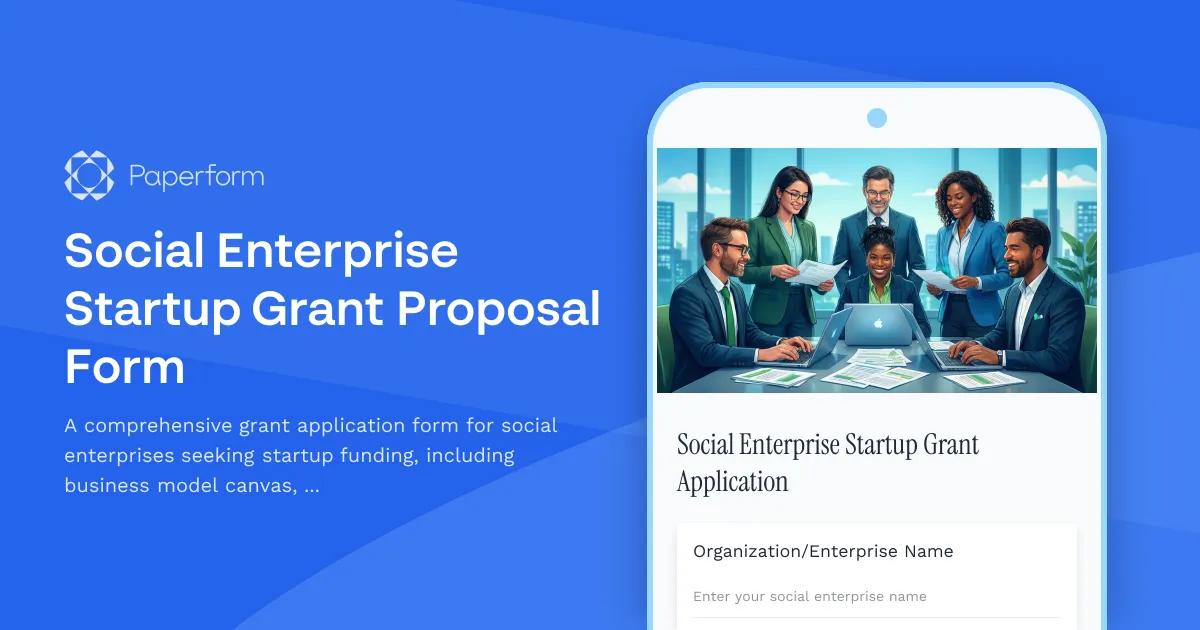
Social Enterprise Startup Grant Proposal Form
A comprehensive grant application form for social enterprises seeking startup funding, including business model canvas, impact metrics, financial projections, and team backgrounds.
Civic Technology Grant Application
Apply for funding to develop civic technology projects focused on open data platforms, resident engagement, language accessibility, and privacy protections.