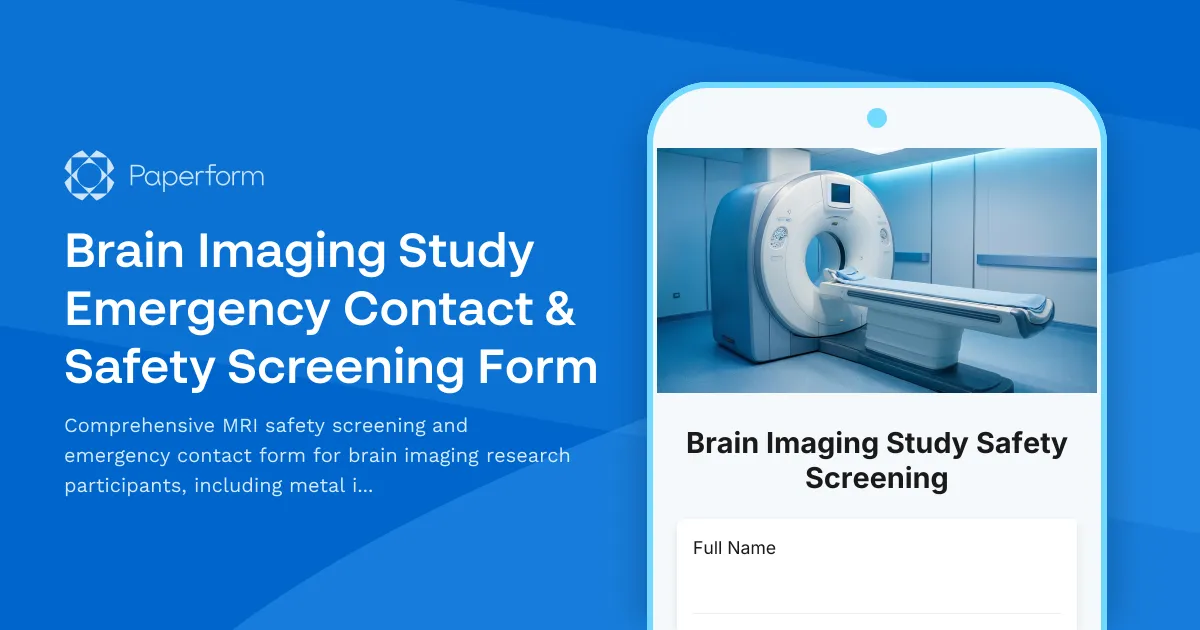
Streamline Brain Imaging Research with Professional MRI Safety Screening
Conducting brain imaging studies requires meticulous attention to participant safety, regulatory compliance, and emergency preparedness. This Brain Imaging Study Emergency Contact & Safety Screening Form template provides researchers, neuroscience labs, and clinical trial coordinators with a comprehensive solution for collecting critical safety information before MRI scans.
Why Brain Imaging Studies Need Specialized Forms
MRI safety isn't just a checkbox—it's a complex screening process that can make or break your study's safety record and institutional review board (IRB) compliance. This template addresses the unique challenges faced by neuroimaging researchers:
Metal implant screening is the cornerstone of MRI safety. This form systematically screens for pacemakers, cochlear implants, aneurysm clips, metallic fragments, joint replacements, and other contraindications that could pose serious risks in the magnetic field. Rather than relying on memory or paper checklists that get lost, Paperform captures every detail digitally and flags concerning responses automatically.
Claustrophobia and anxiety assessment helps you plan ahead. By identifying participants who may struggle with the confined MRI environment, you can arrange for support, consider open-bore alternatives, or schedule additional acclimation time—reducing scan-day dropouts and improving data quality.
Sedation and medication allergies must be documented before any imaging session that might require pharmacological intervention. This form captures comprehensive allergy histories, ensuring the safety team has critical information at their fingertips.
Incidental findings protocols are an ethical requirement in research imaging. This template includes clear consent language explaining how participants will be notified if unexpected abnormalities are discovered during analysis, protecting both participants and your institution.
Built for Research Teams and Clinical Coordinators
Whether you're running a cognitive neuroscience study, a clinical trial with neuroimaging endpoints, or a longitudinal brain health cohort, this form adapts to your workflow:
- Research coordinators can send this form to participants before their scheduled scan, reducing wait times and catching contraindications early
- MRI technologists receive complete safety information before participants arrive, streamlining the screening process
- Principal investigators maintain digital records that satisfy IRB documentation requirements and are easily auditable
Conditional logic ensures participants only see relevant follow-up questions based on their initial responses. If someone indicates they have a metal implant, the form automatically asks for specifics—type, location, date of implantation, and whether they have documentation. This intelligent branching creates a streamlined experience while capturing comprehensive data.
Emergency Contact Information That's Actually Accessible
In research settings, emergency contact information often lives in filing cabinets or scattered across multiple systems. This Paperform template centralizes everything in one secure, searchable database. Should an adverse event occur during scanning, your team has immediate access to:
- Primary and secondary emergency contacts with phone numbers and relationships
- Medical history relevant to emergency response
- Current medications and allergies
- Participant's preferred hospital or medical center
Integrate with Your Research Stack Using Stepper
Modern neuroimaging research involves multiple systems—participant databases, scheduling software, electronic data capture (EDC) systems, and communication tools. Rather than manually transferring safety screening data between platforms, use Stepper (stepper.io) to automate your workflow:
When a participant submits their screening form, Stepper can automatically check for MRI contraindications and route responses accordingly. Safe-to-scan participants can trigger automatic confirmation emails and calendar invites, while flagged responses alert your safety officer or study physician for manual review. Stepper can update your REDCap or other EDC system, create Slack notifications for your coordination team, and maintain a running log in Google Sheets or Airtable—all without a single line of code.
For studies requiring eSignatures on informed consent documents, Papersign (papersign.com) integrates seamlessly with this form. After participants complete their safety screening, automatically generate and send your IRB-approved consent form for secure electronic signature. The complete audit trail—screening responses, consent signature, and timestamp—stays linked together for perfect regulatory compliance.
Design That Builds Trust and Reduces Anxiety
Research participants are volunteering their time and sometimes putting themselves in unfamiliar situations. A professional, thoughtfully designed form builds confidence in your study from the very first interaction. This template uses clear, jargon-free language to explain each safety question, helping participants understand why you're asking about that dental work from 2015 or that childhood surgery.
With Paperform's document-style editor, you can easily customize this template to match your institution's branding, add your lab's logo, include photos of your MRI suite to reduce anxiety, or embed a video message from your research team. The form works beautifully on any device, so participants can complete it on their phone while commuting or on a desktop at home.
Perfect for Research Institutions and Clinical Settings
This template serves a wide range of neuroimaging applications:
- Academic research labs running cognitive neuroscience, neuropsychology, or social neuroscience studies
- Clinical trials with MRI-based endpoints in pharmaceutical research
- Hospital research departments conducting translational neuroscience studies
- Private neuroimaging centers offering research scanning services
- Longitudinal cohort studies tracking brain health across populations
- Pediatric research (easily adapted for parental consent and child-specific screening)
Security and Compliance Built In
Research data requires rigorous protection. Paperform is SOC 2 Type II compliant and offers data residency controls, ensuring participant information is handled according to institutional requirements and data protection regulations. While Paperform is not HIPAA compliant, it's well-suited for research contexts where identifiable health information is collected under IRB-approved protocols with appropriate consent.
Role-based permissions mean you can give MRI technologists access to safety screening responses while restricting access to contact information, or allow research coordinators to view all submissions while giving the PI dashboard-level insights.
Get Started in Minutes, Not Weeks
Rather than building a custom screening form from scratch or battling outdated PDF workflows, simply customize this template with your institution's specific requirements. Add your protocol-specific questions, adjust the emergency contact fields to match your SOPs, and update the incidental findings language to reflect your IRB-approved consent.
With Paperform's AI assistance, you can describe additional safety questions you need in plain language—"add a question about pregnancy status for female participants of childbearing age" or "include a field for contrast agent allergy history"—and watch as the form updates instantly. AI Insights can also help you spot trends in your screening data: Are certain demographics more likely to have contraindications? Is claustrophobia more common in first-time participants?
Trusted by Research Teams Worldwide
Join over 500,000 teams using Paperform to collect research data, manage participants, and maintain regulatory compliance. Whether you're a single research coordinator managing a pilot study or a core facility processing hundreds of scans per month, this template scales with your needs.
Start with Paperform's free plan to test the form with your team, then upgrade to access advanced features like conditional logic, integrations, and unlimited submissions as your study grows.
Ready to improve your MRI safety screening process? This template gives you everything you need to collect emergency contacts, screen for contraindications, assess participant readiness, and document informed consent—all in one professional, secure, and user-friendly form.



More templates like this
Clinical Trial Participant Emergency Contact Form
A comprehensive emergency contact form for clinical trial participants, including study coordinator information, adverse reaction protocols, and 24/7 emergency support details.
Clinical Trial Site Emergency Protocol Form
Emergency response form for clinical trial sites to verify participant safety, maintain study protocol compliance, and notify sponsors during crisis situations.
Pharmaceutical Trial Emergency Contact Form
A comprehensive emergency contact form for clinical trial participants, including adverse event reporting, study compliance tracking, and 24/7 access to study physicians.
Blood Donation Adverse Reaction Emergency Form
Report and manage adverse reactions during blood donation with immediate donor stabilization protocols, medical director consultation, and FDA reporting compliance.
Acupuncture Clinic Emergency Contact & Health Information Form
Comprehensive emergency contact and health disclosure form for acupuncture clinics. Collects emergency contacts, needle phobia information, blood thinner medications, pacemaker details, and consent for traditional Chinese medicine treatments.
Ambulatory Surgery Center Emergency Preparedness Form
Comprehensive emergency preparedness form for ambulatory surgery centers to manage patient procedure continuity, staff deployment, and equipment verification during crisis situations.
Amputation Rehabilitation Emergency Contact Form
A comprehensive emergency contact form for amputation rehabilitation patients to record essential medical details, prosthetic information, pain management needs, mobility goals, and care team coordination.
Burn Rehabilitation Emergency Contact Form
A comprehensive emergency contact form for burn rehabilitation patients that captures burn injury details, graft locations, scar management protocols, and plastic surgeon contact information for emergency care coordination.
Dialysis Center Medical Emergency Report Form
Emergency reporting form for dialysis centers to document critical incidents, activate emergency protocols, and coordinate immediate nephrologist consultation and EMS response.
Emergency Room Staff Post-Shift Wellness Check
A confidential wellness check for ER staff to report trauma exposure, safety incidents, and emotional well-being after shifts while connecting them with peer support and debriefing resources.
Healthcare Emergency Operations Center Activation Checklist
A comprehensive checklist form for activating healthcare emergency operations centers during critical incidents. Streamlines incident classification, resource coordination, and communication protocols.
Hospice Patient Emergency Contact Form
A comprehensive hospice emergency contact form that captures patient comfort care preferences, spiritual support details, funeral arrangements, and family notification hierarchy for end-of-life care coordination.