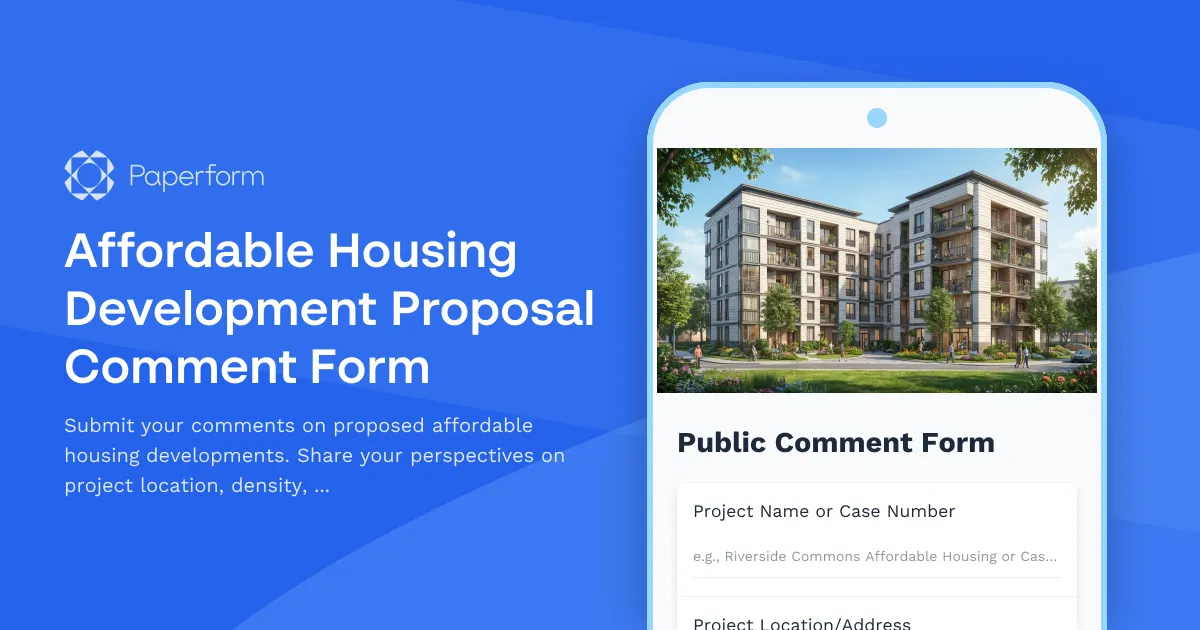
Public Comment Form for Affordable Housing Development Proposals
This affordable housing development proposal comment form provides residents, stakeholders, and community members with a structured way to submit feedback on proposed housing projects during the public comment period. Whether you're commenting on zoning changes, density concerns, parking impacts, or community benefits, this template ensures your voice is heard in the planning process.
Why use Paperform for public comment submissions?
Government agencies, planning departments, and municipal offices can use this form to gather comprehensive community feedback on affordable housing proposals in a transparent, organized way. Unlike email chains or paper comment cards, Paperform centralizes all responses in one place with timestamps, attachments, and structured data that makes analysis straightforward.
The form captures essential details including project identification, commenter demographics, specific concerns about density and parking, traffic impact assessments, and community benefit perspectives. Conditional logic ensures respondents only see relevant follow-up questions based on their initial responses, making the process efficient while gathering detailed insights.
Automate your public engagement workflow
Connect this form to your existing systems using Stepper, Paperform's AI-native workflow builder. Automatically route comments to the appropriate planning staff, trigger acknowledgment emails to commenters, compile responses by project or concern type, and generate summary reports for public hearings—all without manual data entry.
For planning departments managing multiple concurrent proposals, this template can be duplicated and customized per project while maintaining consistent data collection. All submissions are securely stored with SOC 2 Type II compliance, ensuring transparency and accountability throughout the public comment process.
Whether you're a city planner gathering community input, a housing authority evaluating proposals, or a municipal clerk managing public hearing records, Paperform makes it easy to collect, organize, and act on public comments efficiently and professionally.
More templates like this
City Planning Public Hearing Comment Form
Submit your comments, concerns, and suggestions on proposed development projects during city planning public hearings. Share feedback on environmental impact, traffic, and community character preservation.
Local Emergency Services Consolidation Public Hearing Form
Submit your feedback on the proposed emergency services consolidation plan. Share concerns about service areas, response times, and cost impacts for public hearing consideration.
Backyard Chicken Ordinance Public Hearing Comment Form
Submit your comments on the proposed backyard chicken ordinance, including regulations on flock size, coop setbacks, and rooster restrictions for public hearing consideration.
Community Land Dedication Ordinance Public Hearing Form
Submit your feedback on the proposed land dedication ordinance, including parkland requirements, fee-in-lieu options, and neighborhood facility priorities for community development.
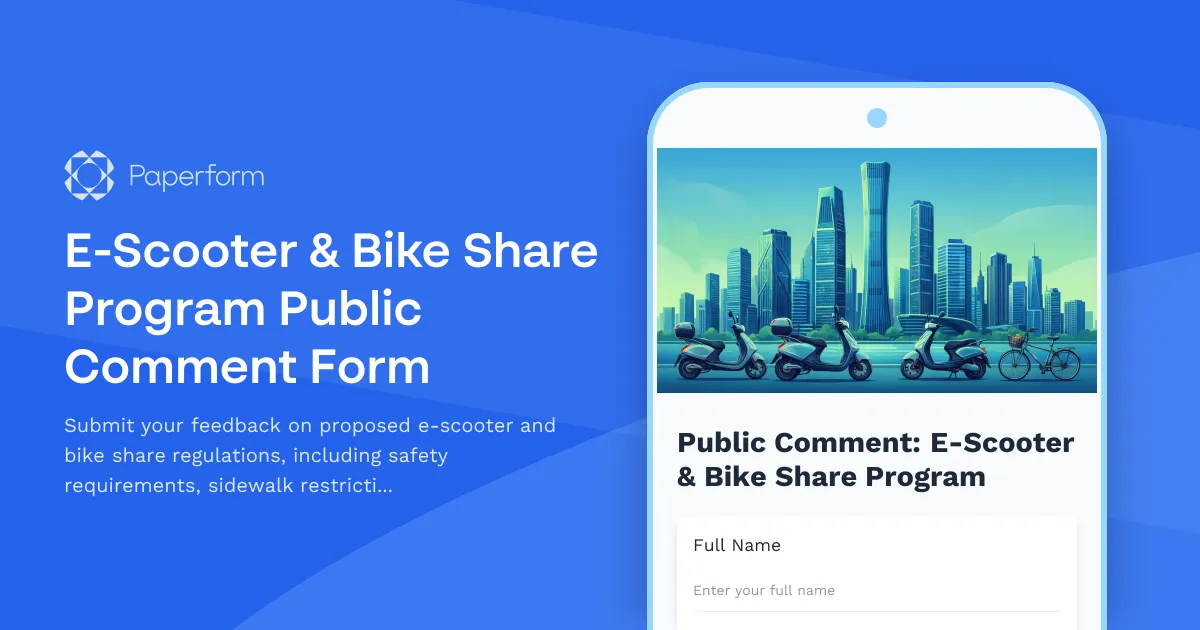
E-Scooter & Bike Share Program Public Comment Form
Submit your feedback on proposed e-scooter and bike share regulations, including safety requirements, sidewalk restrictions, and designated parking locations.

Formula Business Restriction Ordinance Public Input Form
Submit your comments on proposed formula business restrictions, independent business protections, design standards, and neighborhood character preservation. Help shape your community's commercial landscape.
Local Government Budget Priorities Survey
Help shape your local government's budget by sharing your priorities for community spending. Use interactive sliders to allocate resources across key services and share what matters most to you.
Municipal Budget Allocation Public Comment Form
Submit your feedback on the proposed municipal budget and share your priorities for community funding. Help shape how local resources are allocated across departments and services.
Municipal Minority Business Certification Process Feedback Form
Help us improve the minority business certification process by sharing your experience with the application, documentation requirements, site visits, and renewal procedures.
Public Market & Farmers Market Ordinance Public Hearing Form
Submit your feedback on proposed farmers market and public market ordinance regulations, including vendor qualifications, product sourcing requirements, and location criteria.
Town Hall Constituent Services Satisfaction Survey
Gather citizen feedback on constituent services, staff performance, response times, and issue resolution to improve municipal service delivery and communication.
Vacant Lot Transformation Program Comment Form
Submit public comments on the proposed Vacant Lot Transformation Program, including temporary use permissions, liability provisions, and community stewardship models for revitalizing unused municipal properties.