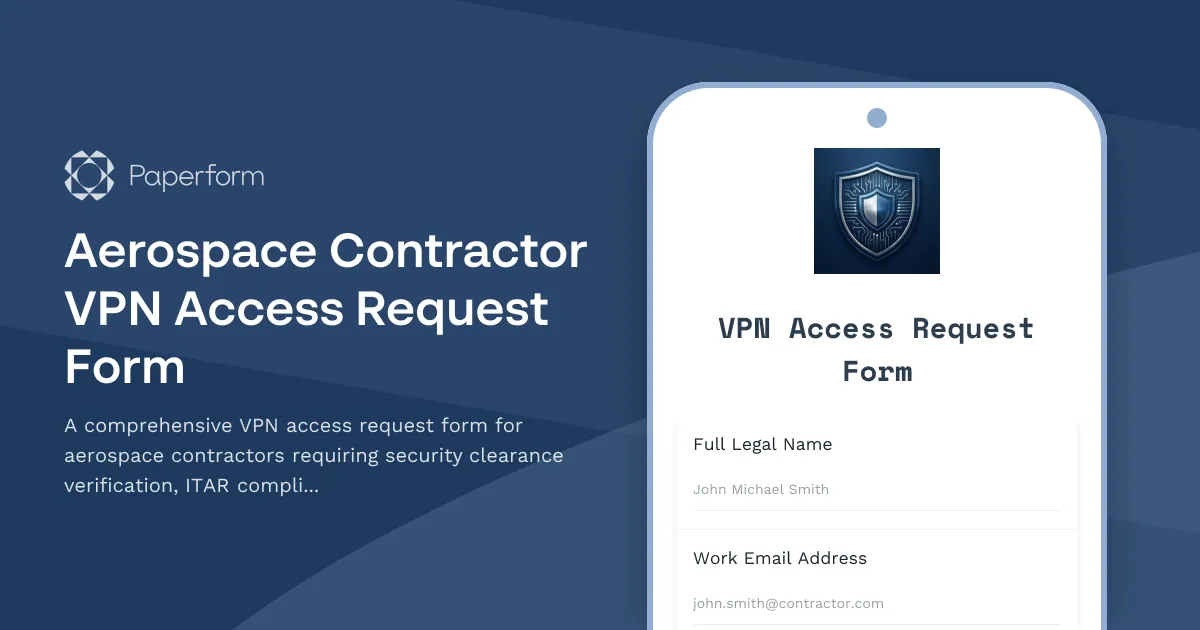
Secure VPN Access for Aerospace Contractors
Managing VPN access for aerospace contractors requires strict security protocols, compliance verification, and careful documentation of clearance levels. This Aerospace Contractor VPN Access Request Form streamlines the approval process while ensuring full compliance with ITAR (International Traffic in Arms Regulations) and classified project requirements.
Built for Defense and Aerospace Security Requirements
Aerospace and defense contractors work with sensitive data that demands rigorous access controls. This template helps IT and security teams:
- Verify security clearance levels before granting network access
- Document ITAR compliance acknowledgment for all contractors
- Control access to classified projects based on need-to-know principles
- Maintain audit trails for compliance reviews and security assessments
The form captures essential contractor information, employment details, security clearance status, and specific project access requirements—all in one organized submission that can trigger your approval workflows.
Automate Access Provisioning with Stepper
Once a VPN access request is submitted, you can use Stepper to automate your entire approval and provisioning workflow. Route requests to security officers for clearance verification, send acknowledgment emails, update your identity management system, trigger account provisioning in Active Directory, and notify the contractor when their VPN credentials are ready—all without manual handoffs.
SOC 2 Compliant and Secure
Built on Paperform's SOC 2 Type II certified platform, this form ensures your sensitive contractor data is handled with enterprise-grade security. Set up SSO for your security team, implement role-based access controls, and maintain complete audit logs of all access requests.
Perfect for aerospace contractors, defense contractors, government IT departments, and any organization managing secure remote access for cleared personnel working on sensitive or classified projects.
More templates like this
Corporate VPN Access Request Form
Streamline remote access requests with this corporate VPN access form. Collect employee details, device information, security clearance levels, and route for manager approval—all in one secure workflow.
Government Agency VPN Access Request Form
Secure VPN access request form for government personnel requiring remote network access with security clearance verification and classified network authorization levels.
Active Directory Access Modification Request Form
Request changes to Active Directory access, group memberships, and permission levels with built-in approval workflows and audit trail logging.
Aerospace Engineer Password Reset & Account Recovery Request
Secure password reset form for aerospace engineers requiring CAD system access and flight test data permissions. Streamline account recovery with verification and approval workflows.
Aviation Maintenance VPN Access Request Form
Secure VPN access request form for aviation maintenance crews requiring aircraft system access, with certification verification and safety compliance tracking.
Banking Customer Account Information Access Request Form
Secure form for bank employees and authorized personnel to request access to customer account information with two-factor authentication, legal basis documentation, and full audit tracking.
Cloud Security Specialist Certification Verification Form
Verify cloud security certifications, continuing education credits, architecture experience, and technical competencies for compliance and hiring purposes.
Cloud Storage File Metadata & Access Request Form
Request file metadata, access logs, sharing permissions, and version history from your cloud storage service. Comprehensive data access request form for IT administrators and users.
Cloud Workload Protection Platform Effectiveness Review
Comprehensive assessment form for evaluating cloud workload protection platform performance, including container runtime security, serverless coverage, and threat detection capabilities.
Collaboration Tool Guest Access Request Form
Streamline external partner access to your collaboration tools with automated permissions, project assignments, and built-in confidentiality agreements.
Consulting Firm Client Site VPN Access Request
A comprehensive VPN access request form for consulting firms requiring client site access, including engagement verification, client approval workflow, and conflict of interest disclosure.
Continuous Security Monitoring Effectiveness Audit
A comprehensive audit form for evaluating the effectiveness of your continuous security monitoring program, identifying detection coverage gaps, measuring alert fatigue, and optimizing sensor placement across your infrastructure.