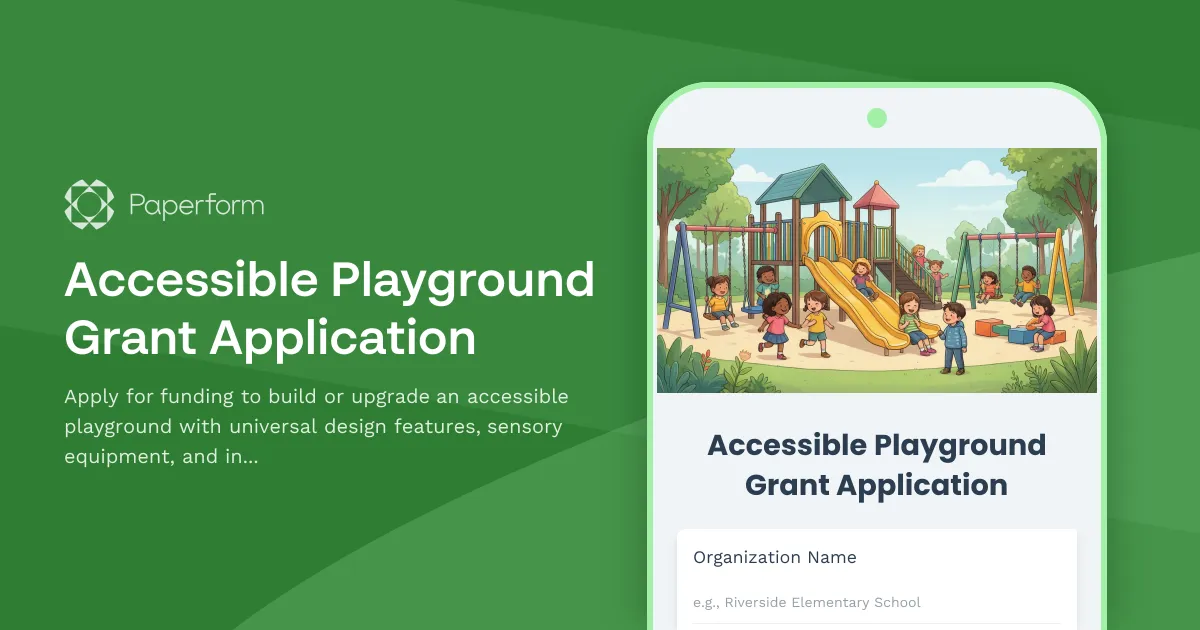
Build Inclusive Play Spaces with an Accessible Playground Grant Application
Creating playgrounds that welcome children of all abilities is more than a nice-to-have—it's essential for building truly inclusive communities. Whether you're a school, municipality, nonprofit, or community organization, securing grant funding for accessible playground equipment and universal design features can transform outdoor spaces into places where every child can play, learn, and thrive together.
Our Accessible Playground Grant Application template makes it simple to submit professional, comprehensive funding requests that demonstrate your commitment to inclusive design, community impact, and long-term sustainability. Built with Paperform, this template helps you present a compelling case for funding while capturing all the technical details grant reviewers need to evaluate your project.
Why use Paperform for accessible playground grant applications?
Grant applications are complex, multi-stakeholder documents that require thoughtful organization and clear communication. Paperform's document-style editor lets you create an application form that feels approachable and professional—guiding applicants through project vision, design specifications, budget details, and community impact without overwhelming them.
Conditional logic ensures applicants only see questions relevant to their project type. For example, if you're applying for new construction versus renovation funding, the form adapts to ask about appropriate site preparation, demolition, or surface replacement details. This keeps applications focused and reduces confusion.
The calculation engine can help applicants understand budget allocations in real-time, automatically totaling equipment costs, installation expenses, and maintenance reserves as they fill out the form. This transparency helps organizations plan more accurately and submit realistic budgets that stand up to review.
Who benefits from accessible playground grant applications?
This template is designed for:
- Schools and school districts seeking funding to upgrade playgrounds with accessible equipment, ramps, sensory panels, and inclusive swings
- Parks and recreation departments applying for grants to retrofit existing playgrounds or build new universally designed play spaces
- Nonprofit organizations focused on disability inclusion, child development, or community improvement
- Community groups and PTAs looking to partner with municipalities or foundations to bring accessible play to their neighborhoods
- Early childhood centers and daycares that want to create outdoor environments serving children with diverse physical, sensory, and cognitive abilities
Whether you're targeting federal accessibility grants, state recreational funding, private foundation programs, or corporate giving initiatives, this template helps you present a thorough, persuasive application.
What makes this template work
The form walks applicants through every critical element of a successful accessible playground grant:
Project overview and community need: Collect compelling narratives about why this playground matters, who it will serve, and how it addresses gaps in accessible recreation in your community.
Universal design features: Gather detailed specifications about ramps, transfer platforms, accessible pathways, ground-level play components, and other features that ensure children using wheelchairs, walkers, or other mobility devices can fully participate.
Sensory equipment and inclusive play: Capture plans for sensory panels, musical instruments, tactile elements, quiet zones, and equipment designed for children with autism, sensory processing differences, or visual and hearing impairments.
Surface material specifications: Collect technical details about safety surfacing—whether you're planning pour-in-place rubber, rubber tiles, engineered wood fiber, or other ADA-compliant materials—and how they'll provide accessibility, impact attenuation, and durability.
Maintenance and sustainability plans: Demonstrate long-term commitment by outlining inspection schedules, repair budgets, cleaning protocols, and replacement timelines that will keep the playground safe and accessible for years to come.
Budget and timeline: Present clear financial requests with itemized costs, matching funds, and realistic project timelines that build confidence in your ability to execute.
With Paperform, you can embed this application directly on your website, share it via custom domain, or send it as a simple link. Submissions flow into your Paperform account where you can review, score, and collaborate with selection committees—no spreadsheet juggling required.
Automate your grant workflow with Stepper
Once applications start coming in, Stepper can help you manage the entire review and approval process. Connect your Paperform grant applications to Stepper workflows that automatically:
- Route new applications to the right internal reviewers based on funding amount, project type, or geographic area
- Send acknowledgment emails with application reference numbers and expected review timelines
- Notify selection committees when applications are ready for scoring
- Update applicant status in your CRM or project management tool as decisions are made
- Trigger award letters, funding agreements, or follow-up requests for additional information
This end-to-end automation means your team spends less time on administrative coordination and more time evaluating the quality and impact of proposed playground projects.
Security and compliance you can trust
Grant applications often include sensitive information—financial details, demographics of underserved populations, and organizational documentation. Paperform is SOC 2 Type II compliant with robust data encryption, role-based access controls, and data residency options to keep applicant information secure and handled responsibly.
For government agencies and larger foundations managing multiple grant programs, Paperform's Agency+ and Enterprise tiers offer SSO, advanced permissions, and white-label options to maintain professional, branded experiences across all your funding initiatives.
Design that reflects your mission
Your grant application form is often the first impression applicants have of your funding program. Paperform's design flexibility lets you create an on-brand experience with your logo, colors, fonts, and imagery that reinforces your commitment to accessibility and inclusion.
Add photos of existing accessible playgrounds, videos explaining universal design principles, or illustrations showing inclusive play in action. These visual elements help applicants see what's possible and inspire thoughtful, creative proposals.
Start building more inclusive playgrounds today
Accessible playgrounds don't just serve children with disabilities—they create richer, more engaging play experiences for all children. By making it easier for organizations to apply for funding, you're removing barriers to inclusive design and helping communities invest in spaces where every child belongs.
Whether you're a foundation launching a new accessible recreation grant program, a municipality opening applications for capital improvement funds, or a nonprofit partnering with schools to upgrade play spaces, this Paperform template gives you a professional, efficient way to collect, review, and award funding for projects that truly matter.
Trusted by nonprofits, government agencies, schools, and foundations worldwide, Paperform combines ease of use with enterprise-grade security—so you can focus on making inclusive play a reality in more communities.
More templates like this
Farm-to-School Grant Application
Apply for farm-to-school funding to support local food procurement, nutrition education programs, school gardens, and cafeteria infrastructure improvements.
Library Services Grant Application
A comprehensive grant application form for libraries seeking funding for collection development, technology upgrades, programming initiatives, and accessibility improvements.
Makerspace Grant Application Form
A comprehensive application form for organizations seeking grant funding to establish or expand a makerspace, including equipment needs, safety protocols, membership plans, and community impact strategies.
Workforce Development Grant Application
Comprehensive grant application form for workforce development programs including skills gap analysis, industry partnerships, job placement commitments, and apprenticeship pathway planning.
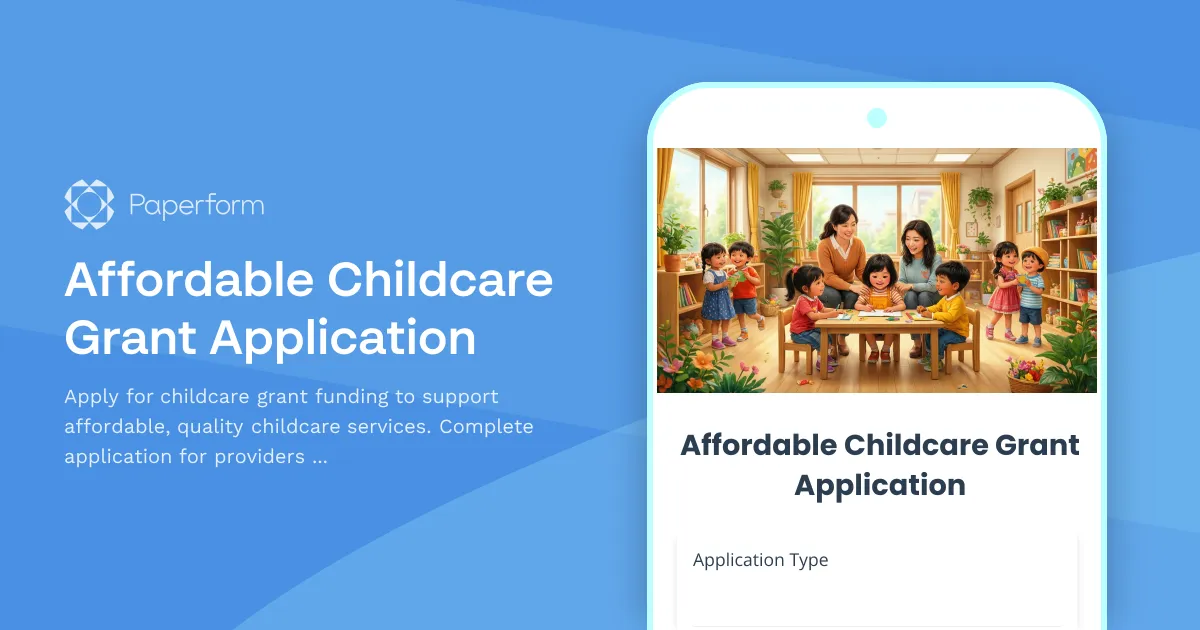
Affordable Childcare Grant Application
Apply for childcare grant funding to support affordable, quality childcare services. Complete application for providers and families seeking financial assistance for early childhood education programs.
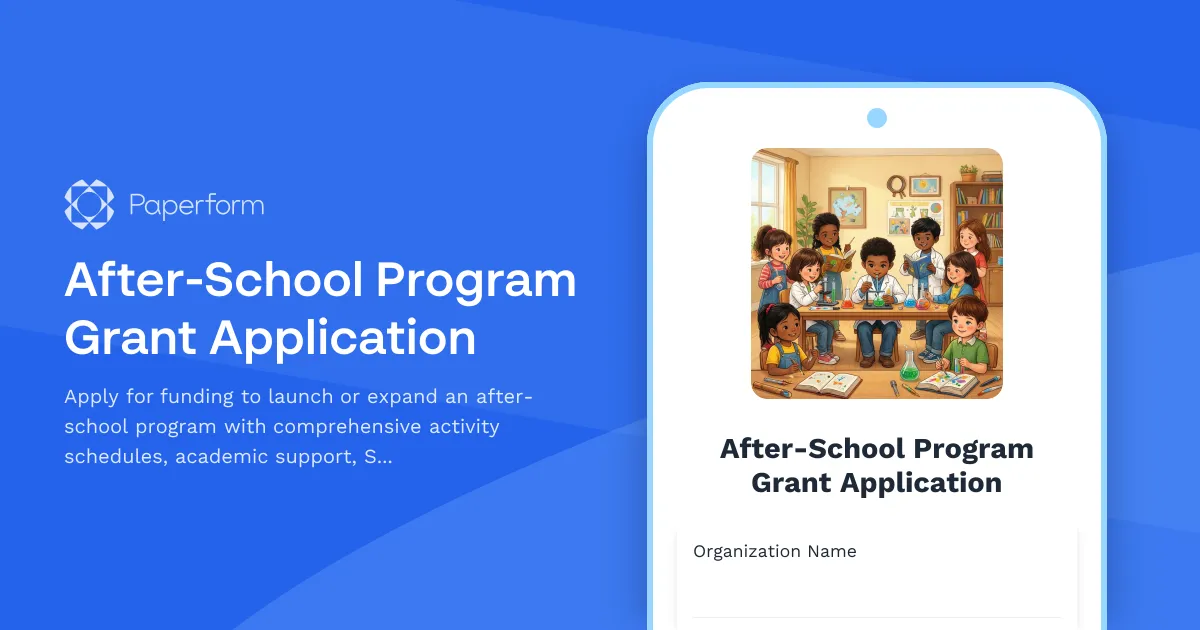
After-School Program Grant Application
Apply for funding to launch or expand an after-school program with comprehensive activity schedules, academic support, STEM enrichment, and student care services.
Assistive Technology Grant Application
A comprehensive application form for individuals and organizations seeking funding for assistive technology devices, including needs assessment, device requests, training plans, and outcome measurement tools.
Childcare Assistance Grant Application
Apply for childcare financial assistance with subsidy calculations based on income, family size, and provider quality ratings.
Civic Engagement Grant Application
Apply for funding to support civic engagement initiatives including voter registration, community organizing, civic education, and language access programs in your community.
Community Controlled Schools Grant Application
A comprehensive grant application for community controlled schools focused on parent and student governance, culturally sustaining pedagogy, community accountability, and liberatory education practices.
Community Technology Grant Application
Apply for funding to support community technology projects including mesh networks, community-owned internet infrastructure, digital security training programs, and tech cooperative development initiatives.
Cultural Exchange Grant Application Form
Comprehensive grant application for cultural exchange programs with program itinerary, participant selection, visa assistance, safety protocols, and reciprocal visit planning.