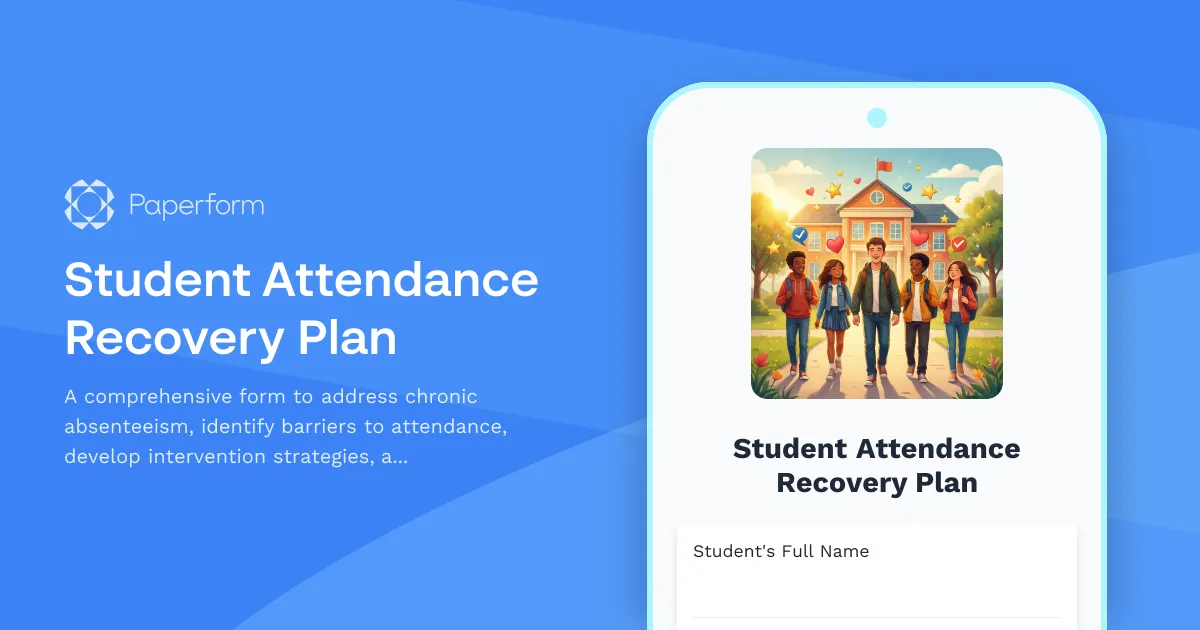
Help Students Get Back on Track with an Attendance Recovery Plan
Chronic absenteeism is one of the most reliable early warning signs that a student is at risk of falling behind academically or dropping out entirely. When students miss 10% or more of school days—whether excused or unexcused—the impact on learning, engagement and long-term outcomes can be significant. That's why schools, counselors and family support teams need a clear, collaborative way to identify attendance barriers, build recovery plans and keep students engaged before absence patterns escalate to truancy court.
This Student Attendance Recovery Plan template gives K-12 schools, districts and student services teams a structured way to work with families, understand the root causes of chronic absence and co-create actionable plans that address barriers, leverage incentives and hold everyone accountable. Built on Paperform, this template replaces scattered PDFs, email threads and paper forms with a single, mobile-friendly tool that keeps the conversation focused, the process transparent and the follow-up on track.
Why schools and districts choose Paperform for attendance recovery
Attendance recovery isn't a one-size-fits-all process. Every student's situation is different—transportation challenges, health issues, family responsibilities, bullying, mental health struggles or disengagement can all play a role. Paperform's doc-style editor and conditional logic let you build a form that adapts to each student's circumstances, showing follow-up questions, resources and intervention options based on the barriers families identify.
Whether you're a school counselor, attendance clerk, social worker or principal, you can customize this template to match your district's policies, add your school's support resources and integrate it into your existing student information system or case management workflow. With Paperform's no-code design, you don't need IT approval to make changes—just update the form as your intervention programs evolve.
What's included in this attendance recovery plan template
This template walks families and school teams through a collaborative planning process:
- Student and family information: Contact details, grade level, homeroom teacher and preferred communication method
- Attendance summary: Current absence count, number of excused vs. unexcused days and percentage of school missed
- Chronic absence reasons: A comprehensive checklist covering health, transportation, family, mental health, school climate and other common barriers
- Barrier removal strategies: Specific interventions the school and family will implement—such as bus passes, check-in/check-out systems, mentorship, flexible scheduling or counseling referrals
- Family commitments: Actions the family agrees to take, like setting morning routines, communicating absences promptly or attending support meetings
- Student commitments: Goals the student sets for themselves, such as attending a certain percentage of days, checking in with a trusted adult or participating in a school activity
- Incentive program enrollment: Options for attendance rewards, recognition programs or motivational supports
- Progress monitoring: Check-in schedule, who will track attendance and how often the plan will be reviewed
- Support services and referrals: Connections to school-based resources like counseling, health services, tutoring or community partners
- Signatures and agreement: Digital acknowledgment from family, student and school representatives
The form uses conditional logic to show relevant intervention options based on the barriers selected, ensuring families only see the strategies that apply to their situation. This keeps the form focused, personalized and easier to complete—especially for families navigating complex challenges.
Move from reactive to proactive with better attendance data
Once a family submits an attendance recovery plan, Paperform sends the data wherever you need it—into your student information system via Stepper workflows, into a Google Sheet or Airtable base for case management, or directly to the inbox of the counselor, social worker or attendance team responsible for follow-up.
You can use Stepper to automate next steps: send a confirmation email to the family with a PDF copy of the plan, assign a case manager, schedule a follow-up meeting, update the student's record and set reminders for progress check-ins. This automation keeps plans from falling through the cracks and ensures every student gets the support they need, when they need.
Paperform's AI Insights can also help you spot patterns across multiple recovery plans—identifying common barriers (like transportation or mental health), measuring which interventions are most effective and giving your team the data to advocate for resources, policy changes or targeted support programs.
A trauma-informed, family-friendly approach
Chronic absenteeism often has roots in circumstances beyond a student's control. This template is designed to be collaborative, not punitive—framing the recovery plan as a partnership between school and family, with shared accountability and shared solutions. The tone is supportive and solution-focused, helping families feel heard and empowered rather than blamed or threatened.
You can embed this form on your school website, link to it from parent portals or email it directly to families who meet chronic absence thresholds. Because Paperform forms are fully mobile-responsive, families can complete the plan on their phone, tablet or computer—no PDF printing, scanning or mailing required. This accessibility is especially important for families facing barriers like limited internet access, language differences or time constraints.
Keep students in school, not in court
For many districts, attendance recovery plans are a critical intervention to avoid formal truancy proceedings. By documenting the barriers, interventions and commitments in a clear, signed agreement, schools can demonstrate good-faith efforts to support the student and family—and often satisfy legal requirements for intervention before escalation. The form creates a paper trail that protects both the family and the school, while keeping the focus on getting the student back in class.
If a case does need to move forward to a student attendance review board or truancy court, the completed recovery plan serves as evidence of the school's proactive support and the family's engagement (or lack thereof), making the process more transparent and outcome-focused.
Integrations, security and compliance for student data
Student attendance data is sensitive, and Paperform takes privacy seriously. The platform is SOC 2 Type II compliant, with data encryption, secure storage and role-based access controls to protect student and family information. You can restrict form access, require passwords or send personalized links to ensure only the right people can submit or view plans.
Paperform integrates with tools schools already use—like Google Workspace, Microsoft 365, student information systems and case management platforms—via native connections, Zapier, Make or Stepper. This means attendance recovery plans flow directly into your existing workflows without manual data entry or duplicate systems.
Who this template is for
This Student Attendance Recovery Plan template is built for:
- School counselors and social workers managing chronic absenteeism cases and family support plans
- Attendance clerks and administrators tracking intervention efforts and compliance with district policies
- Student support teams coordinating wraparound services, mentorship and barrier removal strategies
- Principals and assistant principals overseeing school-wide attendance improvement initiatives
- District-level student services standardizing attendance intervention processes across multiple schools
- Family liaisons and community partners helping families access resources and navigate school systems
Whether you're working with elementary students, middle schoolers or high schoolers, this template gives you a flexible, professional way to document attendance challenges, co-create solutions and keep students on the path to success—without the paperwork chaos or truancy court escalation.
Get started with Paperform's free plan and customize this template to fit your school's attendance policies, support resources and intervention programs. With built-in automation, mobile-friendly design and secure data handling, you'll spend less time chasing paper and more time helping students show up, engage and thrive.

More templates like this

Special Education Evaluation Request Form
Request a formal special education evaluation for your child with documented learning concerns, intervention history, and assessment consent.
Chronic Absence Intervention Form
A comprehensive attendance intervention form that helps schools identify barriers to attendance, create truancy prevention plans, and connect families with support resources to improve student outcomes.
IEP Meeting Preparation Form
A comprehensive form for parents to prepare for IEP meetings by documenting accommodations, progress observations, and questions for the special education team.
Learning Disability Support Program Application
Apply for learning disability support services with documentation upload, accommodation requests, assistive technology needs, and personalized academic strategy planning.
Parent Email Communication Preferences Form
Manage parent email subscriptions, communication frequency preferences, and language needs for school-parent communication.
Parent Liaison Volunteer Application Form
A comprehensive application form for parents interested in becoming school liaison volunteers, capturing multilingual skills, cultural background, availability, and training progress to help bridge communication between families and educators.
Parent School Violence Threat Assessment Cooperation Form
A confidential form for parents and guardians to provide critical information during school safety assessments, including behavioral concerns, home environment details, and intervention coordination to support student wellbeing and school safety.
Parent-Teacher Conference Scheduling Form
Schedule parent-teacher conferences with available time slots, student concerns, and meeting format preferences for effective school-home communication.
Student Health & Emergency Contact Update Form
A comprehensive form for parents to update student health information, emergency contacts, medical conditions, allergies, and authorized pickup persons for school records.
Student Trauma-Informed Practice Parent Education Form
A comprehensive form for educators to understand and support students through trauma-informed practices, documenting adverse experiences, identifying triggers, and coordinating healing strategies between school and home.
504 Plan Accommodation Request Form
A comprehensive form for parents and guardians to request Section 504 accommodations for students with disabilities, including documentation uploads and professional recommendations.
Adverse Childhood Experiences (ACE) Screening Consent Form
A trauma-informed consent form for parents to authorize ACE screening for their child, with clear confidentiality assurances and immediate access to counseling and support resources.