Educational institutions face increasing responsibility to maintain safe, secure environments for students and staff. This School Safety and Emergency Preparedness Survey provides schools, colleges, and educational administrators with a structured way to gather critical feedback on security measures, emergency procedures, and preparedness protocols.
Whether you're a school principal, safety coordinator, or district administrator, understanding how your community perceives and experiences your safety measures is essential for continuous improvement. This template helps you collect honest feedback from students, teachers, staff, and parents about everything from lockdown drills and evacuation procedures to communication systems and visible security measures.
Paperform makes safety assessment simple and actionable. The survey automatically collects and organizes responses, allowing you to identify trends, spot gaps in training, and prioritize improvements. With conditional logic built in, you can ask follow-up questions based on specific concerns, ensuring you gather the detailed insights needed to make informed decisions.
Once responses are submitted, you can use Stepper to automatically route feedback to the appropriate department heads, flag urgent concerns for immediate review, or compile monthly safety reports that keep your leadership team informed. This automation ensures that safety feedback doesn't sit in an inbox—it drives action.
This template is ideal for K-12 schools, colleges, universities, and educational districts conducting regular safety audits, post-drill assessments, or comprehensive security reviews. It addresses physical security, emergency communication, drill effectiveness, and staff preparedness—the four pillars of a robust safety program.
With Paperform's customizable design, you can brand the survey to match your institution, embed it on your intranet or safety portal, and ensure confidential, honest feedback that helps you build a safer learning environment for everyone.



More templates like this
Online Learning Platform Course Feedback Form
Gather comprehensive student feedback on online courses, including technical issues, content clarity, instructor responsiveness, and overall learning experience.
Substitute Teacher Performance Evaluation Form
A comprehensive evaluation form for assessing substitute teacher performance, including classroom management skills, lesson plan adherence, student engagement, and overall teaching effectiveness.
After-School Program Evaluation Form
Gather comprehensive feedback on activity quality, staff interactions, safety measures, and parent communication to continuously improve your after-school program experience.
Classroom Seating & Learning Environment Survey
Evaluate classroom comfort, lighting, temperature, noise levels, and accessibility features to improve student learning environments and ensure optimal conditions for academic success.
Classroom Technology Integration Survey
A comprehensive survey to evaluate how students experience technology in the classroom, including interactive tools, digital platforms, online resources, and tech support effectiveness.
College Academic Probation Support Program Feedback Survey
A comprehensive feedback survey designed to evaluate academic probation support programs, including advisor effectiveness, study skills resources, mental health support, and student success outcomes.
College Accelerated Degree Program Student Survey
Gather comprehensive feedback from students enrolled in accelerated degree programs about course intensity, support services, time management, academic quality, and overall satisfaction with their experience.
College Accessibility Services Student Survey
Evaluate your college's accessibility services with this comprehensive student feedback form covering accommodations, staff support, assistive technology, testing arrangements, and advocacy effectiveness.
College Career Services Satisfaction Survey
Evaluate your career services experience including resume assistance, interview prep, job fairs, employer connections, and alumni networking to help improve student outcomes.
College Course Evaluation Form
A comprehensive course evaluation form for students to provide feedback on professors, course content, workload, and overall learning experience.
College Dining Services Feedback Survey
Gather student feedback on campus dining experiences, meal plan value, food quality, dietary accommodations, and service standards to improve dining services.
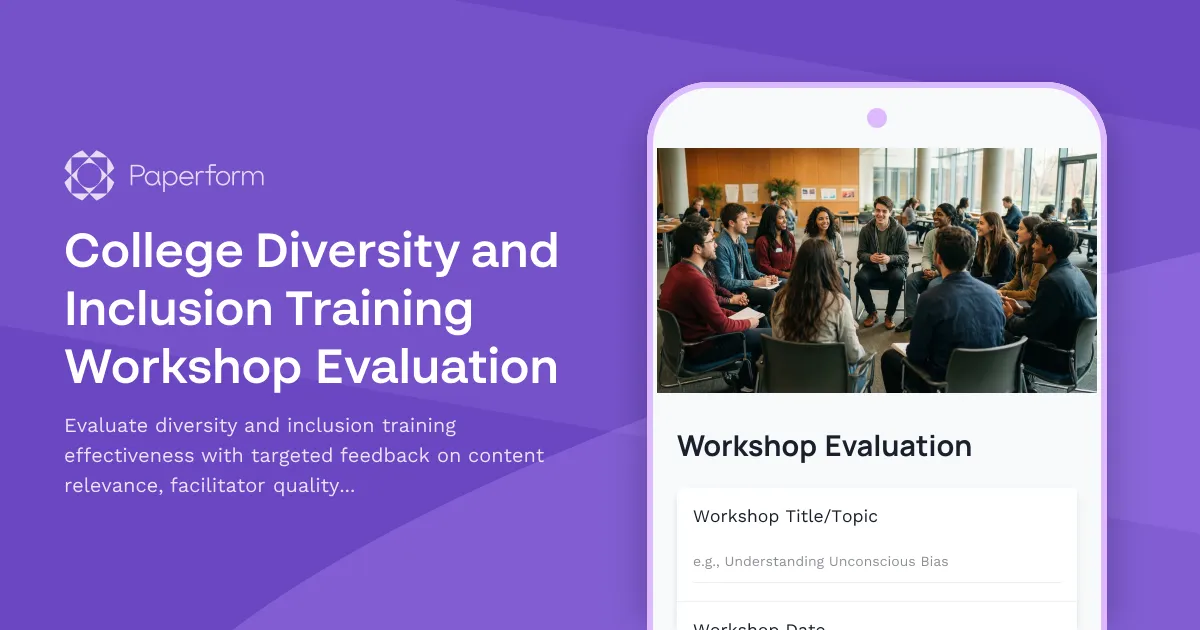
College Diversity and Inclusion Training Workshop Evaluation
Evaluate diversity and inclusion training effectiveness with targeted feedback on content relevance, facilitator quality, dialogue engagement, and campus climate commitment tracking.