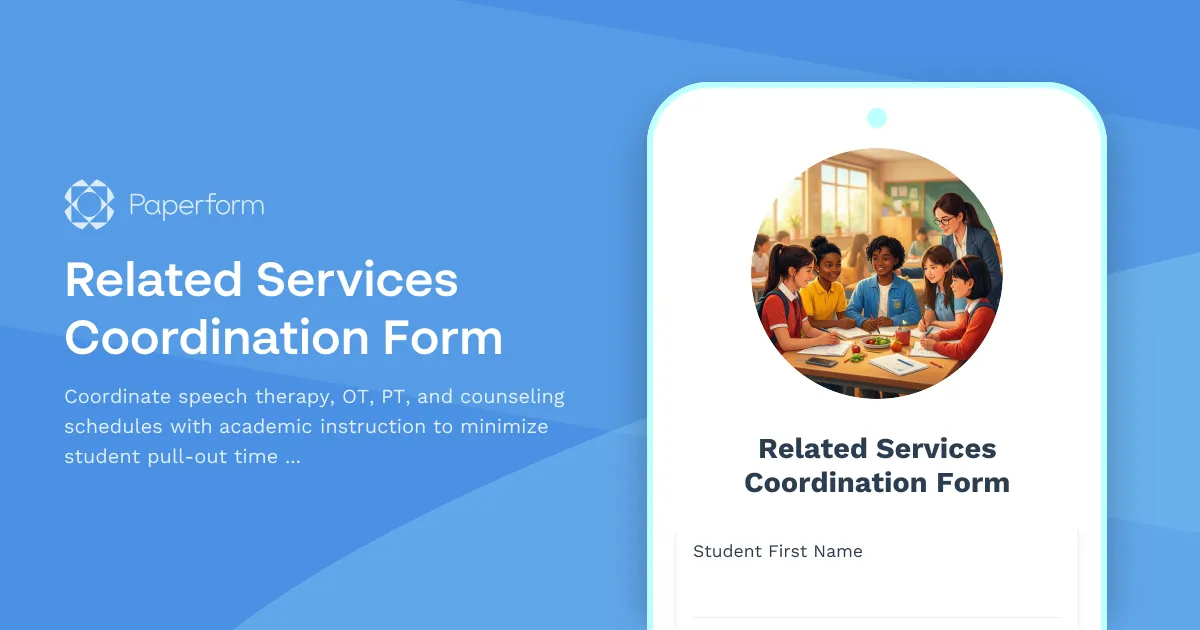
Streamline Related Services Scheduling for Special Education Programs
Coordinating related services—speech therapy, occupational therapy, physical therapy, and counseling—alongside classroom instruction is one of the most complex challenges facing special education coordinators and IEP teams. When schedules aren't aligned, students miss critical academic time, teachers lose instructional flow, and service providers struggle to meet mandated minutes.
This Related Services Coordination Form gives special education teams a centralized tool to map out therapy and support schedules, identify conflicts, minimize pull-out disruptions, and ensure compliance with IEP requirements—all while keeping the student's academic progress front and center.
Built for special education coordinators and IEP teams
Whether you're a special education coordinator, case manager, school psychologist, or building administrator, this template helps you:
- Coordinate multiple service providers across speech, OT, PT, counseling and academic staff
- Minimize pull-out time by scheduling services during natural transitions or non-core instruction
- Track IEP-mandated minutes for each related service to ensure compliance
- Identify scheduling conflicts before they disrupt instruction or therapy sessions
- Communicate clearly with teachers, parents and providers about when services occur
The form collects student details, current IEP service requirements, preferred scheduling windows, conflicts to avoid, and provider availability—giving you all the information needed to build a coordinated, student-centered schedule.
Automate scheduling workflows with Stepper
Once a coordination form is submitted, you can use Stepper to automatically:
- Notify all service providers and classroom teachers of proposed schedules
- Send calendar invites to therapists and staff
- Create shared scheduling documents in Google Workspace or Microsoft 365
- Route scheduling conflicts to the IEP coordinator for resolution
- Update your student information system with finalized service times
This eliminates the back-and-forth emails and spreadsheet chaos that typically come with related services scheduling, freeing up your time to focus on student outcomes.
Designed for K-12 schools and special education programs
This form is ideal for:
- Public and private K-12 schools with special education programs
- Charter schools and district-level special education offices
- Inclusion and resource room programs
- Early intervention and preschool special education teams
- Therapeutic day schools and specialized learning centers
With Paperform's conditional logic, you can customize the form to match your school's specific service offerings, scheduling constraints, and compliance requirements—no coding needed. Whether you're coordinating services for a handful of students or managing district-wide IEP compliance, this template adapts to your needs.
Trusted by schools nationwide
Paperform is trusted by over 500,000 teams worldwide, SOC 2 Type II and GDPR compliant, and designed for education professionals who need secure, flexible forms without the IT bottleneck. Start coordinating related services more effectively today.
More templates like this
Auditory Processing Disorder Support Plan
A comprehensive support plan form for students with auditory processing disorder, documenting classroom accommodations, sensory needs, and therapy collaboration for optimal learning.
Autism Spectrum Support Services Intake Form
A comprehensive intake form for autism spectrum support services that captures sensory profiles, communication preferences, social skills assessments, and behavior patterns to create personalized support plans.
Community-Based Vocational Training Placement Form
A comprehensive placement form for community-based vocational training programs serving students aged 18-21, covering job coach support, work site agreements, transportation arrangements, and skill development goals.
Functional Life Skills Program Enrollment Form
Enroll students with intellectual disabilities in comprehensive life skills training programs focused on community-based instruction, vocational skills, and independent living competencies.
Individual Counseling Services Request for Students with Emotional Disturbance
A comprehensive form for requesting and documenting intensive individual counseling services for students with emotional disturbance, including treatment planning, evidence-based interventions, crisis prevention strategies, and outcome measurement.
MTSS Problem-Solving Team Referral Form
A comprehensive multi-tiered system of supports (MTSS) referral form for educators to document student concerns, baseline data, intervention attempts, fidelity checks, and escalation criteria for problem-solving team review.
Music Therapy Services Request Form
A comprehensive request form for schools and families seeking music therapy services for students with autism or emotional disabilities, including sensory integration support and self-expression goals.
Nonverbal Communication Assessment Form
A comprehensive assessment tool for evaluating nonverbal communication methods in students with complex needs, including gestures, vocalizations, eye gaze, and AAC systems.
Postsecondary Transition Assessment for Special Education Students
A comprehensive transition assessment for students age 16+ with disabilities to explore postsecondary goals, career interests, work preferences, and community resources to support successful transition planning.
Selective Mutism Intervention Plan
A comprehensive assessment and planning tool for selective mutism intervention, including anxiety evaluation, graduated exposure strategies, safe person identification, and speech-language collaboration.
Social-Emotional Learning (SEL) Intervention Form for Students with Autism
A comprehensive assessment and intervention planning form for social-emotional learning programs supporting students with autism, covering perspective-taking, emotion regulation, friendship skills, and pragmatic language development.
Strengths-Based IEP Development Form
A comprehensive form for developing individualized education plans that focus on student strengths, interests, talents, and learning preferences while incorporating positive behavioral supports.