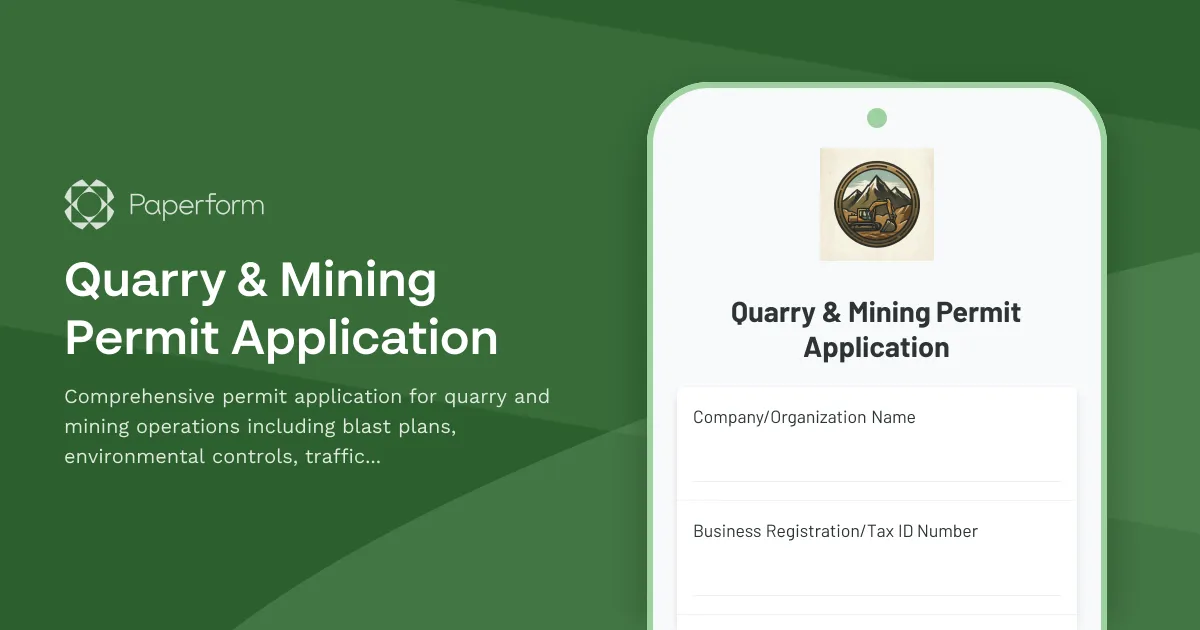
Streamline Your Mining Permit Application with Paperform
Applying for a quarry or mining permit involves extensive documentation, environmental assessments, safety protocols, and regulatory compliance. Our Quarry & Mining Permit Application template simplifies this complex process, giving mining operators, contractors, and environmental consultants a professional, all-in-one solution for submitting comprehensive permit applications to regulatory authorities.
Why Use This Template?
Mining and quarrying operations require careful coordination between geological surveys, environmental impact assessments, safety planning, and community engagement. Traditional permit applications often involve dozens of PDF forms, email attachments, and manual data entry across multiple agencies. This template consolidates everything into one streamlined digital form that captures all required information, supporting documents, and compliance certifications in a single submission.
Key features of this template include:
- Operator and site information collection with automatic address validation
- Detailed blast plan specifications including explosive types, timing, and safety zones
- Environmental control measures for dust suppression, water management, and noise mitigation
- Traffic management plans with haul route mapping and timing schedules
- Reclamation bond calculations based on site acreage and operation type
- Archaeological and cultural heritage survey uploads with declaration checkboxes
- File upload fields for geological reports, environmental assessments, and engineering plans
- Conditional logic that adapts questions based on operation type and scale
Perfect for Mining Industry Professionals
This template is designed for quarry operators, mining companies, environmental consultants, and engineering firms who need to navigate the permit application process efficiently. Whether you're applying for aggregate extraction, hard rock mining, or mineral quarrying permits, this form guides applicants through every regulatory requirement while maintaining a professional, organized workflow.
Industries and roles that benefit:
- Mining companies and quarry operators applying for new or renewed permits
- Environmental consulting firms preparing permit packages for clients
- Civil engineering companies managing site development projects
- Geological survey firms coordinating multi-stakeholder applications
- Local and regional regulatory authorities accepting digital permit submissions
Seamless Integration with Your Compliance Workflow
Paperform's powerful automation capabilities mean this permit application can do much more than just collect information. Connect it to your existing tools to create an end-to-end compliance management system:
- Send submissions to your CRM or project management tool (like HubSpot, Airtable, or Monday.com) so your team can track application status and follow-up tasks
- Trigger approval workflows with Stepper to route applications through internal review, environmental assessment, and legal sign-off before submission to authorities
- Generate automated email confirmations with application reference numbers and estimated review timelines
- Use conditional notifications to alert different team members based on permit type, site location, or environmental risk factors
- Store uploaded documents securely with automatic backup to Google Drive, Dropbox, or your document management system
If your jurisdiction requires formal agreements or signatures on reclamation bonds, blast plans, or archaeological survey certifications, you can seamlessly transition to Papersign to collect legally binding eSignatures. This keeps the entire permit application and approval process digital, auditable, and connected to your original submission.
Designed for Compliance and Clarity
Mining permit applications demand precision, transparency, and thorough documentation. This template uses clear section headings, helper text, and conditional questions to guide applicants through complex requirements without overwhelming them. Each section addresses a specific regulatory requirement—from blast safety protocols to environmental monitoring plans—ensuring nothing gets overlooked.
The form includes calculation fields that automatically compute reclamation bond amounts based on site acreage, operation type, and disturbance factors, reducing errors and speeding up financial compliance. File upload fields support multiple document types including PDFs, engineering drawings (CAD files), geological maps, and photographic evidence, with clear labeling for easy review by regulatory staff.
Built for Speed, Security, and Scale
Processing permit applications involves sensitive site data, proprietary geological information, and financial details. Paperform is SOC 2 Type II compliant and offers data residency controls, ensuring your application data meets government security standards and industry best practices.
For environmental consulting firms or engineering companies managing multiple clients, Paperform's Agency+ plan lets you create separate workspaces for each client while maintaining consistent branding and compliance standards. With roles and permissions, you can control who has access to sensitive permit data, and with Stepper, you can automate the internal review and approval steps before applications are submitted to authorities.
Get Permits Approved Faster
Incomplete or poorly organized permit applications lead to delays, requests for additional information, and missed deadlines. This template ensures every regulatory requirement is addressed upfront, with clear documentation and professional presentation that demonstrates your commitment to safety, environmental stewardship, and community responsibility.
Whether you're a small aggregate producer or a large-scale mining operation, this template adapts to your needs while maintaining the rigorous standards expected by regulatory authorities. Start your next permit application with confidence, knowing you've covered every detail from blast safety to archaeological protection.
Ready to modernize your permit application process? Use this template to submit professional, complete applications that get approved faster and keep your operations on schedule.


More templates like this
Landfill Expansion Permit Application
Comprehensive permit application for landfill expansion projects including liner specifications, groundwater monitoring plans, methane collection systems, odor control measures, and capacity projections.
Coastal Development Permit Application
Apply for a coastal development permit for beachfront construction. Includes sea level rise assessment, beach access preservation, visual impact analysis, and erosion control planning.
Licensed Industrial Stormwater Inspector Application
Professional certification application for industrial stormwater inspectors seeking QCI/QSD credentials, with construction site inspection training and SWPPP compliance verification.
Licensed Stormwater Management Professional Application
Apply for professional stormwater management certification with erosion control training verification, BMP design experience documentation, and CPESC exam scheduling.
Underground Storage Tank Permit Application
Apply for permits to install, modify, or operate underground storage tanks (USTs) for fuel or chemicals with comprehensive leak detection, spill containment, and environmental protection systems.
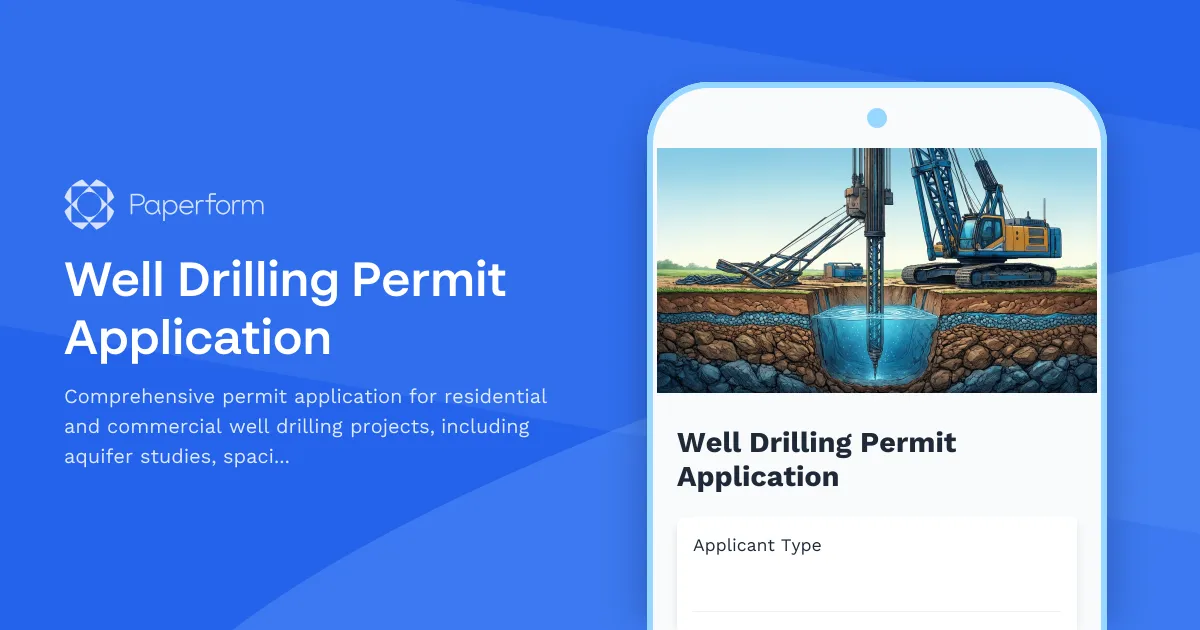
Well Drilling Permit Application
Comprehensive permit application for residential and commercial well drilling projects, including aquifer studies, spacing requirements, water quality testing plans, and geological surveys.
Wetland Alteration Permit Application
Apply for a wetland alteration permit with comprehensive environmental impact documentation, mitigation plans, and species protection measures.
Demolition Permit Application
Apply for a demolition permit with asbestos inspection reports, utility disconnection confirmation, debris disposal plans, and comprehensive site safety measures.
Dock & Pier Construction Permit Application
Apply for a waterfront construction permit for dock, pier, or marine structure with environmental impact assessment and navigational clearance documentation.
Explosives Storage Permit Application
Apply for a permit to store explosives with detailed magazine specifications, quantity limits, security measures, fire prevention plans, and blast zone calculations.
Grading and Excavation Permit Application
Apply for a grading and excavation permit with erosion control plan, drainage impact assessment, neighboring property protection, and soil stability documentation.
Licensed Septic System Designer Application
Apply for your licensed septic system designer certification. Submit your onsite wastewater training credentials, soil evaluation experience, and register for the designer certification exam.