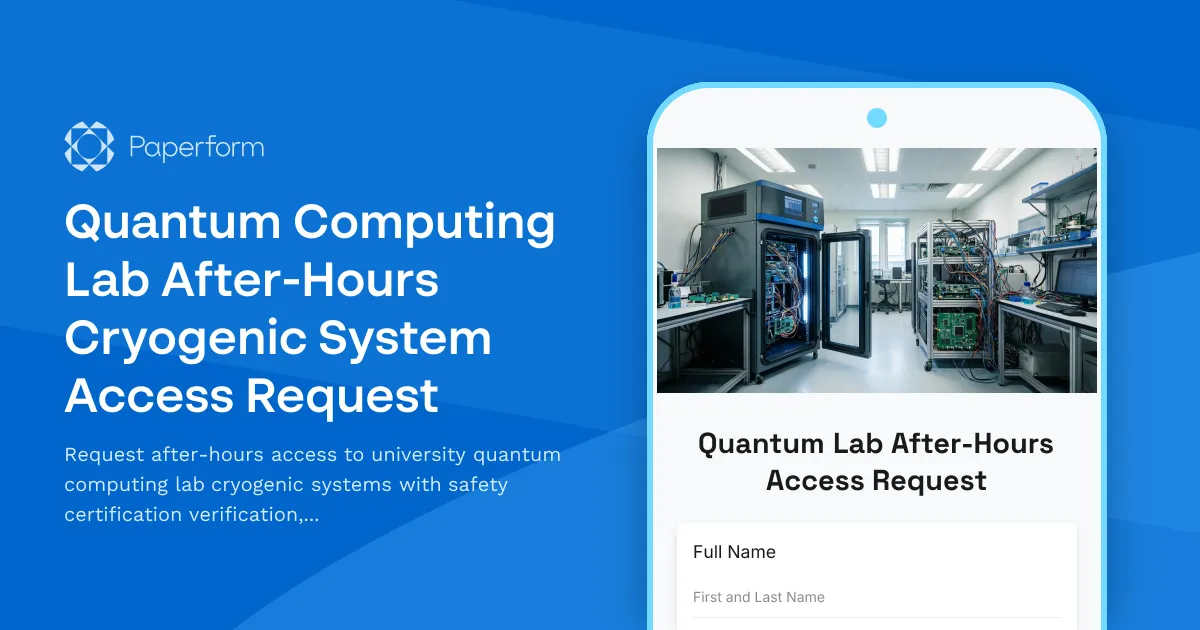
Secure After-Hours Access to Quantum Computing Lab Cryogenic Systems
Managing access to specialized research facilities—especially those involving cryogenic systems, helium safety protocols, and expensive quantum computing equipment—requires careful coordination, safety verification, and approval workflows. Our Quantum Computing Lab After-Hours Cryogenic System Access Request template is purpose-built for university research labs, physics departments, and advanced computing facilities that need to balance 24/7 research schedules with rigorous safety standards.
Why universities and research institutions choose this template
Quantum computing labs operate on research timelines that don't always fit within standard business hours. PhD students, postdocs, and research faculty often need access to dilution refrigerators, helium recovery systems, and quantum processors during evenings, weekends, and holidays when experiments can run uninterrupted. However, working with cryogenic systems—particularly those involving liquid helium at temperatures near absolute zero—demands verified safety training, equipment-specific certifications, and supervisory oversight.
This template transforms a complex, multi-stakeholder approval process into a streamlined digital workflow. Researchers submit a single form detailing their access requirements, safety certifications, and experimental needs. Research group leaders receive automatic notifications for approval, facilities managers can track equipment reservations, and safety officers maintain a clear audit trail of who has been trained and authorized to work with cryogenic systems after hours.
Built for the unique workflows of advanced research facilities
Unlike general building access forms, this template understands the specific requirements of quantum computing and cryogenic research environments:
- Helium safety training verification with certification upload and expiry date tracking
- Equipment-specific reservation system for dilution refrigerators, quantum processors, and helium recovery systems
- Research group leader approval workflow that routes requests to the appropriate PI or lab supervisor
- Emergency contact collection for solo late-night lab work
- Conditional logic that adapts questions based on equipment type and access frequency
- Cryogenic incident acknowledgment confirming understanding of emergency protocols
The form uses Paperform's calculation and conditional logic to ensure only researchers with current safety certifications can request access to cryogenic systems, automatically flags expired training credentials, and ensures proper supervisory approval before facility access is granted.
Perfect for physics departments, research universities, and national labs
This template is ideal for:
- University quantum computing labs managing dilution refrigerators and qubit research
- Physics departments with cryogenics facilities and low-temperature research programs
- Materials science labs conducting superconductivity and quantum materials research
- National research laboratories with shared user facilities and strict safety protocols
- Engineering departments with advanced fabrication and characterization equipment
- Research computing centers managing access to specialized quantum hardware
Whether you're running a small university research group or managing a multi-PI quantum science center, this template provides the structure needed to maintain safety standards while supporting the flexible schedules that cutting-edge research demands.
Seamless approvals and facility management with Stepper
After a researcher submits their access request, Stepper (stepper.io) can automate the entire approval and provisioning workflow:
- Route approval requests to the correct research group leader based on the researcher's department or lab affiliation
- Send automatic reminders if approvals are pending beyond a set timeframe
- Notify facilities management and building security once access is approved
- Update access control systems and electronic door locks with temporary after-hours permissions
- Log approved access windows in shared lab calendars and equipment reservation systems
- Trigger safety officer review if helium training certifications are approaching expiry
- Send pre-access reminder emails with emergency contact numbers and safety protocols
This automation means your lab manager isn't manually forwarding emails, your building security team has real-time visibility into approved after-hours researchers, and your safety compliance documentation stays current without spreadsheet maintenance.
Design that reflects the professionalism of your research institution
The template uses a clean, academic design with university-appropriate fonts and a professional color scheme that conveys the seriousness of cryogenic safety protocols. You can easily customize the theme to match your institution's brand guidelines, add your department logo, and incorporate your lab's specific safety imagery or instructional diagrams.
Questions are organized into logical sections—Researcher Information, Safety Certifications, Equipment & Access Requirements, Research Purpose, and Emergency Contacts—making it easy for researchers to provide complete information in one submission while reducing back-and-forth clarification emails.
Why Paperform for research facility access management
Research administrators, lab managers, and facilities coordinators choose Paperform because it combines the flexibility needed for complex approval workflows with the security and compliance standards that research institutions require:
- Conditional logic ensures only qualified researchers with current certifications can request cryogenic system access
- File uploads for safety training certificates, insurance documentation, and research protocols
- SOC 2 Type II compliance and robust security controls protect sensitive research information
- Integration with university systems via webhooks, API, or Stepper workflows
- Detailed submission tracking for audit trails and safety compliance reporting
- Custom success pages with access instructions, emergency procedures, and equipment manuals
- No-code control for lab managers who need to update forms without IT department involvement
Get researchers safely into the lab, 24/7
If you're currently managing after-hours lab access through email chains, paper forms in the department office, or informal text message approvals, you're creating gaps in your safety documentation and slowing down important research. This template centralizes the entire request, verification, and approval process in one professional, automated workflow that protects both your researchers and your institution.
Trusted by university research facilities worldwide, this Paperform template helps you maintain rigorous safety standards while supporting the flexible, round-the-clock schedules that breakthrough quantum research demands. Start using it today to bring structure, safety, and automation to your lab's after-hours access management.
More templates like this
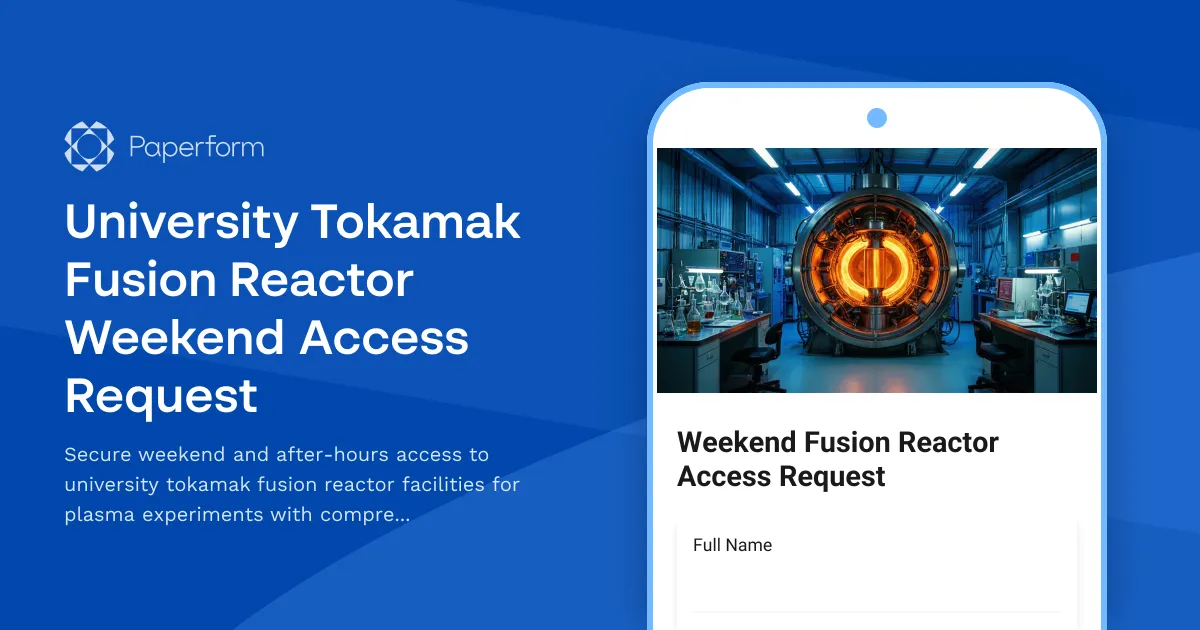
University Tokamak Fusion Reactor Weekend Access Request
Secure weekend and after-hours access to university tokamak fusion reactor facilities for plasma experiments with comprehensive safety certification verification and research director approval.
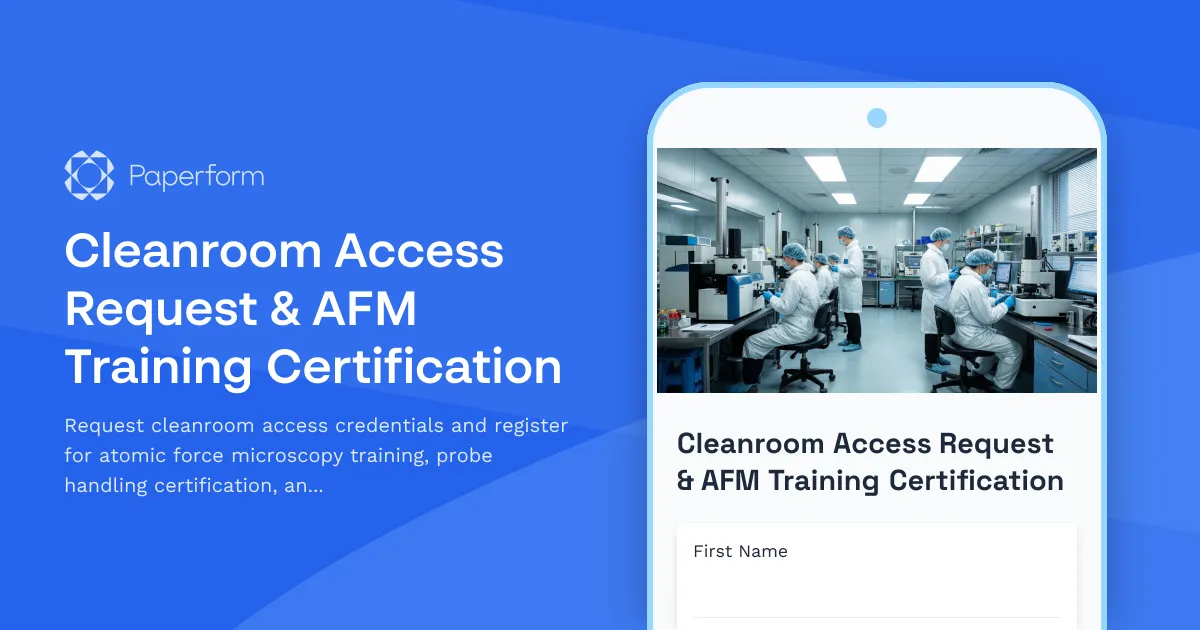
Cleanroom Access Request & AFM Training Certification
Request cleanroom access credentials and register for atomic force microscopy training, probe handling certification, and materials science director authorization for nanoscale research facilities.
Particle Accelerator Beam Time Application Form
Apply for beam time at particle accelerator facilities with experiment proposals, safety verification, detector configuration, and data sharing agreements for physics research projects.
Particle Accelerator Beamline Access Request
Request access to particle accelerator beamlines with radiation safety training verification, interlock system certification, and facility physicist approval for research laboratories and scientific facilities.

Superconducting Magnet Laboratory Access Request Form
Request access to superconducting magnet laboratory facilities with cryogenic safety training verification and quench procedure certification requirements.
University Observatory Night Access Request Form
A comprehensive scheduling form for university students and researchers requesting after-hours access to the astronomical observatory, including equipment reservations, weather contingencies, and supervisor approval.
University Research Lab Weekend Access Application
A comprehensive form for university students and researchers requesting after-hours and weekend access to research laboratories, including safety training verification, project details, and emergency contacts.
University Wind Tunnel After-Hours Testing Reservation
Reserve after-hours access to the university wind tunnel facility for research testing with safety review, equipment configuration, and advisor authorization.
Architecture Fabrication Technology Demonstration Catering Request
Request catering for architecture technology demonstrations, fabrication showcases, and innovation receptions with robotic assembly timing coordination and visiting critic accommodations.
Corporate Innovation Lab Weekend Access Request
Request weekend and after-hours access to the corporate innovation lab for prototype testing, with IP agreement, equipment insurance, and R&D director approval.
Cosmic Ray Detector Facility After-Hours Access Request
Request after-hours access to the cosmic ray detector facility for data acquisition with electronics safety protocol, computer system access, and department approval requirements.
Molecular Biology Core Facility Weekend Equipment Reservation
Reserve core facility equipment for weekend or after-hours use with training certification verification, sample processing timelines, and contamination prevention protocols.