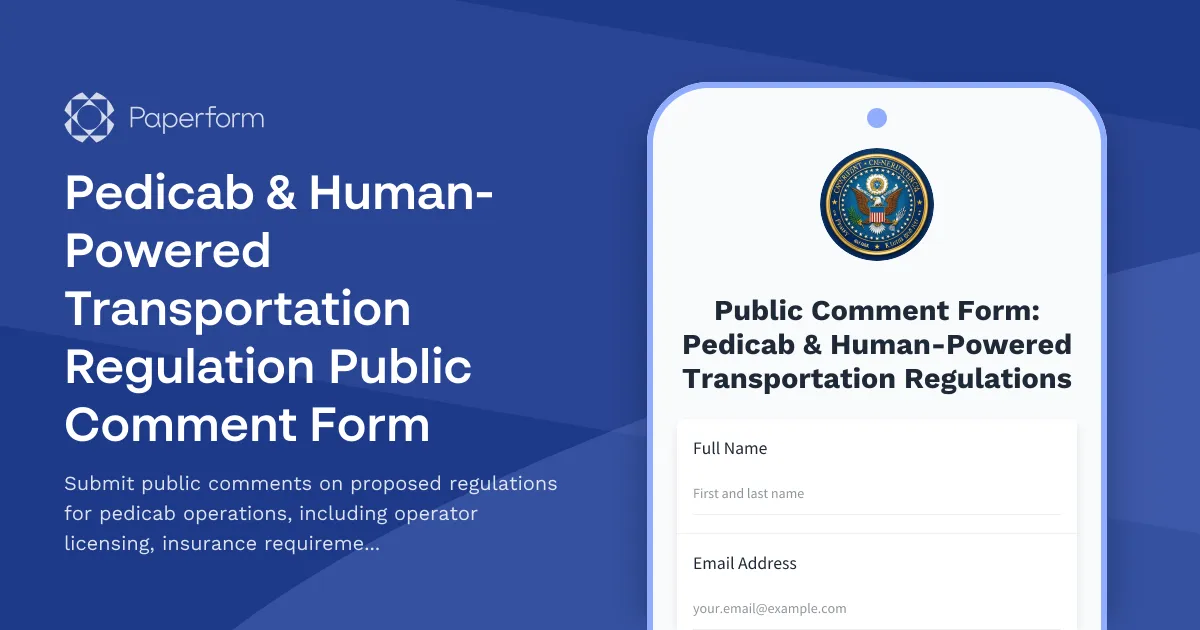
Public Comment Form for Pedicab & Human-Powered Transportation Regulations
The proposed regulations for pedicab and human-powered transportation services represent an important step toward ensuring public safety, fair business practices, and sustainable urban mobility. Your input matters, and this Pedicab & Human-Powered Transportation Regulation Public Comment Form makes it simple to share your perspective with municipal decision-makers.
Whether you're a current pedicab operator, a business owner in the tourism or hospitality sector, a transportation advocate, or a concerned resident, this form provides a structured way to comment on key aspects of the proposed regulations—including operator licensing requirements, mandatory insurance coverage, designated operating zones, and safety standards.
Why Public Comment Matters for Transportation Policy
Pedicabs and other human-powered vehicles play a unique role in urban environments, offering eco-friendly, low-speed alternatives to traditional transportation. However, without clear regulations, issues around safety, liability, traffic flow, and fair competition can arise. Public hearings and comment periods allow municipalities to gather diverse perspectives before finalizing rules that will affect operators, passengers, pedestrians, and the broader community.
This form streamlines the public comment process by organizing feedback into clear sections—whether you're addressing licensing qualifications, insurance minimums, route restrictions, or enforcement mechanisms. It ensures your voice is heard and your concerns are documented in the official public record.
Built for Government Agencies and Civic Engagement
Government agencies, city councils, transportation departments, and civic organizations can use this Paperform template to collect, organize, and analyze public feedback during the regulatory development process. Instead of sifting through unstructured emails or handwritten submissions, decision-makers receive consistent, categorized input that's easy to review, compare, and incorporate into policy drafts.
Paperform's conditional logic allows you to tailor follow-up questions based on the commenter's role—operators might be asked about business impacts, while residents might be asked about neighborhood concerns. The form can also collect demographic data (optional) to ensure diverse voices are represented in the process.
Key Features for Effective Public Comment Collection
- Structured feedback sections: Commenters can address specific regulation topics like licensing, insurance, operating zones, hours of operation, vehicle safety standards, and enforcement.
- Role-based customization: Conditional fields adapt based on whether the respondent is an operator, passenger, business owner, resident, or advocacy group.
- File uploads: Attach supporting documents, photos, accident reports, or written statements to strengthen your comment.
- Transparency and accessibility: Embed the form on your municipal website or share a direct link via social media, newsletters, and public notices to maximize participation.
- Automated confirmations: Respondents receive instant confirmation that their comment has been submitted and will be reviewed by the appropriate department.
Streamline Workflows with Stepper Automation
After comments are submitted, Stepper (stepper.io)—Paperform's AI-native workflow builder—can automatically route feedback to the right departments, flag high-priority concerns, generate summary reports for public hearings, and update case management systems. This ensures no comment gets lost in the shuffle and that the review process stays on track as regulations move toward adoption.
Who Benefits from This Template?
This form is designed for:
- Municipal governments and city councils conducting public hearings on pedicab and human-powered transportation regulations.
- Transportation departments seeking structured feedback on licensing, insurance, and zoning policies.
- Planning and zoning commissions evaluating operating zones, route restrictions, and neighborhood impacts.
- Advocacy groups and chambers of commerce facilitating organized public input from their members.
- Pedicab operators and industry associations submitting formal comments on proposed rules.
- Community organizations ensuring residents have a voice in transportation policy decisions.
Accessible, Secure, and SOC 2 Compliant
Paperform is SOC 2 Type II compliant and GDPR-ready, ensuring that public comments are collected securely and in compliance with data protection regulations. The platform supports accessibility standards, making it easy for all community members to participate regardless of technical ability. Forms can be embedded directly into .gov websites or shared via unique URLs, with mobile-friendly design for on-the-go submissions.
Transparent, Inclusive Regulatory Development
Public comment periods are most effective when they're easy to access, simple to navigate, and inclusive of all stakeholders. This Pedicab & Human-Powered Transportation Regulation Public Comment Form ensures your municipality can gather meaningful, actionable feedback that leads to balanced, well-informed policy decisions.
By using Paperform to collect and organize public input, government agencies demonstrate their commitment to transparency, community engagement, and data-driven decision-making—building trust and ensuring regulations reflect the needs of everyone who shares the road.


More templates like this
Alcohol Sales Density Restriction Ordinance Public Comment Form
Submit your public comment on the proposed alcohol sales density restriction ordinance, including opinions on proximity limits, license transfer restrictions, and crime impact analysis.
Backyard Chicken Ordinance Public Hearing Comment Form
Submit your comments on the proposed backyard chicken ordinance, including regulations on flock size, coop setbacks, and rooster restrictions for public hearing consideration.
Community Land Dedication Ordinance Public Hearing Form
Submit your feedback on the proposed land dedication ordinance, including parkland requirements, fee-in-lieu options, and neighborhood facility priorities for community development.
Cottage Food Operation Ordinance Public Input Form
Submit your feedback on the proposed cottage food operation ordinance, including regulations for home-based food businesses, safety standards, and sales venue restrictions.
Gig Worker Collective Bargaining Ordinance - Public Comment Form
Submit your public comment on the proposed ordinance establishing collective bargaining rights for gig economy workers, including worker classification standards, bargaining unit formation procedures, and platform accountability measures.
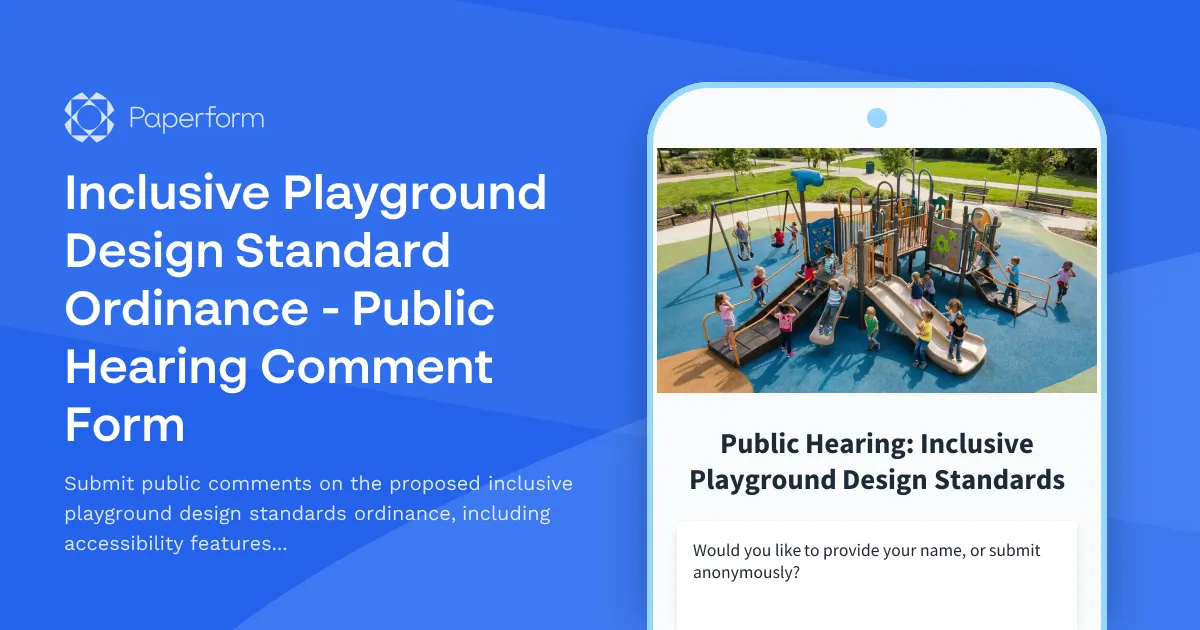
Inclusive Playground Design Standard Ordinance - Public Hearing Comment Form
Submit public comments on the proposed inclusive playground design standards ordinance, including accessibility features, sensory elements, and multigenerational equipment requirements.
Local Emergency Services Consolidation Public Hearing Form
Submit your feedback on the proposed emergency services consolidation plan. Share concerns about service areas, response times, and cost impacts for public hearing consideration.
Metropolitan Planning Organization Records Request Form
Request public records from your MPO including transportation improvement programs, air quality conformity analyses, and public participation reports under open records laws.
Noise Ordinance Revision Public Comment Form
Submit your feedback on proposed changes to local noise regulations. Share your concerns about decibel levels, affected areas, and enforcement mechanisms to help shape community standards.
Public Art Percent-for-Art Program Comment Form
Submit public comments on proposed percent-for-art program regulations, including funding allocation, artist selection processes, and maintenance responsibilities for public art installations.
Public Market & Farmers Market Ordinance Public Hearing Form
Submit your feedback on proposed farmers market and public market ordinance regulations, including vendor qualifications, product sourcing requirements, and location criteria.
Street Vendor & Sidewalk Merchant Permit Comment Form
A public comment form for residents and businesses to provide feedback on proposed street vendor and sidewalk merchant permits, including location restrictions, product categories, and public space allocation.