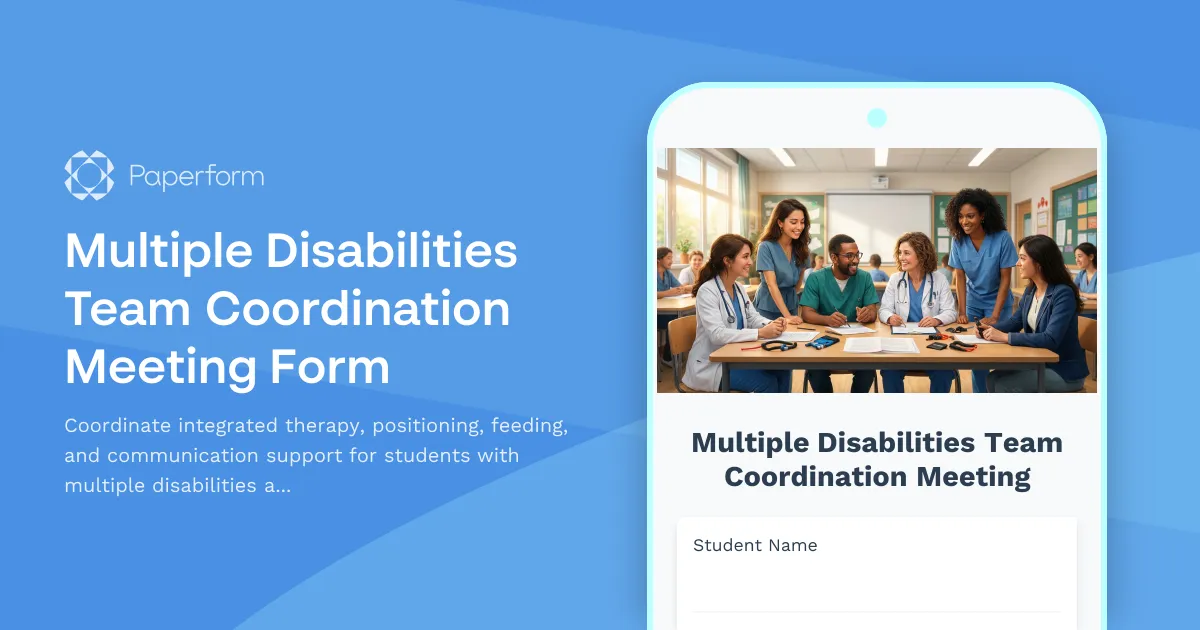
Supporting students with multiple disabilities requires seamless coordination between physical therapists, occupational therapists, speech-language pathologists, nurses, and classroom teachers. This Multiple Disabilities Team Coordination Meeting Form streamlines the planning process, ensuring that integrated therapy, positioning, feeding protocols, and communication strategies are scheduled and documented effectively throughout the school day.
Why use Paperform for special education coordination?
Managing complex care plans across multiple specialists can involve endless email chains, scattered documentation, and missed handoffs. Paperform brings everything into one professional, easy-to-use form that collects availability, schedules therapy blocks, documents positioning and feeding protocols, and keeps communication strategies front and center.
Key benefits for special education teams:
- Integrated scheduling: Capture availability from PT, OT, SLP, nursing, and teaching staff in one place, then coordinate therapy times that work for the whole team
- Comprehensive care planning: Document positioning protocols, feeding schedules, communication systems, and adaptive equipment needs alongside therapy goals
- Conditional logic: Show relevant questions based on team member roles and student needs, keeping the form streamlined for each respondent
- Professional documentation: Generate clean, organized records for IEP meetings, care plan reviews, and parent communication
- Secure data handling: SOC 2 Type II compliance ensures sensitive student health and education information stays protected
Streamline workflows with Stepper
After your coordination meeting form is submitted, use Stepper (stepper.io) to automate next steps. Send meeting summaries to all team members via email, update shared calendars with therapy schedules, create tasks in your special education management system, and notify parents of any care plan changes—all without manual follow-up.
Built for educators and therapists who collaborate
This template is designed for special education coordinators, related service providers, school nurses, and multidisciplinary teams working in inclusive classrooms, self-contained programs, and specialized schools. Whether you're planning for one student or coordinating across multiple caseloads, Paperform gives you the structure and flexibility to document everything that matters while keeping the process simple for busy professionals.
Trusted by over 500,000 teams worldwide and SOC 2 Type II compliant, Paperform is the professional solution for education teams that need forms and workflows without the complexity.



More templates like this
Assistive Technology Evaluation Request Form
Request an assistive technology evaluation for students with learning barriers. Assess current technology use, identify needs, and connect with AT specialists for personalized support.
Auditory Processing Disorder Support Plan
A comprehensive support plan form for students with auditory processing disorder, documenting classroom accommodations, sensory needs, and therapy collaboration for optimal learning.
Augmentative and Alternative Communication (AAC) Device Trial Request Form
Request a trial of AAC devices for students or individuals with communication needs. Assess current communication methods, device preferences, training requirements, and funding options to support communication goals.
Autism Social Narrative Creation Form
Create personalized social stories and visual narratives for students with autism to support social understanding, expected behaviors, and skill generalization across different environments.
Autism Spectrum Support Services Intake Form
A comprehensive intake form for autism spectrum support services that captures sensory profiles, communication preferences, social skills assessments, and behavior patterns to create personalized support plans.
Complex Communication Needs Assessment Form
A comprehensive assessment form for evaluating augmentative and alternative communication (AAC) needs, documenting current communication methods, partner interactions, and device trial recommendations.
Emotional Disturbance Eligibility Evaluation Form
Comprehensive assessment form for evaluating students for emotional disturbance eligibility under special education programs, documenting behavioral incidents, mental health diagnoses, educational impact, and therapeutic recommendations.
Individual Counseling Services Request for Students with Emotional Disturbance
A comprehensive form for requesting and documenting intensive individual counseling services for students with emotional disturbance, including treatment planning, evidence-based interventions, crisis prevention strategies, and outcome measurement.
Learning Disability Assessment Form
A comprehensive pre-assessment form for identifying learning difficulties, academic challenges, processing speed concerns, and accommodation needs for students and individuals seeking evaluation.
Music Therapy Services Request Form
A comprehensive request form for schools and families seeking music therapy services for students with autism or emotional disabilities, including sensory integration support and self-expression goals.
Nonverbal Communication Assessment Form
A comprehensive assessment tool for evaluating nonverbal communication methods in students with complex needs, including gestures, vocalizations, eye gaze, and AAC systems.
Occupational Therapy Evaluation Request Form
Request an occupational therapy evaluation for school-aged children with sensory processing concerns, fine motor skills challenges, or adaptive equipment needs.