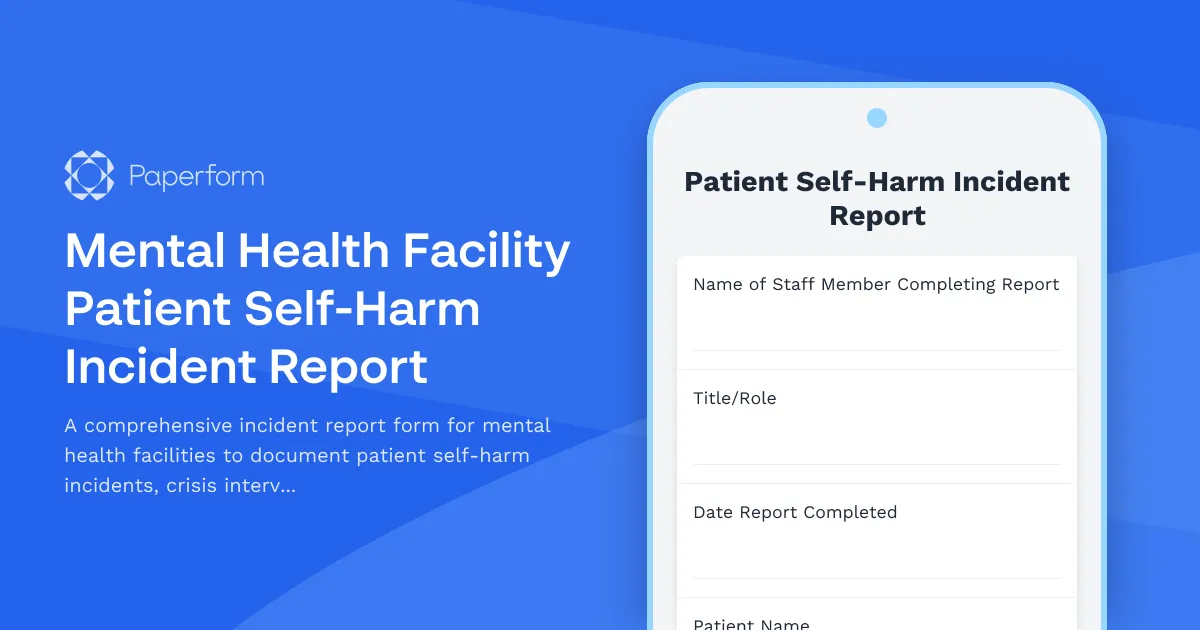
Professional Self-Harm Incident Documentation for Mental Health Facilities
When a self-harm incident occurs in a mental health facility, clear and thorough documentation is critical—not just for regulatory compliance, but for ensuring patient safety, continuity of care, and the effectiveness of your crisis intervention protocols. This Mental Health Facility Patient Self-Harm Incident Report template provides a structured, compassionate framework for capturing the essential details of self-harm events, psychiatric evaluations, immediate interventions, and safety protocol reviews.
Built for behavioral health teams who need clarity in crisis moments
Mental health professionals—psychiatrists, psychiatric nurses, social workers, case managers, and direct care staff—face the dual challenge of responding to patient crises with empathy while maintaining rigorous documentation standards. This template is designed to support both goals. It walks your team through the incident narrative, patient mental status, immediate interventions taken, and post-incident safety planning, all in a format that can be completed quickly on any device.
Whether you're managing an inpatient psychiatric unit, a residential treatment center, a crisis stabilization facility, or an intensive outpatient program, this form ensures you have a complete record that supports quality improvement, risk management, and regulatory review.
Comprehensive documentation meets real-world workflows
The form captures:
- Patient and incident identification details, including date, time, location, and staff present
- Detailed incident narrative, describing what occurred, the method of self-harm, and any precipitating factors observed
- Patient mental status and psychiatric evaluation at the time of and following the incident
- Immediate crisis interventions taken by clinical staff, including de-escalation techniques, medical attention, and environmental safety measures
- Safety protocol review, documenting adherence to facility policies and identifying any protocol gaps
- Post-incident care planning, including changes to the treatment plan, safety precautions, and follow-up actions
Each section uses conditional logic to surface relevant follow-up questions, ensuring your staff document the right details without unnecessary complexity.
Secure, compliant, and ready for integration
Built on Paperform, this template is SOC 2 Type II compliant and GDPR-ready, with data residency controls and role-based permissions to protect sensitive patient information. Please note: while Paperform provides enterprise-grade security, this form is not HIPAA-compliant on its own—mental health facilities handling protected health information (PHI) should consult with their compliance team before deploying this template.
You can integrate incident reports with your electronic health record (EHR) system, case management platforms, or internal reporting dashboards using Stepper workflows. Automatically route high-severity incidents to clinical leadership, trigger follow-up tasks for treatment plan reviews, or compile incident data for your quality assurance and performance improvement (QAPI) committees—all without manual data entry.
Why mental health facilities trust Paperform
Mental health teams need documentation tools that are intuitive, secure, and flexible enough to fit complex clinical workflows. This template gives you a professional, consistent incident reporting process that supports your team's clinical judgment while meeting the documentation standards required by The Joint Commission, state behavioral health authorities, and your facility's own policies.
With Paperform, your staff can complete incident reports on the unit or from home, clinical supervisors can review submissions in real time, and your quality team can analyze trends across incidents to strengthen your safety protocols and improve patient outcomes.
Start with this template, customize it to your facility's policies and forms, and give your team a documentation tool that supports both excellent clinical care and operational excellence.



More templates like this
First Episode Psychosis Program Protocol Deviation Whistleblower Form
Confidential reporting form for protocol deviations in first episode psychosis programs aligned with NIMH RAISE standards and early intervention quality assurance requirements.
Intimate Partner Violence Screening & Safety Assessment
A confidential, trauma-informed screening tool for healthcare providers to assess intimate partner violence risk, conduct safety planning, and connect patients with appropriate resources and support services.
Mental Health Facility Patient Incident Report
A comprehensive incident report form for mental health facilities to document patient incidents, behavioral assessments, staff interventions, and safety protocols with psychiatric notification workflows.
Mental Health Parity Violation Whistleblower Form
Confidential reporting form for mental health parity violations with automated routing to state insurance departments and patient advocacy resources.
Mobile Behavioral Health Crisis Unit Restraint Injury Report
A comprehensive incident report for documenting restraint use, patient injuries, and de-escalation protocols during mobile behavioral health crisis interventions.
Psychiatric Hospital Patient Suicide Attempt Report
A confidential incident report form for documenting suicide attempts in psychiatric facilities, including safety protocol review, family notification procedures, and treatment plan modifications.
Addiction Treatment Center Patient Safety Incident Report
A comprehensive safety incident reporting form for addiction treatment facilities to document medication errors, elopement risks, patient safety concerns, and ensure proper state licensing notifications and regulatory compliance.
Addiction Treatment Facility Safety Incident Report
Document safety incidents in addiction treatment facilities while maintaining patient confidentiality, recording staff response, and tracking treatment plan impacts for clinical review.
Anonymous ACT Fidelity Concern Report
A confidential reporting form for submitting concerns about Assertive Community Treatment (ACT) program fidelity, evidence-based practice adherence, and client outcome monitoring.
Anonymous Peer Support Specialist Boundary Violation Report
A confidential form for reporting boundary violations by peer support specialists, ensuring client safety and adherence to behavioral health certification standards.
Anonymous Suicide Contagion Response Protocol & Postvention Reporting Form
A confidential form for reporting gaps in suicide contagion response protocols and postvention practices. Help improve community safety coordination and mental health crisis response procedures.
Behavioral Health Crisis Center Patient Elopement Report
A comprehensive elopement report form for behavioral health facilities to document missing patients, assess risk factors, and coordinate immediate response efforts with mobile crisis teams.