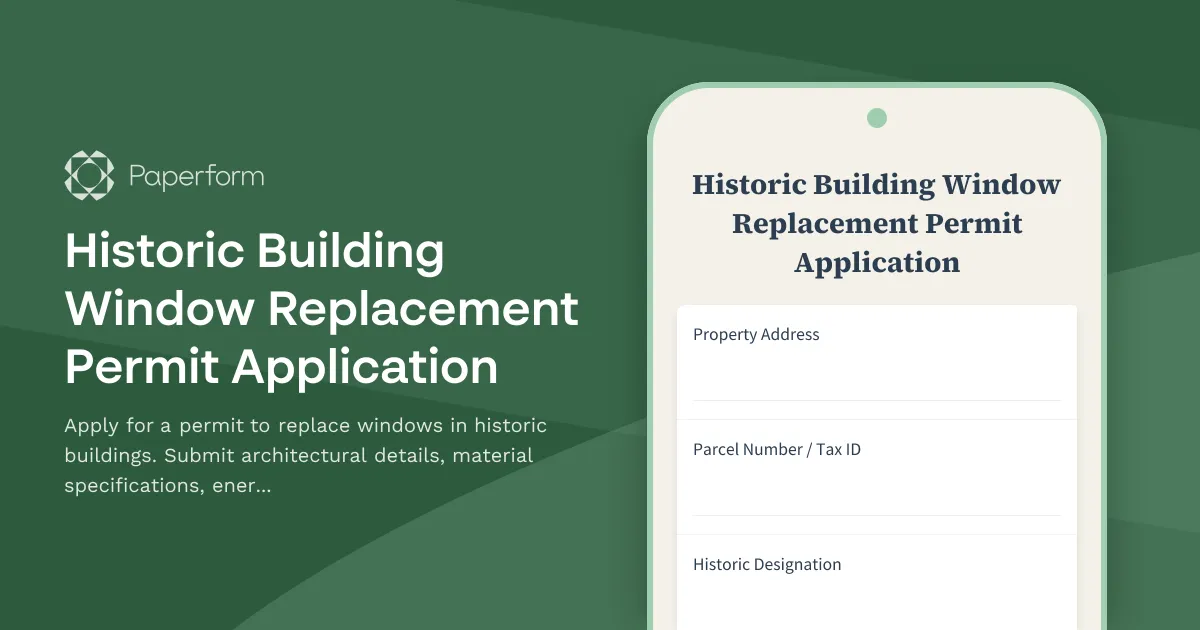
Historic Building Window Replacement Permit Application
Replacing windows in a historic building requires careful planning, documentation, and approval to ensure compliance with preservation standards. Whether you're a property owner, contractor, or architect working on a heritage property, this Historic Building Window Replacement Permit Application template from Paperform streamlines the entire submission process.
Why use Paperform for your permit applications?
Historic preservation applications involve complex requirements—from architectural drawings to material specifications and energy efficiency documentation. Paperform's flexible form builder lets you create professional, on-brand applications that guide applicants through every required field, use conditional logic to show relevant questions based on building type or scope of work, and collect all necessary documentation in one organized submission.
This template is designed specifically for municipal planning departments, historic preservation commissions, architectural review boards, and property owners working with heritage buildings. It captures everything from property details and architectural plans to material specifications and preservation compliance statements.
What's included in this template
This comprehensive permit application collects:
- Property and applicant information including building address, historic district details, and contact information for property owners, contractors, and architects
- Project scope and timeline with detailed descriptions of the window replacement work
- Architectural specifications including window type, materials, dimensions, and design details
- Historic preservation compliance with questions about matching original design, adherence to Secretary of Interior Standards, and preservation guidelines
- Material specifications for frames, glazing, hardware, and finishes
- Energy efficiency documentation including U-factor, SHGC ratings, and Energy Star compliance
- File uploads for architectural drawings, photographs of existing windows, material samples, and supporting documentation
- Contractor licensing and insurance verification
Perfect for historic preservation professionals
This template serves multiple stakeholders in the historic preservation process:
Municipal planning departments can customize the form to match local historic district requirements, add custom review criteria, and integrate submissions directly into permitting workflows using Stepper to route applications to the appropriate review boards and inspectors.
Architectural review boards receive all necessary information upfront, reducing back-and-forth communication and speeding up the review process. Conditional logic ensures applicants only see questions relevant to their specific project type.
Property owners and contractors benefit from a clear, guided application process that explains exactly what documentation is needed, reducing application rejections and delays.
Preservation consultants can use this as a client intake form to gather all necessary information before preparing formal applications.
Automate your permit workflow with Stepper
Once a permit application is submitted through Paperform, you can use Stepper (stepper.io) to automate the entire review process. Create workflows that automatically notify review board members, send acknowledgment emails to applicants, update permit tracking databases, schedule site inspections, and trigger approval or revision notifications. This keeps everyone informed and eliminates manual administrative work.
For example, when a complete application is submitted, Stepper can automatically create a case file in your permitting system, send the architectural drawings to the review committee, schedule a preliminary review meeting, and notify the applicant of the expected timeline—all without anyone touching a spreadsheet.
Secure, compliant, and professional
Paperform is SOC 2 Type II compliant, ensuring that sensitive property information, contractor details, and architectural plans are stored securely. You can control access with roles and permissions, maintain audit trails of all submissions, and ensure your permit process meets municipal standards for data protection.
With custom branding options, you can make the application form match your municipality's website or preservation commission's identity, creating a professional experience that reflects well on your organization.
Flexible pricing for organizations of all sizes
Whether you're a small historic district with occasional applications or a large municipal planning department processing hundreds of permits annually, Paperform's pricing scales with your needs. Start with the Essentials plan for basic permit applications, move to Pro for advanced conditional logic and increased submission volumes, or choose Enterprise for city-wide deployments with SSO and dedicated support.
Get started in minutes
This template includes all the fields and logic you need for a professional historic window replacement permit application. Simply customize the questions to match your local preservation guidelines, add your municipality's branding, and start accepting applications. No coding required—just a clear, efficient path from application to approval.
Trusted by municipal governments, preservation commissions, and heritage organizations worldwide, Paperform makes it easy to modernize your permit process while maintaining the rigor and thoroughness that historic preservation demands.



More templates like this
Coastal Development Permit Application
Apply for a coastal development permit for beachfront construction. Includes sea level rise assessment, beach access preservation, visual impact analysis, and erosion control planning.
Dock & Pier Construction Permit Application
Apply for a waterfront construction permit for dock, pier, or marine structure with environmental impact assessment and navigational clearance documentation.
Accessory Dwelling Unit (ADU) Permit Application
Apply for a permit to construct or convert an accessory dwelling unit (ADU) or backyard cottage on your property with size calculations, parking, utilities, and design review.
Helipad Construction Permit Application
Apply for a helipad construction permit with FAA compliance verification, noise impact assessment, lighting specifications, emergency access planning, and fuel storage safety requirements.
Indoor Gun Range Facility Permit Application
Apply for a permit to operate an indoor gun range facility with comprehensive safety systems including ventilation, lead containment, soundproofing, and ammunition storage.
Deck or Patio Construction Permit Application
Apply for a permit to construct or modify a residential or commercial deck or patio. Includes structural details, load calculations, railing specifications, and building code compliance verification.
Demolition Permit Application
Apply for a demolition permit with asbestos inspection reports, utility disconnection confirmation, debris disposal plans, and comprehensive site safety measures.
Plumbing Permit Application for Bathroom Addition
Professional plumbing permit application for bathroom additions including fixture schedules, water supply calculations, drainage plans, and backflow prevention requirements.
Residential Building Permit Application
Apply for a building permit for residential construction projects. Submit property details, contractor information, project plans, and ensure zoning compliance in one streamlined application.
Shipping Container Conversion Permit Application
Apply for a permit to convert a shipping container into a residential or commercial structure. Submit structural certification, insulation specifications, foundation plans, and demonstrate building code compliance.
Tiny House Placement Permit Application
Apply for a permit to place a tiny house on your property. Submit details about foundation, utilities, size, parking, and zoning requirements.
Chilean Construction Permit Application (DOM)
Complete construction permit application form for Chile's Dirección de Obras Municipales (DOM) including architectural plans, structural calculations, and zoning compliance documentation.