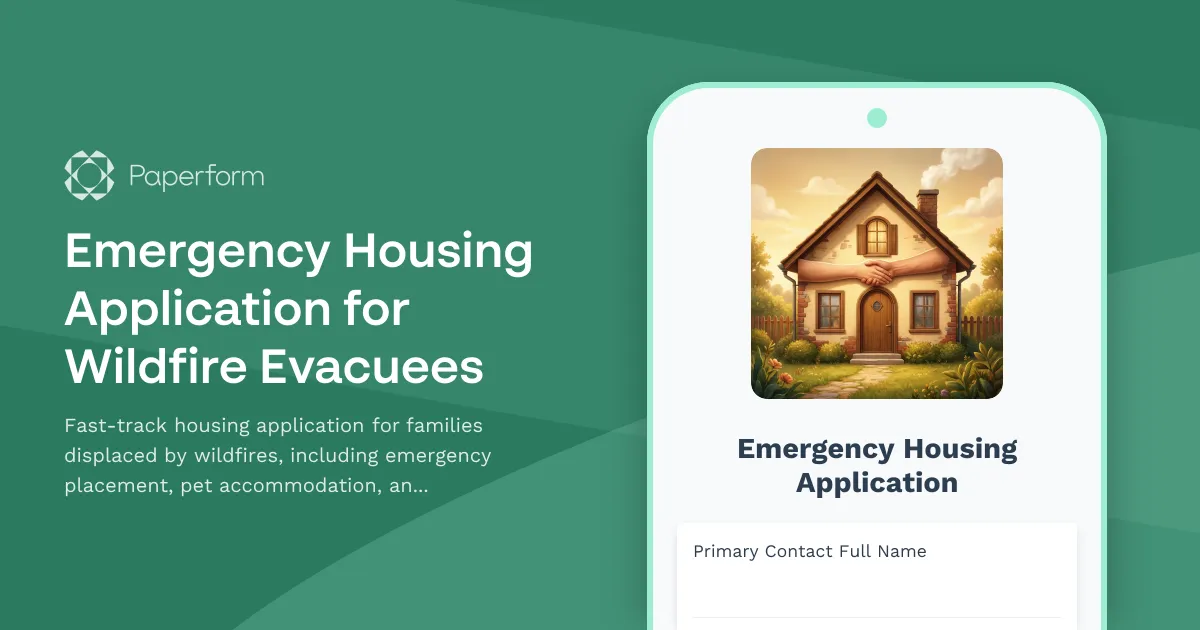
When wildfires force families from their homes, finding safe emergency housing quickly becomes the top priority. This Emergency Housing Application for Wildfire Evacuees is designed to help displaced families secure temporary accommodation as fast as possible, while addressing the real-world challenges that come with sudden evacuation—pets, school-age children, medical needs, and financial uncertainty.
Built for crisis response and compassionate support
This template goes beyond standard rental applications. It's structured to capture essential information for emergency housing placement while being sensitive to the trauma and urgency evacuees are experiencing. The form collects household composition, special needs (including pets and medical requirements), school enrollment details for children, and flexible financial arrangements—all in one streamlined submission.
Whether you're a local government agency, nonprofit organization, property manager, community housing coordinator, or emergency response team, this form helps you match evacuees with available housing quickly and compassionately, while gathering the documentation needed for assistance programs, insurance claims, and temporary school enrollment.
What makes this template essential for wildfire response
Household and evacuation details: The form captures current evacuation status, household size, and immediate needs, helping coordinators understand the urgency and scope of each family's situation.
Pet accommodation tracking: Many evacuees are turned away from shelters because of pets. This form specifically asks about animals—type, size, and any service animal status—so you can match families with pet-friendly housing options from the start.
School enrollment support: For families with school-age children, the form collects student information, grade levels, and previous school details to facilitate rapid temporary enrollment and ensure educational continuity during displacement.
Flexible financial assessment: Understanding that evacuees may have lost income, documentation, or access to funds, the form takes a compassionate approach to financial information, including questions about insurance coverage, FEMA assistance, and alternative verification methods.
Medical and accessibility needs: The form identifies any urgent medical conditions, mobility requirements, or accessibility needs to ensure safe, suitable placement for all household members.
Emergency contact and verification: Since evacuees may not have traditional references or documentation readily available, the form adapts to emergency circumstances while still gathering essential contact information.
Designed for speed and dignity
In crisis situations, every hour counts. This form uses conditional logic to show only relevant questions—if an evacuee doesn't have pets, they skip those sections entirely. If there are no school-age children, enrollment questions disappear. This keeps the form as short as possible while still gathering complete information for those who need specific support.
The tone throughout is supportive and clear, avoiding bureaucratic language that can add stress during an already overwhelming time. Questions are framed to gather necessary information without making evacuees feel they're being interrogated or judged during one of the most difficult moments of their lives.
Automation that accelerates placement
Once a family submits their application, speed is everything. With Stepper (stepper.io), you can automate the entire placement workflow:
- Instant routing: Applications are automatically sent to the right housing coordinators based on family size, location preferences, or special needs.
- Database updates: Submission details flow directly into Airtable, Google Sheets, or your case management system, creating an instant record without manual data entry.
- Multi-team coordination: Trigger notifications to housing teams, school enrollment coordinators, and pet placement specialists simultaneously, so everyone can start working the case at once.
- Status tracking: Update families automatically as housing becomes available, reducing anxiety and unnecessary phone calls to overwhelmed response teams.
- Document collection: Follow up automatically to request any additional documentation as it becomes available, rather than holding up initial placement.
This automation means families get faster responses, and your team can focus on securing housing and support services rather than managing spreadsheets and email threads.
Who benefits from this template
This emergency housing form is ideal for:
- Emergency management agencies coordinating disaster response and temporary housing placement
- Nonprofit housing organizations providing crisis accommodation and family services
- Local government social services managing community disaster response
- Property management companies offering emergency rentals to displaced families
- Community action groups mobilizing private housing resources during wildfires
- School districts coordinating with housing teams to support displaced students
- Faith-based organizations providing temporary shelter and family support
- Red Cross and disaster relief organizations managing evacuation centers and housing referrals
Compliance, compassion, and coordination
During emergencies, compliance doesn't disappear—but it needs to be balanced with urgency and humanity. This form helps you maintain proper records for FEMA reimbursement, insurance coordination, and assistance program eligibility while treating evacuees with the dignity and speed their situation demands.
Paperform is SOC 2 Type II compliant and GDPR-ready, so sensitive information about evacuees—including children's details, medical conditions, and financial hardship—is handled securely. You can set up role-based access so housing coordinators see placement details, school liaisons access education information, and financial assistance teams review aid eligibility, all without exposing unnecessary personal information.
Customize for your community's response
Every wildfire situation is different, and every community has unique resources. You can easily adapt this template to match your specific response structure:
- Add fields for specific local assistance programs or housing vouchers
- Include questions about cultural or language preferences to improve placement success
- Customize school enrollment sections to match your district's temporary enrollment policies
- Add conditional routing for different housing types (shelters, hotel vouchers, private rentals, host families)
- Include fields for specific animal restrictions if you're coordinating with particular properties
- Adjust financial questions based on available emergency funding or insurance coordination
The form's flexible structure means you can launch it immediately in a crisis, then refine questions as your response evolves and you learn more about what evacuees need most.
Forms that help families and communities rebuild
When wildfires displace families, the path from evacuation to stability is long and complicated. This emergency housing form is the critical first step—connecting families with safe shelter quickly while laying the groundwork for longer-term support including school enrollment, financial assistance, and eventually permanent housing.
By combining urgent placement with thoughtful support for pets, children, and special needs, this form helps ensure that no family falls through the cracks during one of the most vulnerable moments of their lives.
Ready to support your community? Start with this template and customize it to match your local resources, response structure, and available housing. With Paperform's flexible design and Stepper's automation, you can deploy an emergency housing system in hours, not days, ensuring displaced families get the help they need when they need it most.



More templates like this
Affordable Housing Lottery Application
Complete application form for affordable housing lottery programs with income verification, household composition details, and priority preference selection for housing authorities and community development organizations.
Farm Worker Housing Application
A comprehensive application form for farm workers seeking seasonal housing, including employment verification, family composition, and transportation requirements.
Low-Income Housing Tax Credit (LIHTC) Application
Apply for affordable housing through the Low-Income Housing Tax Credit program. This application verifies household income, size, and eligibility for priority placement based on qualifying preferences.
Section 8 Housing Application - Proof of Residence & Income Verification
Complete Section 8 housing application form with proof of residence verification, income documentation, employment records, landlord references, and background check consent.
Accessible Housing Modification Application
A comprehensive application for accessible housing modifications, including occupational therapist evaluations, contractor approvals, and funding coordination.
Brazilian Social Housing Program Application Form
Complete application form for Brazilian social housing programs (Minha Casa Minha Vida) with family income verification, CPF validation, and automatic eligibility scoring for housing benefits.
Disability-Accessible Housing Application
A comprehensive housing application for applicants requiring disability accommodations, including medical certification and modification approval requests for accessible living arrangements.
Income-Restricted Housing Application
A comprehensive application for income-qualified affordable housing with income verification, asset declaration, and household composition tracking for HUD and LIHTC programs.
Kinship Care Housing Application for Grandparents
A compassionate housing application designed specifically for grandparents raising their grandchildren, with dedicated support for kinship care services, respite care options, and legal guardianship assistance.
Section 8 Housing Voucher Application
Complete Section 8 Housing Choice Voucher Program application with income verification, household information, and accommodation requests for affordable housing assistance.
Accessible Housing Application for Adults with Autism Spectrum Disorder
A comprehensive, inclusive housing application designed specifically for adults with autism spectrum disorder, covering sensory needs, routine preferences, and communication support requirements.
Accessible Housing Application for Adults with Fibromyalgia
A specialized housing application designed for adults with fibromyalgia seeking low-stimulation living environments with access to pain management and rheumatology care.