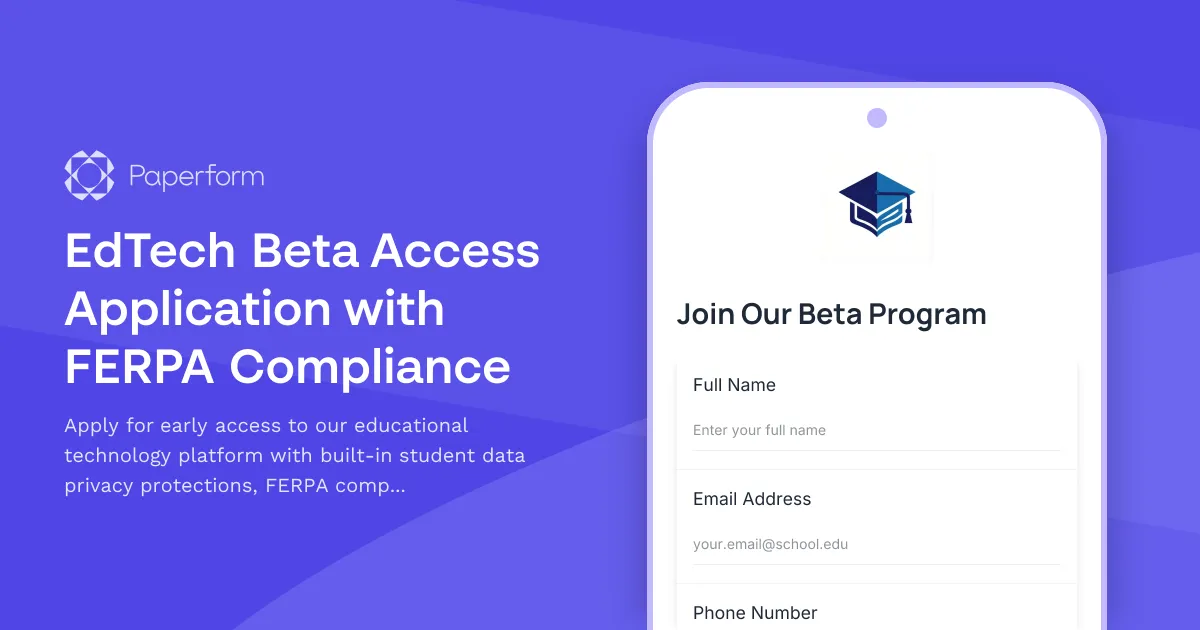
Secure EdTech Beta Access Application with Student Privacy at the Core
Launching a new educational technology platform requires more than just great features—it demands trust, especially when student data is involved. This EdTech Beta Access Application template is purpose-built for startups and SaaS companies entering the education space who need to demonstrate FERPA compliance, data privacy commitment, and proper consent workflows from day one.
Why Student Data Privacy Matters in EdTech Beta Programs
Schools, districts, and parents are increasingly vigilant about how student information is collected, stored, and used. Before granting access to any new platform, educational institutions need assurance that your beta program adheres to the Family Educational Rights and Privacy Act (FERPA) and implements appropriate safeguards. This template helps you collect the right information upfront while demonstrating your commitment to data protection standards.
What This Template Includes
This comprehensive beta application walks potential users through:
- Institutional information to understand your beta participant's context and needs
- User role identification to customize access and workflows appropriately
- Student data handling acknowledgments that outline your privacy commitments
- FERPA compliance confirmations for educational institutions
- Parental consent workflows for applications involving minor students
- Use case documentation to prioritize feature development based on real needs
- Technical requirements assessment to ensure compatibility
Perfect for EdTech Startups and SaaS Companies
Whether you're launching a learning management system, assessment platform, student information system, or educational app, this template provides the foundation for a compliant and trustworthy beta program. It's designed for:
- EdTech founders building K-12 or higher education solutions
- SaaS product managers expanding into the education vertical
- Instructional technology companies piloting new features with schools
- Educational platform developers seeking early adopter feedback
Streamline Compliance with Paperform and Stepper
Using Paperform's conditional logic, this template automatically adjusts questions based on user type—whether they're district administrators, teachers, parents, or students. When integrated with Stepper, you can automate the entire beta onboarding workflow: trigger welcome emails, provision accounts, send parental consent forms when needed, update your CRM, and notify your team when high-priority institutions apply.
For applications requiring formal agreements, Papersign can turn accepted applicants into signed data processing agreements or beta participation contracts, creating a complete audit trail for compliance purposes.
Build Trust from Your First Beta User
In the education sector, your beta program is your first impression. Show schools and parents that data privacy isn't an afterthought—it's built into every step of your process. With this template, you'll collect the information you need to run a successful beta while demonstrating the security-first approach that educational institutions require.
More templates like this
AI Tool Early Access Application
Apply for early access to our AI platform. Tell us about your use cases, data volume needs, and API requirements to join our beta program.
Beta Feature Request & Priority Voting Form
Empower your beta users to submit, vote on, and prioritize feature requests while sharing real-world use cases to shape your product roadmap collaboratively.
Beta Feedback & Bug Report Form
Gather actionable feedback from beta testers with structured bug reporting, feature requests, and UX ratings to improve your product before launch.
Beta Feedback Prioritization Matrix
A structured form for collecting and prioritizing beta user feedback with importance-urgency scoring, feature ranking, and development impact assessment to guide your product roadmap.
Beta Feedback Sprint Scheduling Form
Schedule focused beta testing sessions with early adopters, gather structured feature feedback, and coordinate usability testing sprints for your product launch.
Beta Program Accessibility Testing Recruitment Form
Recruit beta testers with disabilities to evaluate product accessibility, WCAG compliance, and inclusive design. Gather insights on assistive technology compatibility and user experience barriers.
Beta Program Office Hours Booking Form
Schedule personalized office hours with our product experts during the beta program. Get guidance on technical questions, implementation strategies, and best practices for your use case.
Beta Program Performance Testing Application
A comprehensive form for recruiting beta testers to participate in performance testing, load generation, and scalability feedback for SaaS products and startups.
Beta Program User Acceptance Testing Checklist
Comprehensive UAT checklist for beta testers to execute test cases, log defects, and provide formal sign-off on product features and functionality.
Beta Tester Product Usage Analytics Consent Form
A comprehensive consent form for beta testers that explains telemetry data collection, provides granular privacy controls, and offers clear opt-out options for product analytics.
BlueSky Early Adopter Application Form
A comprehensive early adopter application form for BlueSky product launches, featuring AT Protocol integration, decentralized identity verification, and strategic Twitter migration positioning.

E-learning Platform Content Gap Analysis Survey
A comprehensive market research survey to identify content gaps, assess subject matter demand, understand instructor quality expectations, evaluate certification value, and determine pricing model preferences for e-learning platforms.