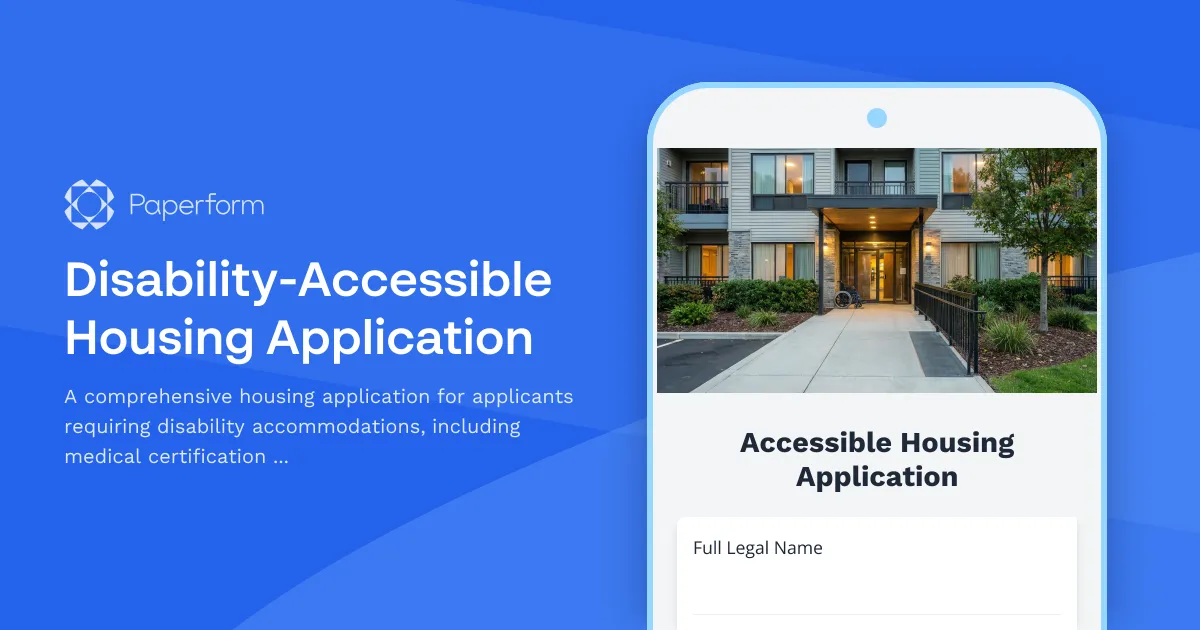
Accessible Housing Application Form: Streamlined, Dignified & Compliant
Finding appropriate housing shouldn't mean navigating complicated paperwork or facing accessibility barriers in the application process itself. Our Disability-Accessible Housing Application template is designed to help property managers, housing authorities, and residential communities collect comprehensive information while respecting applicants' dignity and ensuring compliance with fair housing laws.
This form template goes beyond basic rental applications by incorporating dedicated sections for accommodation requests, medical provider certification, and modification approval—all critical components when matching applicants with truly accessible housing.
Why Property Managers & Housing Providers Choose This Template
Whether you manage affordable housing complexes, senior living facilities, or private rentals with accessible units, this template helps you:
- Meet Fair Housing Act Requirements: Collect accommodation requests in a structured, compliant manner that demonstrates your commitment to reasonable accommodations
- Streamline Medical Documentation: Built-in sections for healthcare provider certification eliminate back-and-forth requests for supporting documentation
- Process Modification Requests Efficiently: Clearly capture requested physical modifications to units, from grab bars to ramp installations
- Reduce Application Processing Time: Conditional logic shows only relevant questions, making the form faster for applicants and easier for staff to review
- Maintain Compliance Records: Digital submissions create an auditable trail of accommodation requests and responses
Built for Accessibility Coordinators & Fair Housing Specialists
Property managers, accessibility coordinators, and housing counselors particularly appreciate how this template balances thoroughness with sensitivity. The form structure acknowledges that disability-related information is deeply personal while recognizing that proper documentation protects both applicants and housing providers.
The multi-page layout allows applicants to complete sections at their own pace, with clear progress indicators. Conditional fields ensure applicants only see questions relevant to their situation—those not requesting accommodations skip directly to standard application sections.
How This Template Works With Your Housing Workflow
This Paperform template captures everything in one professional, accessible experience:
- Applicant Information & Housing Needs: Standard contact details plus specific accessible unit requirements (wheelchair accessibility, visual/hearing accommodations, service animal approval, etc.)
- Accommodation Request Section: Detailed description of needed accommodations with conditional fields that adapt based on request type
- Medical Provider Certification: HIPAA-compliant section for healthcare professionals to verify accommodation necessity without disclosing specific diagnoses
- Requested Modifications: Itemized list of physical modifications with cost estimation and restoration responsibility
- Standard Application Components: Income verification, rental history, references, and household composition
- Document Upload: Secure file upload for medical letters, previous accommodation approvals, and supporting documentation
With Paperform's conditional logic, the form intelligently adapts—if an applicant indicates they're not requesting accommodations, they skip directly to standard application questions. If modifications are requested, additional fields appear for contractor information and modification timelines.
Automate Follow-Up & Approval Workflows
Once submitted, the real power comes from connecting this form to your housing management workflow:
- Route to Compliance Review: Use Stepper to automatically send accommodation requests to your accessibility coordinator or legal team for fair housing compliance review
- Track Application Status: Push submissions to your property management software or create tracking records in Airtable or Google Sheets
- Schedule Inspections: Trigger calendar invites for unit walk-throughs when modification requests require assessment
- Send Confirmation Emails: Automatically acknowledge receipt and provide applicants with timeline expectations and case numbers
- Request Additional Documentation: Set up conditional email notifications to request missing certifications or clarifications
For housing authorities managing high volumes, Stepper can orchestrate multi-step approval processes—routing medical certifications to third-party reviewers, notifying maintenance teams of modification needs, and updating applicant portals with real-time status.
Accessibility & Compliance Built In
The template is designed with WCAG accessibility guidelines in mind, ensuring applicants using screen readers or other assistive technology can complete it independently. Large, clear form fields, logical tab order, and descriptive labels make the experience dignified for all users.
For organizations subject to Section 504, Fair Housing Act, or ADA requirements, this template helps demonstrate good-faith efforts to provide reasonable accommodations while maintaining necessary documentation for HUD audits or compliance reviews.
Who Benefits Most From This Template
This template is ideal for:
- Public Housing Authorities (PHAs) managing Section 8 vouchers and accessible unit allocations
- Property Management Companies with accessible housing inventory requiring compliant intake processes
- Senior Living Communities balancing independent living with accommodation support
- Supportive Housing Providers serving individuals with disabilities who need documentation for program eligibility
- Fair Housing Organizations helping applicants navigate accommodation request processes
- Accessibility Consultants working with property owners to establish compliant application systems
Secure Document Management With Papersign
Once an accommodation is approved, you can use Papersign to turn the submission into a formal accommodation agreement requiring signatures from both the applicant and property representative. This creates a legally binding record of approved modifications, maintenance responsibilities, and restoration requirements—all linked back to the original application.
Customization for Your Housing Program
Every housing program has unique requirements. Easily customize this template to include:
- Income limits and verification requirements for affordable housing programs
- Preference points for veteran status, local residency, or homeless prevention programs
- Waitlist ranking criteria and point systems
- Program-specific certifications (HOME, LIHTC, etc.)
- Language translations for multilingual communities
- Branding to match your housing authority or property management company
Get Started Today
With Paperform's intuitive editor, you can launch a professional, compliant accessible housing application in minutes—not weeks. The SOC 2 Type II compliance means applicant data is protected with enterprise-grade security, while the user-friendly interface ensures high completion rates.
Whether you're a solo property manager handling a handful of accessible units or a housing authority processing thousands of applications annually, this template scales with your needs. Start with the free plan for testing, then upgrade as application volumes grow—with predictable pricing and no surprise fees.
Transform your accessible housing application process from a paperwork burden into a streamlined, dignified experience that serves both applicants and housing providers with professionalism and compliance.

More templates like this
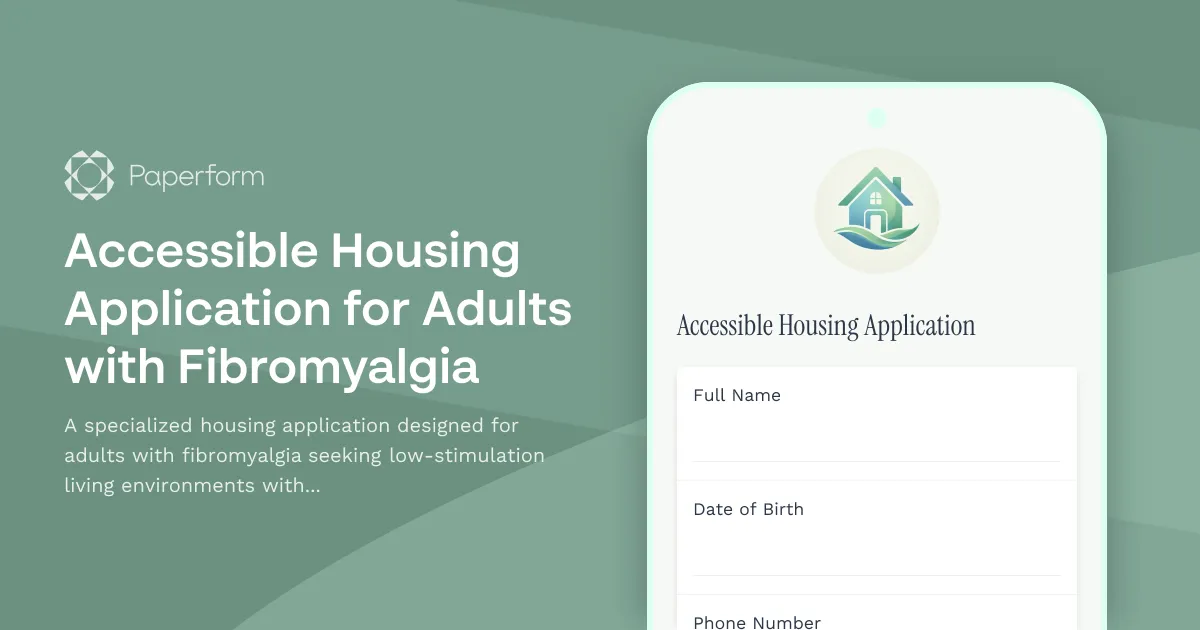
Accessible Housing Application for Adults with Fibromyalgia
A specialized housing application designed for adults with fibromyalgia seeking low-stimulation living environments with access to pain management and rheumatology care.
Accessible Housing Application for Individuals with Cerebral Palsy
A comprehensive housing application designed for individuals with cerebral palsy, featuring accommodation requests for mobility equipment, personal care attendant space, and accessible transportation needs.
Accessible Housing Application for Individuals with Epilepsy
A comprehensive housing application designed for individuals with epilepsy, ensuring safe living environments with seizure-safety features, secure medication storage, and accessible transportation to medical appointments.
Accessible Housing Application for Individuals with Lupus
A specialized rental application for individuals with lupus, designed to assess accommodation needs including sun exposure protection, fatigue management, and proximity to rheumatology care.
Accessible Housing Modification Application
A comprehensive application for accessible housing modifications, including occupational therapist evaluations, contractor approvals, and funding coordination.
Affordable Housing Lottery Application
Complete application form for affordable housing lottery programs with income verification, household composition details, and priority preference selection for housing authorities and community development organizations.
ALS-Accessible Housing Application
A compassionate housing application designed specifically for adults living with ALS, featuring adaptive technology accommodations, caregiver space requirements, and optional support planning resources.
Cystic Fibrosis Housing Application
Specialized rental application for adults with cystic fibrosis featuring infection control requirements, medical equipment accommodation, and healthcare facility proximity assessment.
Emergency Housing Application for Wildfire Evacuees
Fast-track housing application for families displaced by wildfires, including emergency placement, pet accommodation, and temporary school enrollment assistance.
Farm Worker Housing Application
A comprehensive application form for farm workers seeking seasonal housing, including employment verification, family composition, and transportation requirements.
Housing Application for Immigrant & Asylum-Seeking Families
A culturally sensitive housing application designed for immigrant and asylum-seeking families, with language support options and accessibility accommodations.
Housing Application for Individuals with IBD
A specialized housing application for individuals with inflammatory bowel disease, featuring accessibility requirements, dietary accommodations, and proximity to medical facilities.