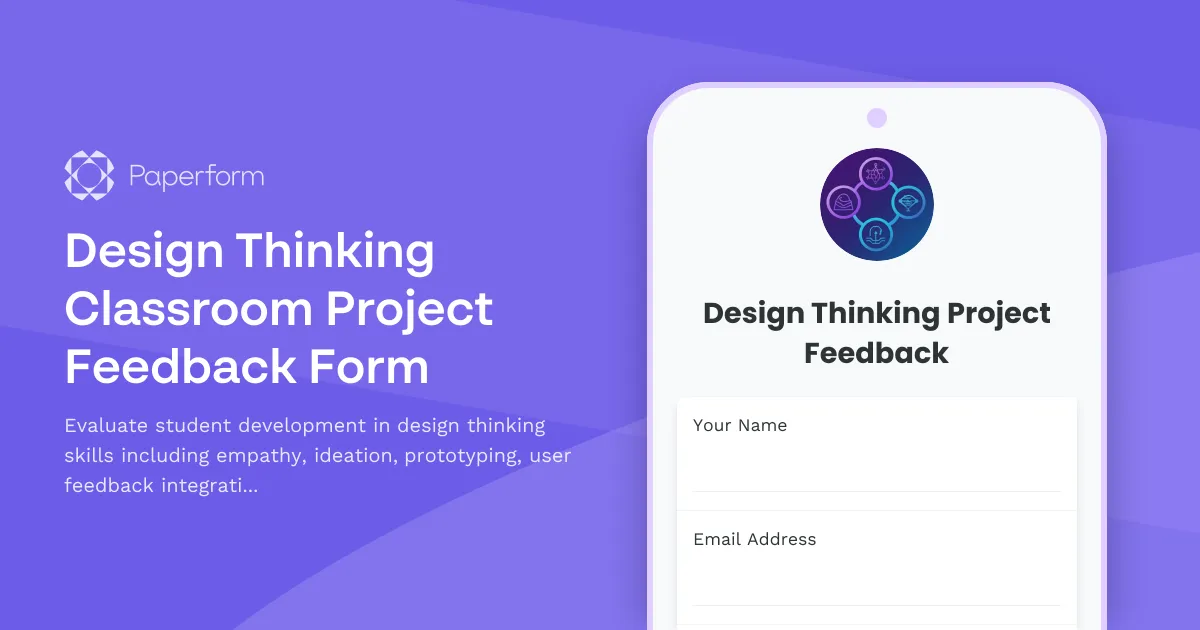
Assess Design Thinking Skills with a Purpose-Built Student Feedback Form
Design thinking has become an essential framework in modern education, helping students develop critical skills like empathy, creative problem-solving, and iterative thinking. But how do you effectively measure growth across these multifaceted competencies? A Design Thinking Classroom Project Feedback Form gives educators a structured way to capture student reflections, track skill development, and refine their teaching approach.
This template is built specifically for teachers, instructional designers, and program coordinators running design thinking workshops, innovation challenges, or project-based learning units in K-12 schools, universities, and training programs. Whether you're teaching human-centered design, running a maker challenge, or facilitating a semester-long innovation project, this form helps you gather meaningful insights on how students are applying each phase of the design thinking process.
What Makes This Template Effective
Unlike generic course evaluations, this form zeroes in on the core pillars of design thinking: empathy development, ideation creativity, prototyping iteration, user feedback integration, and problem-solving confidence. Students reflect on their journey through each stage, self-assess their growth, and provide honest feedback on what worked and what didn't.
The form structure guides students through reflection questions, scaled assessments, and open-ended responses that reveal not just what they learned, but how they experienced the process. This gives educators actionable data to improve future projects, identify students who may need additional support, and celebrate breakthroughs in creative confidence.
Built for Educators, Designed for Students
Paperform makes it easy to create forms that students actually want to fill out. With a clean, intuitive interface and mobile-friendly design, this template ensures high completion rates and thoughtful responses. You can embed the form directly into your LMS, share via link, or display on a classroom screen.
Conditional logic helps tailor the experience based on student responses, while Paperform's AI Insights can automatically summarize hundreds of responses into clear themes—perfect for busy educators who need to spot trends fast without manually reading every submission.
If you're running a multi-stage project, consider pairing this form with Stepper to automate follow-up actions like sending personalized feedback emails, updating grade trackers, or notifying teaching assistants when a student flags a challenge. For courses requiring signed reflections or consent forms, Papersign lets you turn responses into formal documentation with secure eSignatures.
Perfect for K-12, Higher Ed, and Innovation Programs
This template is ideal for middle and high school teachers running STEAM challenges, university professors teaching innovation courses, boot camp facilitators, and nonprofit educators leading youth development programs. It supports reflective learning, formative assessment, and continuous improvement—core outcomes for any design thinking initiative.
With Paperform's flexible editor, you can adjust questions to match your specific curriculum, add your school's branding, and connect responses to Google Sheets, Airtable, or your student information system for seamless record-keeping.
Start gathering better feedback on your design thinking projects today. This template helps you build a culture of reflection, iteration, and creative confidence—one submission at a time.
More templates like this
Classroom Technology Integration Survey
A comprehensive survey to evaluate how students experience technology in the classroom, including interactive tools, digital platforms, online resources, and tech support effectiveness.
College Academic Probation Support Program Feedback Survey
A comprehensive feedback survey designed to evaluate academic probation support programs, including advisor effectiveness, study skills resources, mental health support, and student success outcomes.
College Accelerated Degree Program Student Survey
Gather comprehensive feedback from students enrolled in accelerated degree programs about course intensity, support services, time management, academic quality, and overall satisfaction with their experience.
College Accessibility Services Student Survey
Evaluate your college's accessibility services with this comprehensive student feedback form covering accommodations, staff support, assistive technology, testing arrangements, and advocacy effectiveness.
College Career Services Satisfaction Survey
Evaluate your career services experience including resume assistance, interview prep, job fairs, employer connections, and alumni networking to help improve student outcomes.
College Entrepreneurship Course Evaluation
A comprehensive evaluation form for entrepreneurship course participants to assess course effectiveness, business development skills, pitch presentation capabilities, mentor engagement, and venture launch readiness.

College Peer Review Writing Workshop Evaluation
Evaluate peer review writing workshops with this comprehensive feedback form. Assess feedback quality, revision improvements, critical reading skills, collaborative learning value, and writing confidence development.
Educational Augmented Reality Lesson Feedback Form
Gather student feedback on AR-enhanced lessons to measure technology integration effectiveness, visual engagement, interactivity, technical challenges, and learning outcomes.
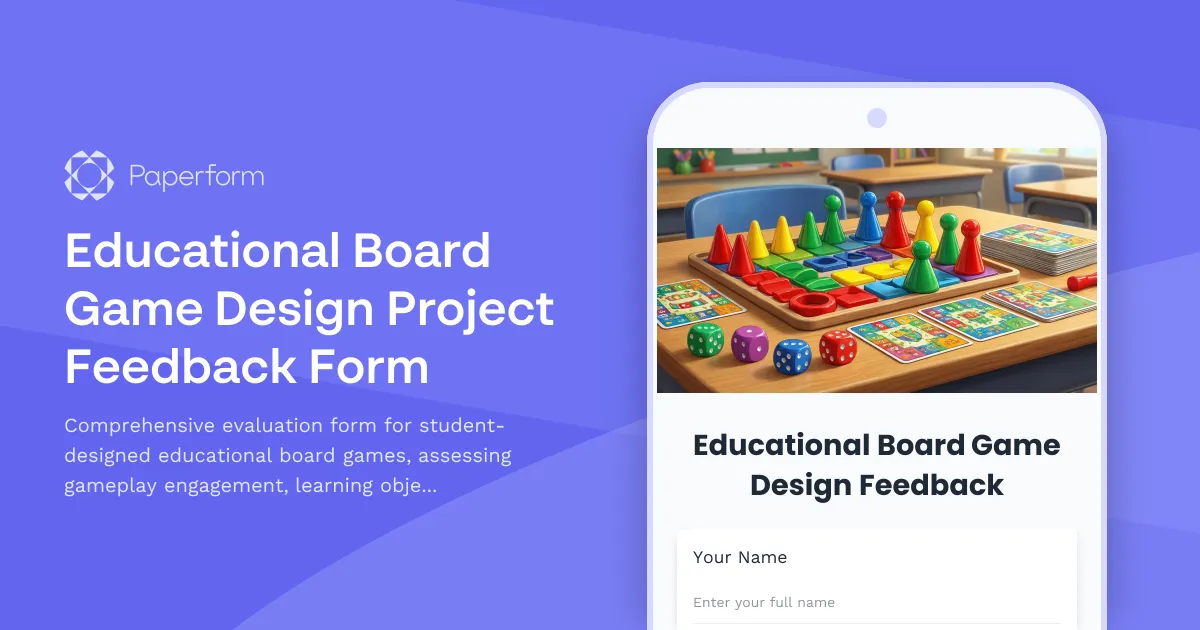
Educational Board Game Design Project Feedback Form
Comprehensive evaluation form for student-designed educational board games, assessing gameplay engagement, learning objectives, rule clarity, creativity, and peer teaching effectiveness.
Educational Game-Based Learning Feedback Form
Gather comprehensive feedback on educational games with questions covering game mechanics, learning outcomes, difficulty progression, engagement levels, and knowledge retention to improve game-based learning experiences.
Educational Podcast Creation Assignment Student Feedback Form
A comprehensive evaluation form for assessing student podcast assignments, measuring research skills, audio editing proficiency, storytelling ability, audience awareness, and subject expertise demonstration.
Educational Podcasting Assignment Survey
Gather student feedback on podcasting assignments, evaluating skill development, creative expression, technical challenges, peer collaboration, and subject engagement to improve future podcast-based learning.