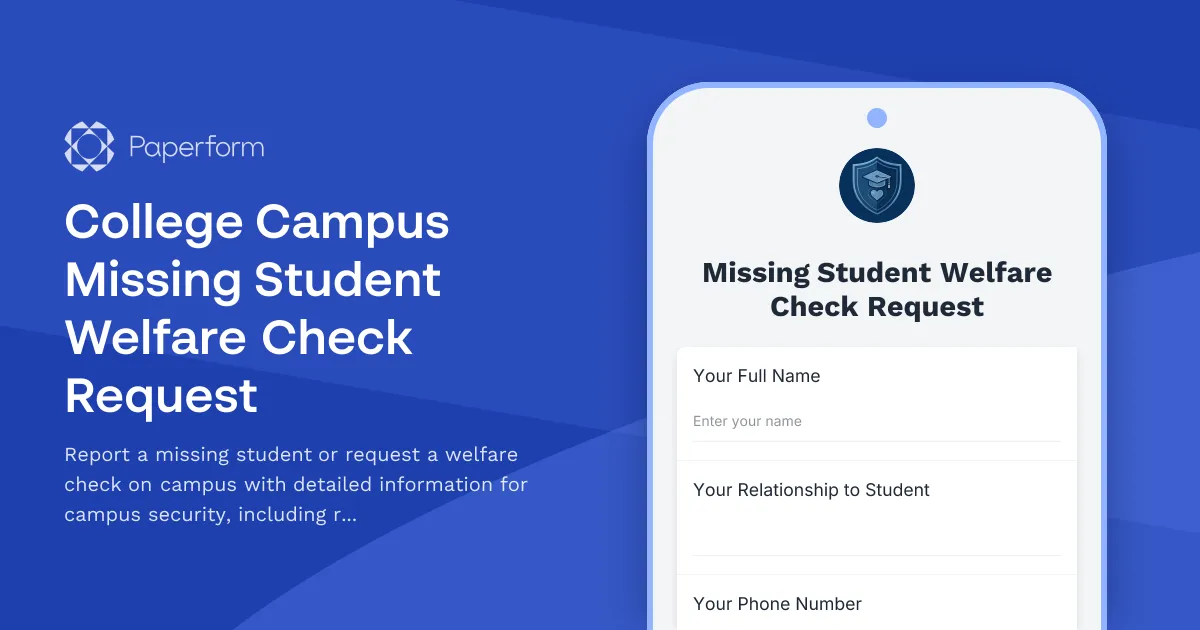
Help Keep Your Campus Community Safe
When a student goes missing or you're concerned about their wellbeing, every minute counts. This College Campus Missing Student Welfare Check Request Form provides campus security and administration with the critical information they need to locate a student quickly and ensure their safety.
Why Use This Template?
College campuses are unique environments where students often operate independently for the first time. Roommates, friends, and staff play a vital role in looking out for one another. This form streamlines the welfare check process by collecting structured information about:
- Student identification and contact details
- Last known location and time seen
- Roommate and close friend information
- Class schedule and typical patterns
- Mental health or medical concerns
- Behavioral changes or risk factors
Built for Educational Institutions
Whether you're a residential advisor, campus security officer, concerned roommate, or faculty member, this form helps you communicate critical details clearly and completely. The information collected can be immediately shared with campus police, local authorities, and emergency contacts to coordinate an effective response.
Universities, colleges, and residential campuses can embed this form on student portals, RA resource pages, or campus safety websites. With Paperform's conditional logic, the form adapts based on the urgency level and type of concern reported, ensuring the right follow-up actions are triggered.
Automate Your Response Workflow
Connect this form to your campus safety protocols using Stepper to automatically:
- Alert campus security and residential life staff via email or SMS
- Create incident reports in your case management system
- Notify emergency contacts based on threat level
- Log all welfare checks in Airtable, Google Sheets, or your student information system
- Trigger different response protocols based on time missing or risk assessment
With Paperform's secure, SOC 2 Type II compliant platform, sensitive student information is protected while still being immediately accessible to authorized personnel. The form works seamlessly on mobile devices, making it easy to report concerns the moment they arise.
Support Student Wellbeing
Beyond immediate safety concerns, this template helps institutions identify patterns and improve support services. Use AI Insights to analyze submissions over time and identify trends in student welfare concerns, helping your campus improve mental health resources and early intervention programs.



More templates like this

Missing Student Report Form for Therapeutic Boarding Schools
A comprehensive form for therapeutic boarding schools to report missing students, coordinate search efforts, and manage parent notification protocols with detailed behavioral history and law enforcement coordination.
Boarding School Missing Student Overnight Absence Report
A comprehensive reporting form for boarding school staff to document missing students, overnight absences, and initiate emergency protocols with detailed student information and welfare check procedures.
International School Missing Exchange Student Report
A comprehensive form to report missing exchange students, capturing host family details, visa status, last known whereabouts, and emergency contacts to ensure swift coordination with program staff and authorities.
International Student Dormitory Missing Student Report
A comprehensive form for reporting missing international students from university dormitories, capturing visa status, academic contacts, cultural considerations, and international student office details.
Missing Student Report - Special Needs & Autism Support
A specialized missing student report form for special needs schools, designed to capture critical information about students with autism including sensory triggers, communication preferences, safe spaces, and behavioral support contacts.
School Missing Student Emergency Report Form
A comprehensive emergency form for reporting missing students, documenting parent contact information, student schedules, known associates, and activating emergency response protocols to ensure swift and coordinated action.

Cooperative Education (Co-op) Program Application
A comprehensive application form for students seeking cooperative education placements, featuring employer preferences, work-study commitment, industry goals, and career exploration objectives.
Dormitory Fire Evacuation Check-In Form
A quick and efficient fire evacuation check-in form for residence halls to verify all residents and guests are safely accounted for during emergency evacuations.
Fraternity House Safety Inspection Failure Report
Report building code violations, occupancy concerns, and safety hazards in fraternity housing with automatic notification to university housing offices and relevant authorities.
School Bus Accident Emergency Report
A comprehensive emergency report form for school bus accidents, including student injury assessment, parent notification tracking, and automated transportation department alerts.
School Counselor Student Wellness Check-In Form
A comprehensive wellness check-in form for school counselors to assess student wellbeing, behavioral observations, academic concerns, home situation, and plan appropriate interventions.
School Safety Threat Assessment Form
Comprehensive threat assessment form for K-12 schools to evaluate safety concerns, initiate lockdown protocols, notify law enforcement, and trigger parent communications during critical incidents.