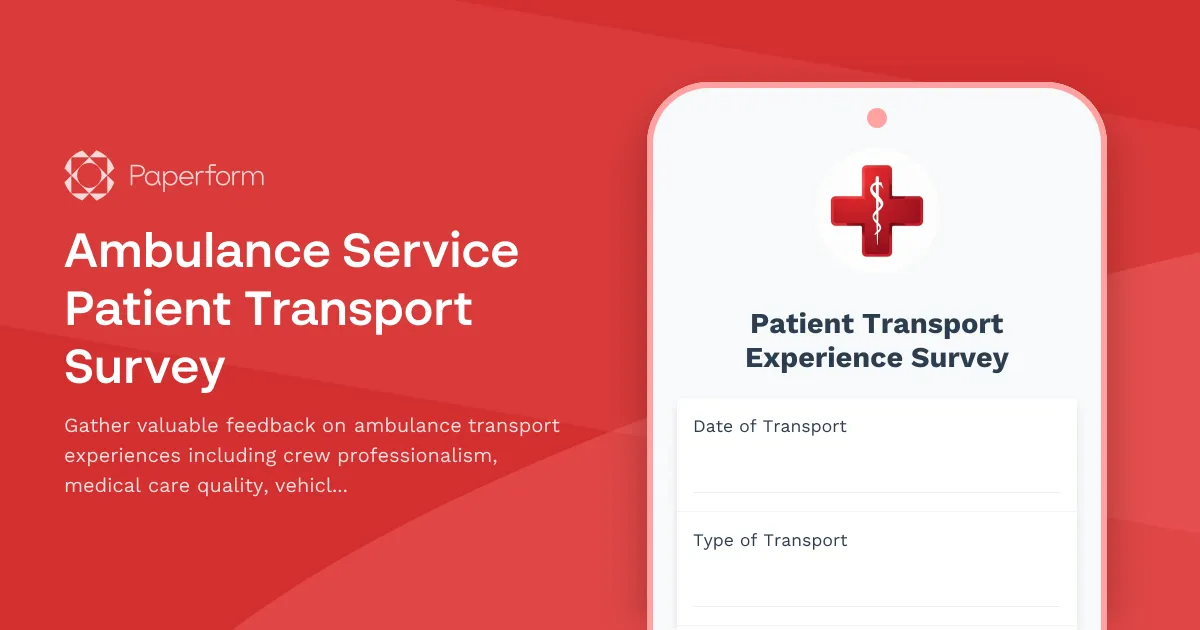
Improve Your Ambulance Service with Patient-Centered Feedback
Emergency medical services play a critical role in healthcare delivery, and understanding the patient experience during ambulance transport is essential for continuous quality improvement. This Ambulance Service Patient Transport Survey template helps EMS providers, private ambulance companies, and hospital transport departments collect structured feedback on every aspect of the transport experience.
Why Patient Feedback Matters in EMS
Ambulance transport is often a patient's first encounter with the healthcare system during an emergency. The quality of care, professionalism of crew members, vehicle conditions, and transparency of billing all contribute to patient satisfaction and trust. By systematically collecting feedback, ambulance services can identify training opportunities, operational improvements, and communication gaps that impact patient outcomes and satisfaction scores.
What This Template Captures
This comprehensive survey covers the full patient transport experience:
- Crew professionalism and communication – How well did paramedics and EMTs interact with the patient and family?
- Medical care quality – Was the clinical care appropriate, timely, and explained clearly?
- Vehicle and equipment condition – Were the ambulance interior and medical equipment clean and well-maintained?
- Billing transparency – Did patients understand costs and insurance coverage before or after transport?
- Overall experience ratings – Net Promoter Score and likelihood to recommend
Built for Healthcare Workflows
Paperform makes it easy to deploy this survey immediately after transport via email, SMS, or QR code on discharge paperwork. Responses flow directly into your quality assurance dashboard, and with Stepper you can automatically route negative feedback to service recovery teams, flag critical incidents for review, or update your CRM with satisfaction scores—all without manual data entry.
For multi-site ambulance services or healthcare systems managing multiple transport contracts, Paperform's Agency+ plan lets you customize this template for different regions or service lines while maintaining centralized reporting and SOC 2 Type II compliance.
Who This Template Is For
This survey is designed for:
- Private ambulance companies and EMS agencies
- Hospital-based patient transport departments
- Air ambulance and critical care transport services
- Healthcare quality and patient experience teams
- Medical billing departments seeking to improve transparency
Whether you're pursuing accreditation, responding to patient complaints, or simply committed to delivering compassionate care, this template gives you a professional, mobile-friendly way to listen to the people you serve.



More templates like this
Assisted Living Family Satisfaction Survey
Gather feedback from family members about care quality, communication, activities, and decision-making involvement at your assisted living facility to improve resident experience and family satisfaction.
Clinical Laboratory Outreach Program Survey
Evaluate laboratory outreach services including specimen collection convenience, courier timeliness, test result accuracy, and provider integration quality to improve healthcare delivery.
Healthcare Quality Improvement Patient Advisory Council Survey
A comprehensive survey designed to evaluate patient engagement effectiveness, feedback implementation transparency, co-design participation value, and shared decision-making support within healthcare quality improvement advisory councils.
Healthcare Value-Based Payment Patient Survey
A comprehensive patient survey designed to measure satisfaction with value-based care models, cost transparency, quality measure awareness, and perceived improvements in healthcare outcomes.
Hospice Care Family Satisfaction Survey
A compassionate survey to gather feedback from families about their loved one's hospice care experience, including patient comfort, emotional support, communication, and dignity in end-of-life care.
Hospital Chaplaincy Spiritual Care Survey
A comprehensive patient and family survey to evaluate the quality of spiritual care services, religious accommodation, end-of-life support, crisis counseling, and interfaith sensitivity provided by hospital chaplaincy teams.
Hospital Medical Interpreter Service Quality Survey
Evaluate the quality of medical interpretation services with questions on interpretation accuracy, cultural competency, communication effectiveness, and scheduling convenience to improve patient care.
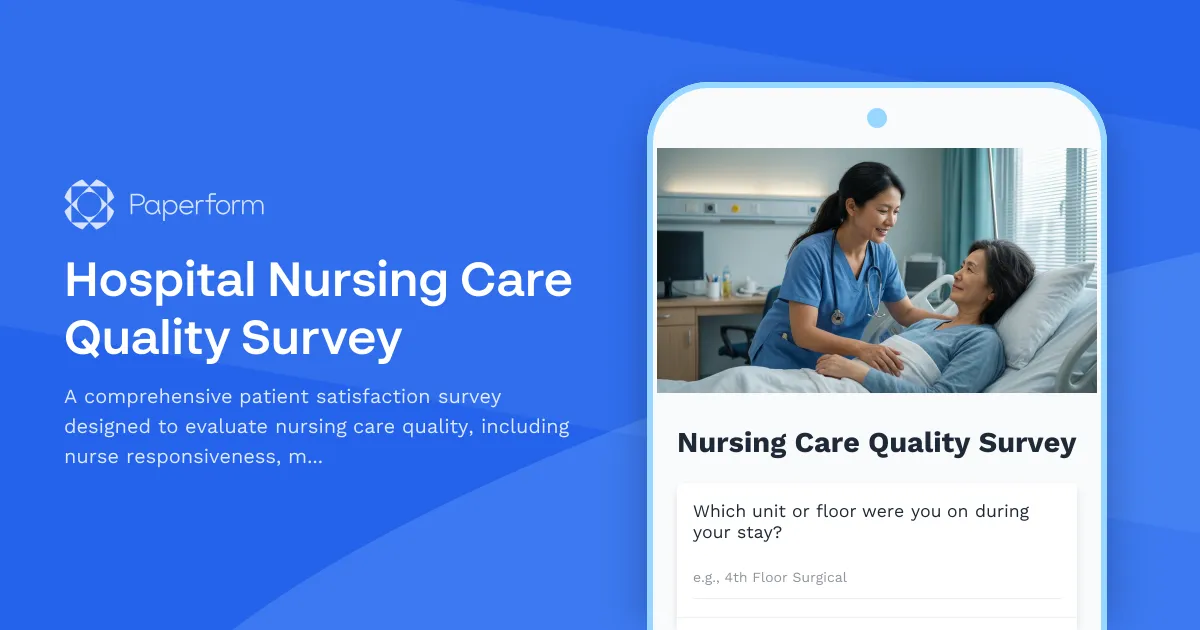
Hospital Nursing Care Quality Survey
A comprehensive patient satisfaction survey designed to evaluate nursing care quality, including nurse responsiveness, medication communication, bedside manner, and pain management effectiveness.
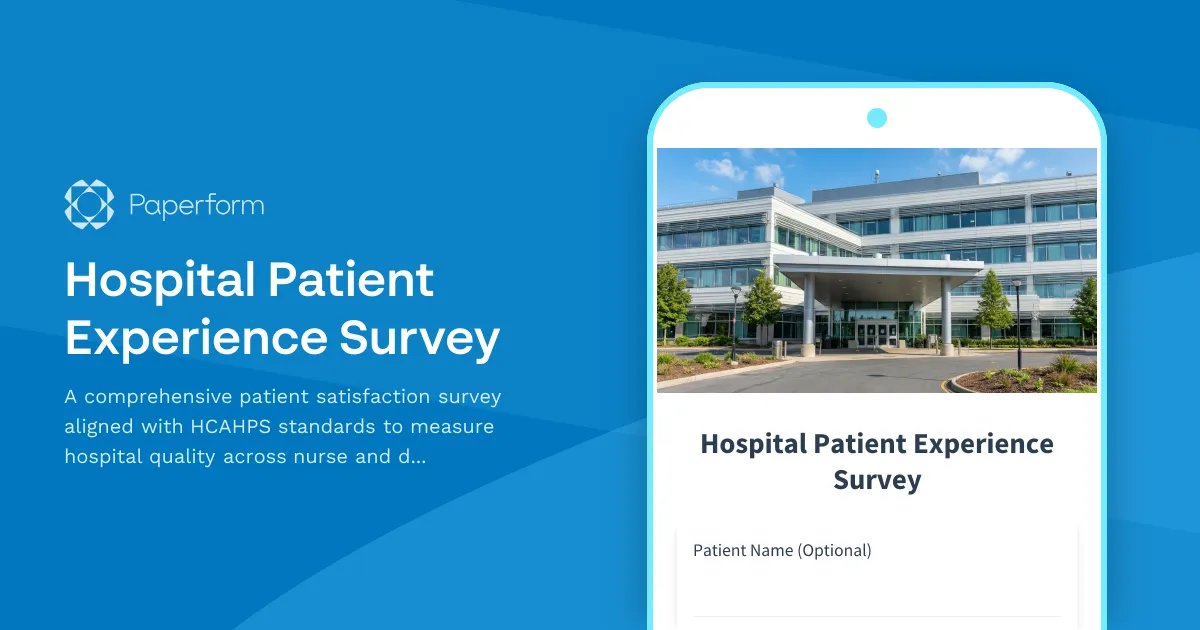
Hospital Patient Experience Survey
A comprehensive patient satisfaction survey aligned with HCAHPS standards to measure hospital quality across nurse and doctor communication, environment, pain management, medications, discharge, and overall experience.
Medical Incident Patient Experience Survey
A comprehensive survey for healthcare organizations to gather patient feedback on medical incident disclosure, communication, and resolution processes to improve patient safety and care quality.
Medical Laboratory Patient Experience Survey
Gather patient feedback on phlebotomy services, wait times, results delivery, and specimen collection instructions to improve laboratory service quality and patient satisfaction.
Medical Staff Peer Review Survey
Evaluate the effectiveness of peer review processes, credentialing fairness, competency assessments, and quality improvement programs within your medical staff structure.