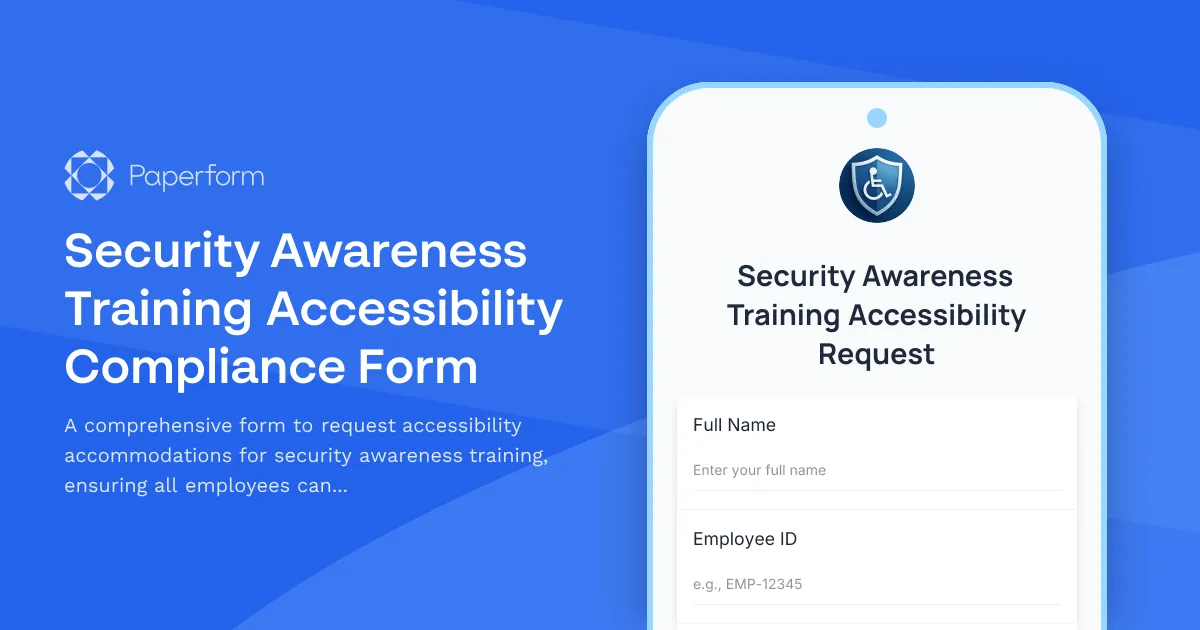
Security awareness training is essential for protecting your organization from cyber threats, but it must be accessible to every employee. This Security Awareness Training Accessibility Compliance Form helps IT and security teams ensure that mandatory training programs meet accessibility standards and accommodate diverse learning needs.
This template is designed for IT professionals, security officers, compliance managers, and HR teams who need to provide inclusive security training across their organization. Whether you're working in technology, healthcare, education, finance, or government, accessibility compliance isn't optional—it's both a legal requirement and a cornerstone of effective security culture.
The form captures critical information about accommodation requests, preferred alternative formats (audio, braille, large print, captioned video), assistive technology requirements, and specific learning barriers. It includes sections for verifying inclusive design elements, scheduling flexible training sessions, and documenting compliance with ADA, Section 508, and WCAG standards.
By collecting this information upfront, you can proactively identify accessibility gaps, provide appropriate accommodations, and ensure that your security awareness program reaches every team member. This reduces compliance risk, improves training completion rates, and builds a more security-conscious workforce.
Paperform makes it easy to create accessible, compliant forms that integrate seamlessly with your existing training platforms and HRIS systems. Use conditional logic to route accommodation requests to the right teams, and leverage Stepper (stepper.io) to automatically trigger follow-up workflows—like provisioning alternative materials, scheduling interpreter services, or notifying training coordinators about specific needs.
With Paperform's SOC 2 Type II compliance and GDPR-ready infrastructure, you can confidently collect sensitive accommodation information while maintaining the security standards your organization demands. This template helps you build a truly inclusive security awareness program that protects both your people and your data.



More templates like this
Cybersecurity Awareness Training Quiz
Test employee knowledge on phishing detection, password security, and data protection with this comprehensive cybersecurity awareness quiz designed for workplace training programs.
Security Awareness Training Completion & Phishing Simulation Results Form
Track security training completion, phishing simulation performance, and assign follow-up training with automated department-level scoring and reporting.
Corporate VPN Access Request Form
Streamline remote access requests with this corporate VPN access form. Collect employee details, device information, security clearance levels, and route for manager approval—all in one secure workflow.
Cybersecurity Incident Report Request Form
Request comprehensive documentation and forensic analysis records for cybersecurity incidents. Designed for IT auditors to collect incident reports, affected system details, and supporting evidence.
Identity and Access Management Quarterly Review Form
Conduct comprehensive IAM quarterly reviews with user provisioning audits, role-based access validation, and orphaned account identification to maintain security compliance and minimize access risks.
IT Security Architecture Review Board Submission Form
Submit security architecture proposals to the review board for evaluation, approval, and decision documentation with comprehensive risk assessments and compliance considerations.
IT Security Control Baseline Deviation Request Form
Request approval for deviations from IT security baselines with risk assessment, configuration changes, and compensating controls documentation.
IT Security Data Classification Change Request Form
Submit and track IT security data classification automation change requests, including labeling rules, handling procedures, and enforcement mechanisms for organizational data governance.
Network Security Incident Log
A comprehensive form for logging network security incidents, intrusion detection alerts, firewall rule analysis, and threat intelligence correlation. Streamline your incident response process with structured data collection.
Phishing Incident Report Form
Report suspected or confirmed phishing attempts with email header analysis, identify affected users, and enroll staff in security awareness training to prevent future incidents.
Quantum-Safe Cryptography Readiness Assessment
Evaluate your organization's preparedness for post-quantum cryptography threats with a comprehensive assessment of current cryptographic algorithms, migration planning, and implementation roadmap.
Security Incident Escalation Criteria Definition Form
Define clear escalation criteria for security incidents with severity matrices, notification thresholds, and communication protocols to ensure rapid and appropriate response.