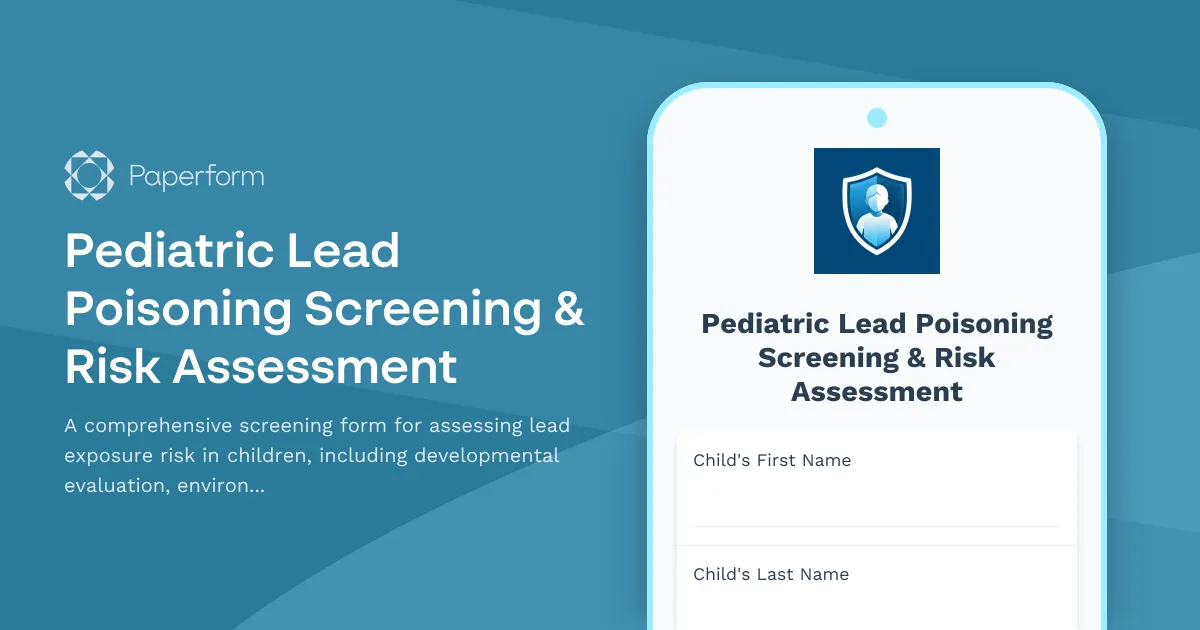
Comprehensive Pediatric Lead Poisoning Screening Made Simple
Lead poisoning remains one of the most preventable environmental health hazards affecting children, yet early detection and intervention are critical for protecting developmental outcomes. This Pediatric Lead Poisoning Screening & Risk Assessment template provides healthcare providers, pediatric clinics, public health departments, and family health centers with a structured, evidence-based tool for identifying at-risk children and documenting comprehensive exposure assessments.
Why digital lead screening forms matter
Traditional paper-based lead screening creates administrative bottlenecks, risks incomplete documentation, and delays critical follow-up care. With Paperform, you can transform this essential health screening into a streamlined digital workflow that:
- Captures complete risk profiles through conditional logic that adapts questions based on age, housing conditions, and exposure history
- Ensures nothing falls through the cracks with required fields for critical clinical data
- Speeds up toxicology referrals by automatically generating consultation requests when blood lead levels exceed action thresholds
- Maintains HIPAA-aligned security through SOC 2 Type II compliance and secure data handling
This template is specifically designed for pediatricians, family medicine practitioners, community health workers, public health nurses, and occupational health specialists working with vulnerable populations including children in older housing, immigrant families, and communities with known environmental lead sources.
What this screening template includes
The form guides healthcare teams through a systematic assessment covering:
Patient Demographics & Medical History: Basic identifying information, date of birth for age-appropriate screening protocols, primary care provider details, and relevant medical conditions that may increase vulnerability to lead toxicity.
Environmental Risk Assessment: Detailed questions about housing age and condition (pre-1978 construction is a key risk factor), recent renovations, occupational exposures from family members, proximity to industrial sites, water sources, imported products, and traditional remedies that may contain lead.
Developmental Screening: Age-appropriate developmental milestone evaluation, behavioral observations, speech and language development, fine and motor skills assessment, and educational concerns that may signal neurodevelopmental impact from lead exposure.
Exposure History & Symptoms: Documentation of known or suspected lead exposure events, pica behavior (mouthing non-food items), recent symptoms consistent with lead toxicity including abdominal pain, irritability, fatigue, and developmental regression.
Blood Lead Level Documentation: Current and historical blood lead level (BLL) results, testing dates, laboratory information, and comparison to CDC reference values for clinical decision-making.
Clinical Action & Referral: Based on risk factors and BLL results, the form supports appropriate clinical pathways including repeat testing schedules, environmental investigation referrals, nutritional counseling, developmental services, and toxicology consultation for elevated cases.
How healthcare providers use this template
Community health centers use this form during well-child visits for children ages 1-6 years in high-risk ZIP codes, with results feeding directly into their EHR systems via Paperform integrations with eClinicalWorks, Athenahealth, and other major platforms.
Public health departments deploy the template for universal screening programs, using conditional logic to prioritize urgent follow-up for children with BLL ≥5 mcg/dL while tracking population-level risk factors through built-in analytics.
Pediatric practices embed the form into their patient portal, allowing families to complete risk assessment questions before appointments, saving clinical time and ensuring providers have complete information for screening decisions.
School health programs use the template during kindergarten health screenings, identifying children who may need catch-up testing and connecting families with environmental remediation resources.
Streamline follow-up with Stepper workflows
Lead poisoning screening doesn't end with the form submission—it's the beginning of a care coordination process. By connecting your Paperform to Stepper, you can automatically trigger different pathways based on screening results:
- Low-risk screenings generate an educational resource email and schedule routine follow-up in 12 months
- Medium-risk assessments (BLL 3.5-4.9 mcg/dL) trigger environmental health referral, nutritional counseling scheduling, and 3-month repeat testing reminder
- Elevated cases (BLL ≥5 mcg/dL) immediately notify the supervising physician, create a toxicology referral, alert the health department for environmental investigation, and initiate case management
This level of automation ensures that every screening leads to appropriate action, reducing the administrative burden on clinical staff while improving patient outcomes.
Built for compliance and collaboration
Healthcare teams need tools that meet rigorous standards. This template works within Paperform's SOC 2 Type II certified infrastructure, ensuring patient data is handled securely. For organizations requiring additional controls, Paperform Enterprise offers SSO, data residency options, BAA agreements, and role-based access controls.
Multi-disciplinary teams benefit from Paperform's collaboration features—pediatricians, nurses, social workers, and environmental health specialists can all access relevant screening data with appropriate permissions, supporting coordinated care for affected children.
Customize for your screening protocols
Every health system has unique screening protocols based on state requirements, CDC guidelines, and local epidemiology. This template is fully customizable:
- Adjust BLL action thresholds to match your clinical protocols
- Add or modify risk factor questions based on local environmental concerns (mining, smelters, lead-painted bridges, contaminated soil)
- Include language-specific consent and education materials for your patient population
- Integrate screening results with your laboratory information system or state registry
- Add custom fields for grant reporting or quality improvement initiatives
The doc-style editor makes these changes simple for clinical staff without requiring IT support.
Why healthcare providers choose Paperform
With over 500,000 teams worldwide trusting Paperform for critical workflows, healthcare organizations choose this platform because it combines:
- Clinical-grade security with SOC 2 Type II compliance and GDPR alignment
- Flexible design that adapts to diverse screening protocols without coding
- Powerful automation through conditional logic and integration with 3,000+ healthcare tools
- Real-time insights with built-in reporting and AI-powered response analysis
- Accessible pricing designed for community health organizations and growing practices
Whether you're conducting targeted screening in a high-risk neighborhood or implementing universal screening across your health system, this template provides the foundation for effective, efficient lead poisoning prevention.
Start protecting children's health today with a digital screening tool that keeps pace with clinical best practices and makes every follow-up action easier to execute.
More templates like this
Atrial Fibrillation Screening & Stroke Risk Assessment
Comprehensive AFib screening form for high-risk patients including pulse assessment, ECG ordering, CHA₂DS₂-VASc stroke risk calculation, and cardiology consultation scheduling.
Raynaud's Phenomenon Screening Questionnaire
A comprehensive screening tool for Raynaud's phenomenon that documents color changes, identifies triggers, assesses underlying conditions, and determines the need for rheumatology consultation.
Achalasia Screening Questionnaire
A comprehensive achalasia screening form for patients experiencing dysphagia, weight loss, and esophageal symptoms requiring gastroenterology evaluation.
Achondroplasia Growth Monitoring & Care Coordination Form
A comprehensive telehealth form for monitoring growth patterns, assessing treatment options, screening for complications, and coordinating psychosocial support for patients with achondroplasia.
Age-Related Macular Degeneration Screening Form
Screen patients for AMD risk factors, assess visual changes, conduct Amsler grid testing, and facilitate retinal specialist referrals with this comprehensive eye health assessment form.
Allergy & Immunology Symptom Diary
Track allergy symptoms, reaction severity, allergen exposures, and medication use with this comprehensive symptom diary designed for patients and healthcare providers.
Ambulatory Surgery Center Pre-Operative Intake Form
Complete pre-operative assessment for ambulatory surgery patients including anesthesia history, NPO compliance verification, medication management, and same-day discharge planning.
Anemia Screening & Fatigue Assessment Form
A comprehensive anemia screening form that assesses fatigue levels, evaluates dietary iron intake, facilitates lab test ordering, and provides hematology referrals for severe cases.
Anticoagulation Safety Checklist & Bleeding Risk Assessment
A comprehensive pre-visit assessment for patients on anticoagulation therapy to evaluate bleeding risk, fall frequency, medication compliance, and dietary vitamin K intake.
Asthma Action Plan Compliance & Symptom Tracker
Track asthma symptoms, peak flow readings, trigger exposure, and medication usage to help your healthcare provider assess control and adjust your treatment plan.
Asthma Control Test
A comprehensive asthma control assessment form that tracks symptom frequency, peak flow measurements, inhaler technique, and action plan effectiveness to help healthcare providers monitor patient asthma management.
Atrial Fibrillation Screening Form
A comprehensive atrial fibrillation screening form for high-risk patients, including pulse assessment, ECG ordering, stroke risk calculation, and cardiology referral options.