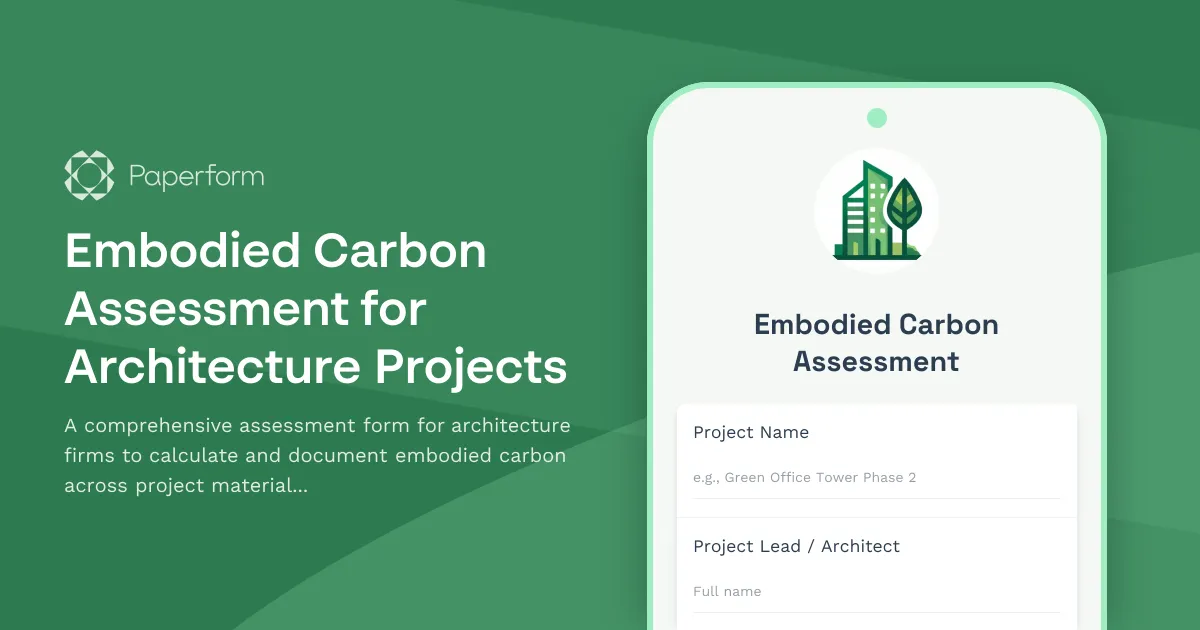
Architecture firms today face increasing pressure to design buildings that minimize environmental impact throughout their entire lifecycle. This Embodied Carbon Assessment template helps architects, sustainability consultants, and project managers evaluate the carbon footprint of building materials, construction methods, operational lifespan, and demolition planning—all in one streamlined form.
Embodied carbon accounts for all greenhouse gas emissions associated with materials and construction processes, from extraction and manufacturing to transportation, assembly, and eventual deconstruction. For architecture firms committed to ESG goals and climate-positive design, understanding and reducing embodied carbon is essential.
Why use Paperform for embodied carbon assessments?
With Paperform's flexible form builder, you can create detailed, project-specific assessments that capture the nuances of each design—from material quantities and sourcing locations to construction sequencing and waste management strategies. The doc-style editor lets you embed explanatory text, reference images, and calculation fields that automatically compute carbon impacts as team members fill out the form.
Conditional logic ensures that the form adapts based on building type, construction method, or material choices, showing only relevant follow-up questions. For example, if a project specifies timber framing, the form can automatically prompt for FSC certification and transport distances, while concrete structures trigger questions about cement replacement and embodied carbon coefficients.
Calculations and pricing fields can be repurposed to tally carbon totals in kgCO₂e or tCO₂e, giving instant feedback on the environmental cost of each decision. This makes it easy to compare design alternatives and identify high-impact opportunities for carbon reduction.
Automate sustainability workflows with Stepper
Once an assessment is submitted, you can use Stepper to automate what happens next. Route the form data to your project management tools like Asana or Monday, generate summary reports in Google Docs, update carbon tracking dashboards in Airtable or Notion, and notify sustainability leads via Slack or email. Stepper's AI-native workflows mean you can connect Paperform to any tool in your stack, keeping carbon data centralized and accessible without manual data entry.
For firms managing multiple projects or clients, this template can be cloned and customized for each new development, ensuring consistency across assessments while accommodating unique project requirements.
Who this template is for
This form is ideal for architecture firms, sustainability consultants, civil engineers, construction managers, and property developers who need to document embodied carbon for LEED, BREEAM, Living Building Challenge, or internal ESG reporting. It's also valuable for firms pursuing net-zero commitments or responding to client and regulatory requirements for carbon transparency.
By centralizing embodied carbon data in Paperform, your team can make informed material and design decisions, demonstrate environmental leadership, and contribute to a more sustainable built environment—one project at a time.


More templates like this
Historic Preservation & Restoration Carbon Assessment Form
Calculate the carbon footprint of heritage building restoration projects including material sourcing, specialized equipment use, climate control systems, and waste management practices.
Living Building Scope of Work
Define your sustainable building project with comprehensive scope planning for biophilic design, net-zero energy systems, water recycling, and Living Building Challenge certification requirements.
Arctic Infrastructure Scope of Work Template
A comprehensive scope of work template for Arctic infrastructure projects, covering permafrost assessment, climate adaptation measures, logistics planning, environmental protection protocols, and indigenous consultation requirements.
Bioluminescent Lighting Scope of Work
A comprehensive scope of work template for bioluminescent lighting projects, covering organism selection, genetic optimization, emission control, lifecycle management, and architectural integration planning.
Regenerative Real Estate Development Stakeholder Briefing
A comprehensive briefing form for regenerative real estate projects, capturing progress on biophilic design, energy performance, community activation, tenant wellbeing, and sustainability certifications for stakeholder communications.

Sustainable Construction Certification Exam Preparation Course Registration
Register for our sustainable construction certification exam prep course. Verify your experience, join a study group, and select your preferred exam date.
Advanced Air Mobility Scope of Work
Define project scope for advanced air mobility initiatives including vehicle certification, vertiport design, traffic management, noise mitigation, and route planning for urban and regional air transportation.
Architecture Firm Client Site Visit Expense Report
Streamline expense tracking for architecture firm site visits with project phase tracking, billable travel time calculation, and photo documentation of expenses.
Architecture Firm Project Bid Submission Form
A comprehensive bid submission form for architecture firms to present project proposals, design concepts, team qualifications, timelines, and detailed fee structures to prospective clients.
Chilean Forestry Carbon Offset Project Registration Form
Register forestry carbon offset projects with Chile's Climate Change Office. Submit project details, baseline calculations, and monitoring plans in compliance with Chilean environmental regulations.
Climate Resilience Infrastructure Stakeholder Report
A comprehensive stakeholder report template for climate resilience infrastructure projects, including vulnerability assessments, adaptation measures, community preparedness, funding analysis, and impact projections.

Commercial Kitchen Design Milestone Sign-Off Form
A comprehensive milestone approval form for commercial kitchen design projects, covering equipment layout, ventilation systems, health code compliance, and consultant authorization.