How Co.Lab founder Sefunmi Osinaike uses Paperform to capture leads, run operations, and scale with less admin
What started as a simple application form became the system behind more than 30,000 leads, roughly $300,000 in payments, weekly student workflows, and a calmer way to grow.
Sefunmi Osinaike did not start Co.Lab with a polished business plan. He started with a problem he knew well. After breaking into tech without formal product training, then working at Microsoft, Apple, and Ecobee, he kept hearing the same question from people trying to do the same: how do you get real experience before someone gives you a chance? That question became Co.Lab. What began with nine people grew into a business that has trained more than 2,000 people in 60 countries.
As Co.Lab grew, the real challenge was not demand alone. It was building a system that could handle applications, book downloads, email follow-up, CRM routing, payments, student check-ins, file uploads, and hiring without creating more manual work every month. That is where Paperform became central. For Sefunmi, it stopped being just an application form and became part of the operating system behind the business.
Key results
- More than 30,000 leads captured through Paperform.
- Roughly $300,000 processed through Paperform forms.
- Applications, book downloads, quizzes, CRM tagging, student submissions, hiring, and payments connected in one system.
- One form handled more than 5,000 applications without worries about space or capacity.
- Less manual work, fewer tool gaps, more confidence that core workflows would keep running.
About Sefunmi Osinaike

Sefunmi built Co.Lab to help people break into tech by getting real experience before they land the job. The idea came from his own path.
"I’m originally from Nigeria, and I moved to Canada to study electrical engineering. I was fascinated by startups and product, but I didn’t know how to code or design, and I was trying to solve that problem of needing experience before anyone would hire me."
So he decided to create his own proof of experience by building an app.
"I pulled together a team of six people to build a productivity app for students. We launched it over one summer. It didn’t blow up, but it gave me something I didn’t have before, which was experience. I took that project into interviews and showed employers that I had actually done the work. That helped me land my first role at Microsoft, and later I went to Apple."
That experience stayed with Sefunmi. He realized he had been hired because he could show what I’d done, even without formal training or direct experience in the role. Later, when I was back in Canada working at Ecobee, I had around 36 coffee chats in one year with people asking him how he broke into the industry.
"I realized that I kept telling them the same story; build something. That’s what led to Co.Lab. We wanted to help people get experience before they land the job, so they have real skills and real proof of what they can do.”
That origin still shapes the business. Co.Lab is intentionally hands-on. Students work through real deadlines, weekly submissions, mentoring, and team-based projects. When the experience depends on trust and follow-through, even small workflow gaps matter.
Founder: Sefunmi Osinaike
Business: Co.Lab
Industry: Tech and Education
Founded: 2020
LinkedIn: https://www.linkedin.com/in/sefunmiosinaike/
The challenge: scale without more admin
In the early days, Co.Lab was focused on getting the program right. The team interviewed applicants, tested different cohort models, matched the right people, and managed much of the process by hand. Once that foundation was in place, the next problem was growth.
Co.Lab needed a better way to capture leads, track touchpoints, and run more of the business without piling on more admin. That is the point where a lot of small businesses start to feel strain. Manual workflows can work at first. Then demand grows, more tools get added, and simple tasks start slipping between systems. Co.Lab needed a system that could keep up.
Why Paperform became the engine behind their system
Paperform came in through a simple need. Co.Lab needed an application form. It was accessible for a small bootstrap company, and it solved the first job cleanly. Then Sefunmi and his co-founder realized it could do more than they expected.
“It’s not just a form. You can do a bunch of other things.”
The first win was basic, but important. Collecting application data through Paperform, data could go straight into Google Sheets and send an automatic email response. From there, the team soon connected it to MailerLite, handled free book delivery, and tagged leads in their CRM, pushing them into the right sequence. Step by step, one form became a workflow.
It's important to recognize that Co.Lab did not start with a giant systems project. They started with one clear use case then it expanded from there. That lines up with how Paperform is built for small and growing businesses that want forms to run more of the business, not just collect data. With Paperform lead capture, payments, bookings, eSignatures, and workflows can live in one place.
Co.Lab had even dropped other tools once the team realized Paperform already covered those jobs. That matters for founders who care about staying in control without building everything from scratch.
“Every single form on our website is through Paperform.”
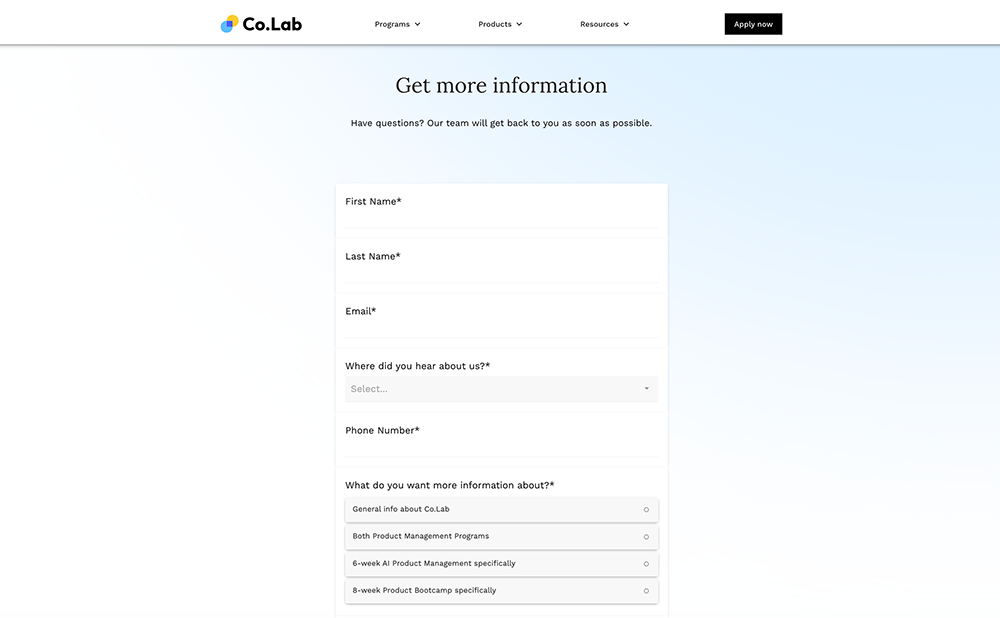
How Co.Lab uses Paperform to power their business
Applications and first response
Paperform powers the application process, pushes data into Google Sheets, and sends an immediate follow-up email. That keeps first contact fast and makes the workflow easier to trust from the start.
"We've generated more than 30,000 leads now just through Paperform. And normally, that's just all sitting in there. With Paperform, you can easily just like access it and you know exactly where leads are coming from."
Lead magnets and email list growth
Co.Lab created free booklets as part of its marketing. Paperform collects the contact details, emails the PDF, and adds the person to the mailing list. That turned a useful free resource into a repeatable lead capture system.
"I think the productivity Paperform enables is immeasurable. Prior to Paperform, we would have to email every single person who is filled in the form. But now that's just automated.
CRM routing and sales context
As more leads came in, Paperform started feeding Co.Lab’s CRM. The team could tag people by interest, see which actions they had already taken, and move them into the right email sequence. For Sefunmi it was critical to be able to see when someone had taken enough steps to book a call and become ready to close.
"Because of Paperform, we know what these people need. Do they need a book download? Are these people who want to get more information, or want to know about more specific programs? We're looking at those touch points in our CRM, and thanks to Paperform, we have all those insights. We know, for example, that this person has done five of these actions, and now they're booked to call with our career advisor, and now we can close them."
That is powerful for any founder who wants better follow-up without more sorting.
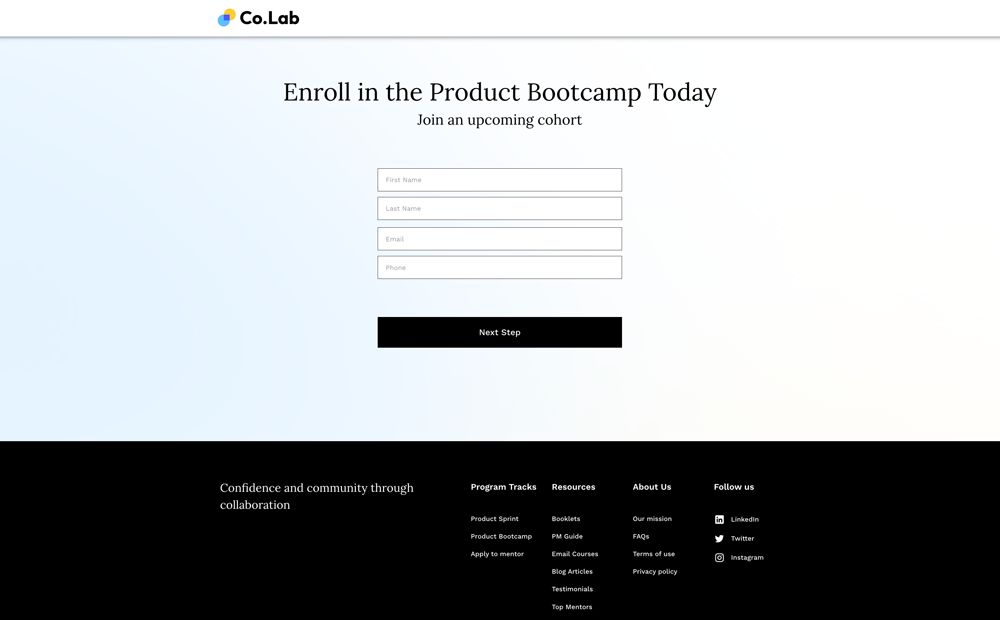
Payments and Subscriptions
Paperform became the standard way for Co.Lab customers to book classes or subscription-based learning.
"We started using Paperform for our checkout because we introduced subscriptions and Paperform made it a lot easier for customers to decide what subscription that they were going to pick. Using Paperform we processed well over six figures, close to $300,000. It is straightforward."
And it's usefulness didn't stop there. Paperform was able to handle complex cost adjustments based on students location.
"It was especially helpful with taxes because there's always an adjustment depending on where you are in the US or Canada. So Paperform allowed us to build that logic."
Student operations
Co.Lab runs weekly milestones inside its programs. Students submit work every week, upload files, and share portfolio material through Paperform. For a business built around accountability and progress, that keeps the process clear for students and easier to manage for the team.
"Before we're using like another tool for that. And I realized quickly: 'wait, why don't we just use Paperform? It seamlessly integrates with everything that we need to do.' So we started it for students onboarding and student success.
"With onboarding, students can submit info and even upload their picture, and we build a profile with that. With student success we use it for their weekly submissions. All their assignments are submitted, through a form where they can upload files, upload their video portfolio, or whatever else they need."
Paperform just makes all our lives easier because it's just so straightforward.
At one point, Co.Lab ran a program that received more than 5,000 applications. For Sefunmi, one of the practical benefits was not having to worry about space, limits, or whether the system could hold up under a spike in volume.
Hiring and internal workflows
Paperform is not only for customers. Sefunmi said Co.Lab now uses it for hiring too.
"Whenever we or our partners are trying to hire, it's through Paperform. We're collecting candidates and their information. It's just become this integral part of everything that we do."
That says a lot. Once a founder trusts a tool in one part of the business, it often spreads to every workflow where information needs to move cleanly from one step to the next.
The result with Paepwas more than time saved
Sefunmi’s numbers are clear. Co.Lab has captured more than 30,000 leads through Paperform. He says the business processed roughly $300,000 through Paperform forms. Those are real outcomes, and they matter. But the more interesting result is what sat underneath them. Before Paperform, the team was doing manual replies, moving data by hand, and managing extra steps that should not have needed a person in the middle. With Paperform, much of that work simply stopped being manual.
Sefunmi did not need a flashy standalone tool. He needed something that played well with the rest of the stack and reduced friction between tools. Paperform’s is built for exactly that. It connects with CRMs, spreadsheets, calendars, payment tools, and workflow automations without forcing growing businesses into a tangle of extra setup.
But the strongest outcome in this story is not a number. It is reliability.
“The fact that it works gives you peace of mind. It just works.”
For small founders, that peace of mind matters. It gives you room to focus on delivery, customers, and growth instead of checking whether the plumbing broke overnight.
Why this story matters for small businesses
Most small business owners do not need more software. They need fewer breaks between one step and the next. When a form gets filled out, a lead should enter the CRM, a follow-up should go out, payment should be taken, and a file should land in the right place. The team should know what happens next. When those handoffs are manual, growth gets expensive in time and attention. When they are connected, the same small team can do a lot more.
Sefunmi’s story makes that practical. He did not keep using Paperform because he wanted a nicer form. He kept using it because it kept removing work. Over time, it became the system he trusted for lead capture, nurturing, payments, student operations, and hiring. That why Paperform is the form engine for small and growing businesses that need forms to do more than collect data.
There is a clear takeaway here for systems-minded business owners. Start with one workflow that matters. Build it well. Then let the same tool take on the next step as the business grows. That is a calmer way to scale. It keeps complexity under control.
FAQ
How can Paperform help a small business owner save time?
Co.Lab used Paperform to remove manual handoffs. Applications went into Google Sheets automatically. Follow-up emails went out right away. Book downloads went to the mailing list. Lead data moved into the CRM without someone cleaning it up by hand. That is where the time saving happens. It is not one big shortcut. It is dozens of small tasks that stop needing a manual management.
Is Paperform only for forms?
No. Sefunmi started with an application form, then expanded into lead capture, quizzes, payments, weekly student submissions, hiring, and more. His experience shows that Paperform can act as a workflow layer across the business, not just a way to collect information.
Can Paperform support lead capture and lead nurturing?
Yes. Co.Lab used Paperform for book downloads, quizzes, mailing list growth, and CRM tagging. That meant the team could see where a lead came from, what they had already done, and when they were ready for the next conversation.
Can Paperform handle payments for a growing business?
Yes. Paperform supports payments, subscriptions, calculations, and tax logic, and Sefunmi said Co.Lab processed roughly $300,000 through Paperform. He even used it to test a separate side sales projects because it was easier than setting up a full ecommerce setup from scratch.
Is Paperform a good fit for tech-savvy solopreneurs?
Yes. Sefunmi liked that Paperform gave him integrations and flexibility without a pile of extra setup. He also said it stayed simple enough for technical and non-technical people on the team. That mix matters when a founder wants control without building every connection from scratch.
Why does this matter for businesses that want to scale?
Because growth creates more handoffs. More leads, more submissions, more files, more follow-up, more payments. Sefunmi’s team hit more than 5,000 applications for one program and kept using Paperform because it could handle the volume without adding more operational stress. That is the real test. A tool that works when the workflow is small is useful. A tool that still works when demand jumps is what helps a business grow well.
Closing
Co.Lab shows what many small founders actually need. Not more dashboards or a bigger stack. But a simple system that captures interest, routes work, supports delivery, and keeps running. That is what Paperform became for Sefunmi. He started with one form and he ended up with a stable business.
Ready to start saving time? Build the first form that matters most, then let it earn its place in the rest of your workflow.
Sign up free for Paperform now.
Further reading and templates
This Founder Built A Global Business with Paperform
How This App Founder Built Her Infrastructure with Paperform