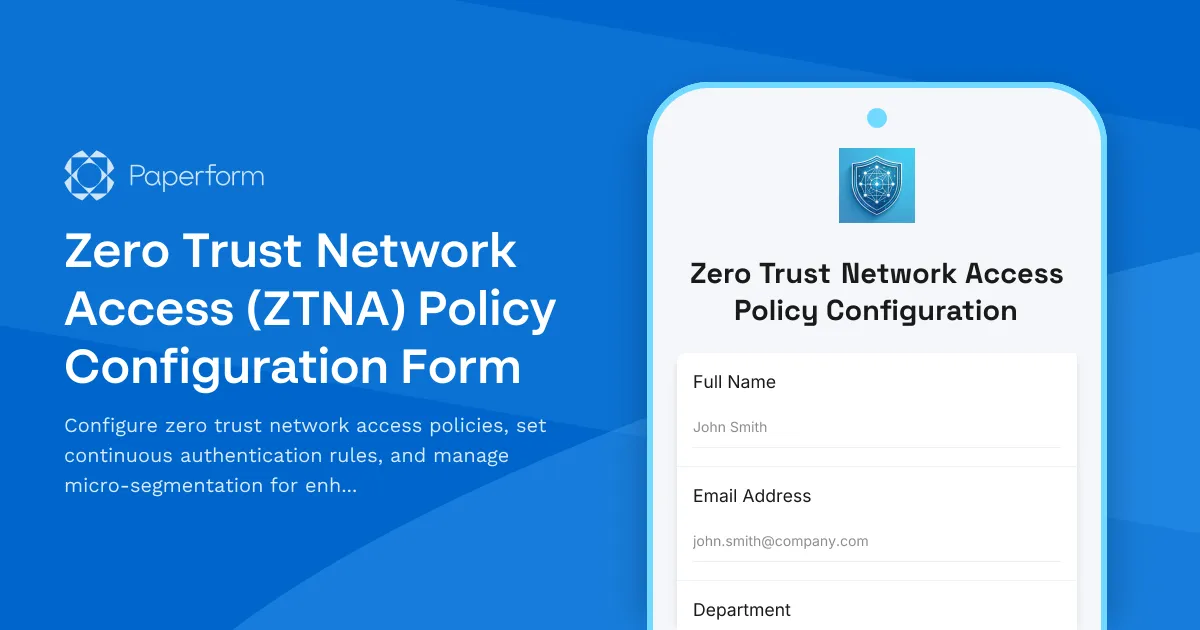
Implement Zero Trust Security with Confidence
Zero trust network access (ZTNA) represents a fundamental shift from traditional perimeter-based security to a model where trust is never assumed and verification is continuous. This Zero Trust Network Access Policy Configuration Form helps IT security teams efficiently manage access policies, authentication rules, and network micro-segmentation through a centralised, structured process.
Why use this ZTNA configuration form?
Modern organisations need to balance security with productivity. This form template enables IT administrators and security teams to:
- Define granular access policies based on user identity, device posture, location, and risk level
- Configure continuous authentication requirements that adapt to changing threat landscapes
- Implement micro-segmentation to limit lateral movement and contain potential breaches
- Document policy changes with clear audit trails for compliance and security reviews
- Streamline approval workflows for access requests and policy modifications
Built with Paperform, this template transforms complex security configurations into a clear, structured process that both technical and non-technical stakeholders can understand.
Automate your ZTNA workflows with Stepper
Connect this form to Stepper to automate your entire zero trust policy lifecycle. Automatically route policy requests for approval, update your identity provider and ZTNA platform, notify affected users of changes, and maintain synchronised security postures across your entire infrastructure—all without writing code.
Who benefits from this template?
This form is designed for IT security professionals, network administrators, security operations teams, and anyone responsible for implementing zero trust architectures. Whether you're a growing SaaS company, a financial services firm, or an enterprise managing complex hybrid environments, this template provides the structure needed to maintain robust, auditable zero trust policies.
Get started with Paperform and bring enterprise-grade security management to your organisation with professional forms that integrate seamlessly into your existing security stack.



More templates like this
IT Security Architecture Review Board Submission Form
Submit security architecture proposals to the review board for evaluation, approval, and decision documentation with comprehensive risk assessments and compliance considerations.
Server Confidential Computing Enablement Request Form
Request and configure confidential computing environments with trusted execution environment (TEE) setup, enclave configuration, remote attestation, and secure key management for sensitive workloads.
Third-Party Vendor Data Sharing Access Request Form
A comprehensive form for managing third-party vendor data access requests, including data processing agreement requirements, security assessments, and purpose limitation controls for IT and compliance teams.
Cybersecurity Incident Post-Mortem Report
Conduct thorough post-incident analysis with attack vector documentation, response timeline tracking, and security gap identification to strengthen your organization's cybersecurity posture.
Data Center Server Room Access Request Form
Request secure access to data center server rooms with two-factor authentication setup, equipment authorization, and compliance acknowledgment for IT professionals and technicians.
Identity and Access Management Quarterly Review Form
Conduct comprehensive IAM quarterly reviews with user provisioning audits, role-based access validation, and orphaned account identification to maintain security compliance and minimize access risks.
IT Compliance Audit Remediation Change Request Form
A comprehensive form for requesting and tracking IT compliance audit remediation changes, including finding resolution, evidence collection, and verification procedures for compliance teams.
Privileged Access Request Form
Request temporary or permanent admin rights with business justification and security approval. Streamline privileged access management for IT teams.
Security Incident Escalation Criteria Definition Form
Define clear escalation criteria for security incidents with severity matrices, notification thresholds, and communication protocols to ensure rapid and appropriate response.
Two-Factor Authentication Rollout Compliance Form
Streamline your 2FA rollout with this comprehensive enrollment verification form. Includes backup code distribution, exception requests, and compliance tracking for IT security teams.
Adversary Emulation Exercise Planning Form
A comprehensive planning form for red team operations, purple team collaboration, and detection capability validation exercises. Define scope, schedule collaborative sessions, and validate your security controls.
Catastrophic Data Loss Incident Report
Report critical data loss incidents, activate business continuity protocols, and manage customer notification and regulatory disclosure requirements for corporate emergencies.