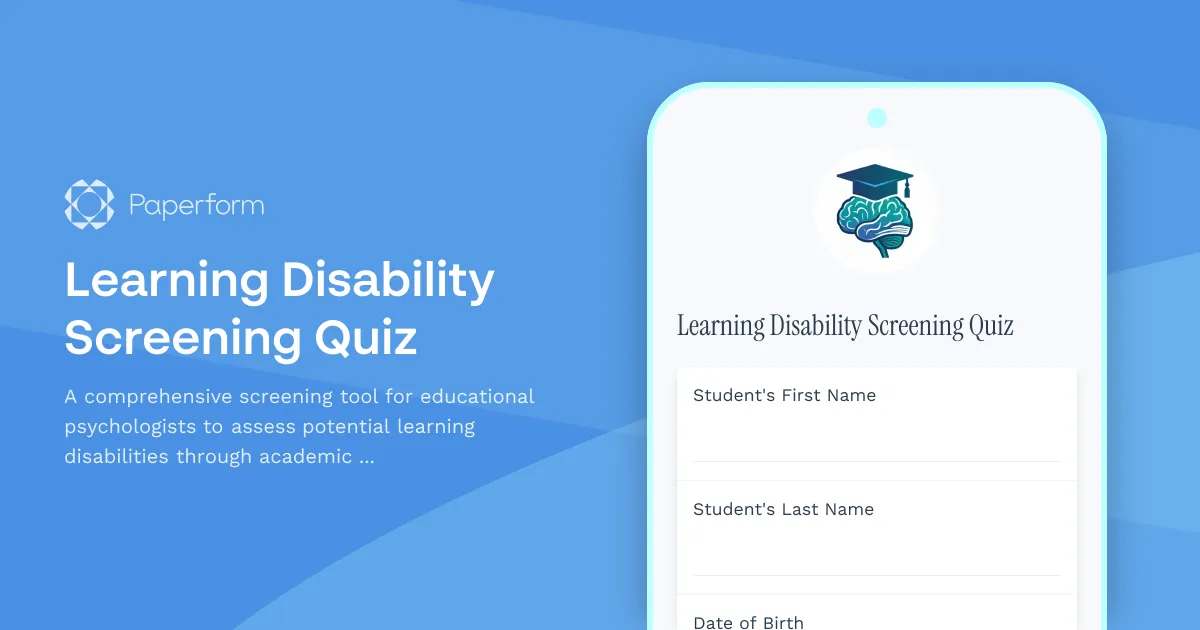
Learning Disability Screening Quiz for Educational Psychologists
Early identification of learning disabilities is crucial for providing timely support and interventions that can significantly improve student outcomes. This Learning Disability Screening Quiz is designed specifically for educational psychologists, school counselors, and special education coordinators who need a structured, evidence-based tool to assess students for potential learning disabilities.
Comprehensive Assessment Framework
This screening tool combines multiple assessment dimensions to provide a holistic view of student functioning. The quiz evaluates academic performance indicators across reading, writing, and mathematics, captures behavioral observations from classroom settings, assesses cognitive and processing patterns, and identifies social-emotional factors that may impact learning. By gathering information across these domains, educational professionals can identify patterns that may indicate specific learning disabilities such as dyslexia, dyscalculia, dysgraphia, or processing disorders.
Designed for Educational Professionals
Whether you're conducting initial screenings in a school district, evaluating referrals from teachers and parents, or triaging cases for comprehensive psychoeducational assessment, this template provides the structure you need. The quiz is built around best practices in educational psychology and aligns with common diagnostic frameworks while remaining accessible and efficient to complete.
Intelligent Referral Triggers and Next Steps
One of the most powerful features of this screening tool is its ability to help prioritize cases and determine appropriate next steps. Based on the severity and patterns of indicators captured, you can quickly identify students who may benefit from comprehensive evaluation, targeted interventions, or additional monitoring. The form creates a clear pathway from initial concern to actionable recommendations.
Streamline Your Assessment Workflow with Paperform
Using Paperform for your learning disability screening brings several advantages to your practice. The intuitive interface makes it easy for teachers or parents to complete pre-screening information, while conditional logic ensures that follow-up questions appear only when relevant, keeping the assessment efficient. You can customize the questions to align with your district's specific protocols and referral criteria, and all responses are automatically organized for easy review.
With Paperform's calculation and scoring capabilities, you can build in weighted scoring systems that help flag high-priority cases automatically. Integration with your existing tools means screening results can flow directly into your student information system, Google Sheets for tracking, or even trigger a Stepper workflow that automatically schedules follow-up appointments and sends parent notification letters.
The ability to save partial responses ensures that lengthy screenings can be completed over multiple sessions without losing data. For agencies serving multiple schools or districts, Paperform's branding options let you maintain professional, district-specific forms while managing everything from one platform.
HIPAA Considerations
Please note that while Paperform offers robust security features including SOC 2 Type II compliance, it is not a HIPAA-compliant solution. Educational psychologists working with student health information should ensure their data handling practices align with FERPA requirements and district policies regarding student privacy and confidentiality.



More templates like this
Dyslexia Screening Quiz
A comprehensive dyslexia screening tool for educators and specialists to identify reading difficulties, assess phonological awareness, and determine if formal diagnostic testing is recommended.
Autism Spectrum Disorder Diagnostic Observation Consent Form
A comprehensive consent and information form for ASD diagnostic observation including ADOS-2 assessment, parent interview, school observation, and multidisciplinary team evaluation.
Autism Spectrum Support Services Intake Form
A comprehensive intake form for autism spectrum support services that captures sensory profiles, communication preferences, social skills assessments, and behavior patterns to create personalized support plans.
Functional Behavioral Assessment Parent Questionnaire
A comprehensive parent questionnaire for functional behavioral assessments (FBA) that helps educators understand student behavior patterns, environmental triggers, reinforcement factors, and communication methods to develop effective behavioral intervention plans.
Individual Counseling Services Request for Students with Emotional Disturbance
A comprehensive form for requesting and documenting intensive individual counseling services for students with emotional disturbance, including treatment planning, evidence-based interventions, crisis prevention strategies, and outcome measurement.
K-2 Reading Disability Early Intervention Screening Form
Comprehensive early screening tool for K-2 students to identify reading disabilities through phonemic awareness, rapid naming, and letter knowledge assessments with tiered support recommendations.
Learning Disability Assessment Form
A comprehensive pre-assessment form for identifying learning difficulties, academic challenges, processing speed concerns, and accommodation needs for students and individuals seeking evaluation.
Nonverbal Communication Assessment Form
A comprehensive assessment tool for evaluating nonverbal communication methods in students with complex needs, including gestures, vocalizations, eye gaze, and AAC systems.
Social-Emotional Learning (SEL) Intervention Form for Students with Autism
A comprehensive assessment and intervention planning form for social-emotional learning programs supporting students with autism, covering perspective-taking, emotion regulation, friendship skills, and pragmatic language development.
Adapted Physical Education Evaluation Request Form
A comprehensive evaluation request form for adapted physical education programs, assessing gross motor skills, fitness levels, adaptive equipment needs, and inclusive sports participation opportunities for students with diverse abilities.
Assistive Technology Evaluation Request Form
Request an assistive technology evaluation for students with learning barriers. Assess current technology use, identify needs, and connect with AT specialists for personalized support.
Augmentative and Alternative Communication (AAC) Device Trial Request Form
Request a trial of AAC devices for students or individuals with communication needs. Assess current communication methods, device preferences, training requirements, and funding options to support communication goals.