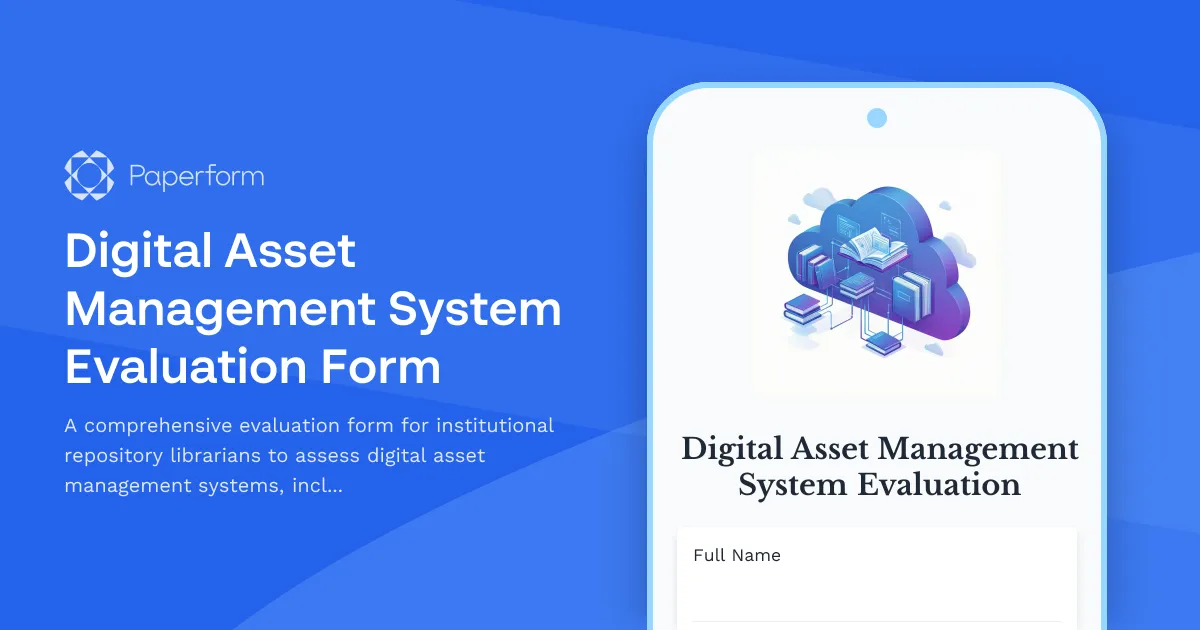
Managing an institutional repository requires specialized software that can handle complex metadata, preserve digital assets for the long term, and ensure compliance with open access mandates. This Digital Asset Management System Evaluation Form is designed specifically for academic librarians, repository managers, and research administrators who need to assess DAM solutions for their institutions.
Whether you're evaluating a new system, conducting annual reviews, or gathering feedback from repository users, this template helps you systematically capture critical information about metadata harvesting protocols (OAI-PMH, SWORD), preservation format support (PDF/A, TIFF, XML), usage analytics capabilities, and open access mandate compliance tracking.
Built for libraries, universities, research institutions, and academic repositories, this form enables you to collect detailed technical assessments alongside user experience feedback. The structured approach ensures you're evaluating systems against the specific needs of scholarly communication, long-term digital preservation, and funder compliance requirements.
With Paperform's conditional logic, you can customize the evaluation path based on system type or institutional priorities. Integration capabilities mean you can automatically route feedback to your project management tools, update evaluation matrices in Airtable or Google Sheets, and notify stakeholders via Slack when critical assessments are submitted.
For workflows that extend beyond initial evaluation, Stepper can automate your vendor assessment process—routing responses to different review committees, triggering follow-up demos, updating procurement tracking systems, and coordinating cross-departmental approval workflows without manual coordination.
This template transforms a complex technical evaluation into a clear, actionable assessment tool that helps library and IT professionals make informed decisions about the digital infrastructure that will support their institution's scholarly output for decades to come.
More templates like this
Cultural Heritage Digitization Equipment Request Form
A comprehensive form for museum registrars to request and document digitization equipment for cultural heritage collections, ensuring archival quality standards and grant funding compliance.
Digital Preservation Software Archivist Evaluation Form
A comprehensive evaluation form for archivists to assess digital preservation software performance, covering format migration success, metadata compliance, long-term accessibility, and audit trail documentation capabilities.
Rare Book Conservation Materials Evaluation Form
A specialized form for archivists and conservators to document and evaluate conservation materials for rare books, ensuring acid-free composition, longevity standards, reversibility, and museum-grade compliance.

Archaeological Conservation Chemical Specialist Form
A specialized form for archaeological conservation specialists to assess artifact material compatibility, excavation site stability, and documentation requirements for publication-quality preservation.

Educational Toy Developmental Impact Assessment
Collect comprehensive feedback on educational toys with developmental impact analysis, age group testing, learning outcomes, engagement metrics, and educator ratings.
Lab Equipment Researcher Feedback Form
Collect detailed feedback from researchers on lab equipment performance, including measurement accuracy, calibration stability, data export functionality, and grant funding justification support.
Clinical Research Conference Attendee Survey
Professional post-conference feedback form for clinical research events covering protocol design, IRB compliance, patient recruitment, and data management technology sessions.

Lab Instructor Evaluation Form
Evaluate lab instructors on experiment preparation, safety supervision, data analysis guidance, and lab report feedback quality in science courses.
Library Program Participant Feedback Form
Gather valuable feedback from library program participants about program quality, staff helpfulness, and resource availability to improve your library services.
Preventive Conservation Monitoring Equipment Feedback Form
A comprehensive feedback form for collections managers to evaluate preventive conservation monitoring equipment, assessing early detection capabilities, false alarm rates, staff training requirements, and disaster response integration.
Rare Disease Medication Patient Registry Form
A comprehensive patient registry form for tracking symptom improvement, side effects, quality of life metrics, and clinical trial interest for patients taking rare disease medications.
Accessibility Technology User Feedback Form
Gather detailed feedback on accessibility technology products from users with disabilities, covering effectiveness, usability, independence improvement, learning curve, and caregiver training needs.