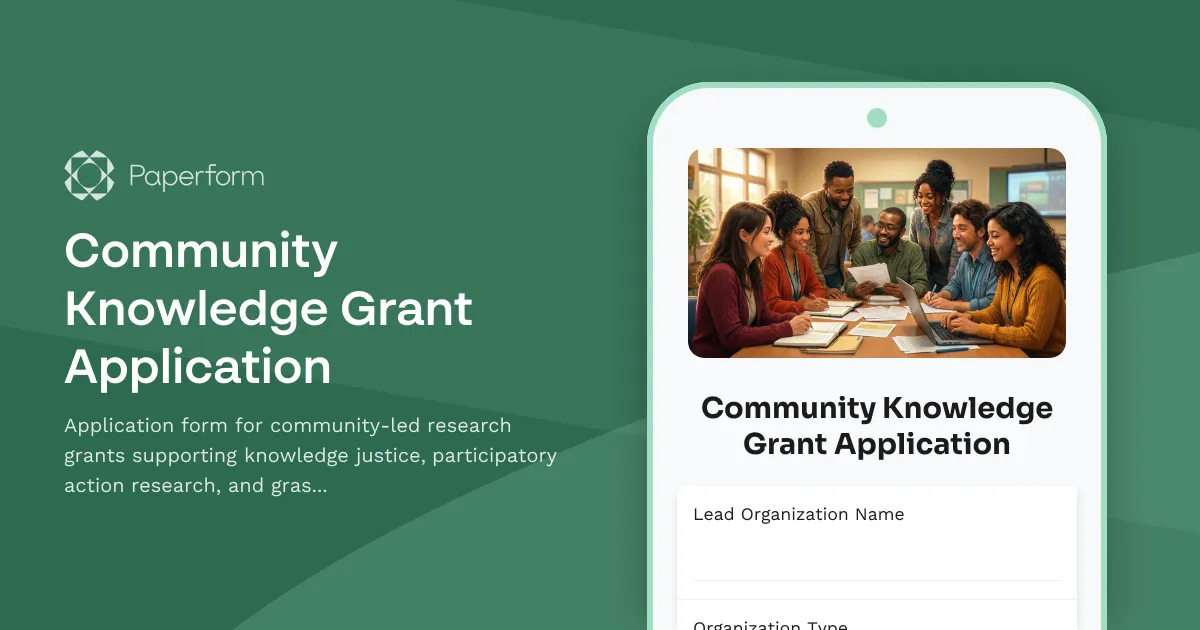
Empower Community-Led Research with Our Community Knowledge Grant Application Template
Access to knowledge creation shouldn't be limited to traditional academic institutions. Community-led research, participatory action research, and grassroots intellectual production are transforming how we understand knowledge justice and who gets to be a knowledge creator. Our Community Knowledge Grant Application template is purpose-built for foundations, universities, nonprofit organizations, and community development corporations seeking to fund equitable, community-centered research partnerships.
Why Community Knowledge Grants Matter
Traditional research models have historically extracted knowledge from communities without giving back agency, ownership, or benefit. Community knowledge grants flip this paradigm by centering community voices, supporting participatory action research methodologies, and acknowledging that communities are experts in their own experiences. These grants fund projects where community members aren't just research subjects—they're co-researchers, co-designers, and co-beneficiaries of the knowledge produced.
Whether you're a community foundation investing in knowledge justice, a university building authentic community partnerships, or a nonprofit supporting grassroots intellectual movements, having a structured yet accessible application process is essential for identifying truly community-centered projects.
What Makes This Template Different
This isn't your standard academic grant application. We've designed this template specifically for community knowledge work, incorporating questions that assess:
- Community leadership and ownership in the research process
- Participatory methodologies that ensure community members shape the research questions, methods, and outcomes
- Knowledge justice principles including who owns the data, who benefits from findings, and how knowledge will be shared
- Community-university partnership dynamics that are equitable and reciprocal
- Grassroots intellectual production that values non-academic forms of knowledge and dissemination
The form collects comprehensive information about the applicant organization, community context, research approach, partnership structure, and impact plans—all while remaining accessible to community organizations that may not have professional grant writers on staff.
Perfect for Multiple Stakeholders
For Funders & Foundations: Screen applications efficiently while ensuring you're truly funding community-led work. The form's structure helps you identify projects with genuine community ownership versus extractive research disguised as participatory. You can collect all the information you need to make informed funding decisions while supporting applicants through a clear, transparent process.
For Universities & Research Institutions: Build authentic community-university partnerships by demonstrating your commitment to equitable collaboration from the application stage. This template helps you assess whether proposed partnerships center community needs and knowledge, ensuring your institution's research activities contribute to knowledge justice rather than knowledge extraction.
For Community Development Corporations & Intermediaries: Support grassroots organizations in accessing research funding by providing a clear, navigable application process. The form helps community groups articulate their research vision in ways that funders will understand while maintaining their authentic voice and approach.
For Nonprofit Organizations: Whether you're a community-based organization applying for funding or a nonprofit managing a grant program, this template provides structure for complex community research proposals while remaining accessible to organizations without extensive grant-writing capacity.
Key Features That Support Community-Centered Work
Our template includes carefully designed sections for:
- Community profile and context to understand the specific community being served
- Participatory research methodology to assess genuine community involvement in the research process
- Partnership structure and equity to evaluate how power, resources, and decision-making are shared
- Knowledge ownership and dissemination to ensure communities control and benefit from the knowledge produced
- Community capacity building to understand how the research strengthens community power and capabilities
- Budget and resource allocation that demonstrates fair compensation for community researchers and knowledge holders
Conditional logic ensures applicants only see questions relevant to their project type, making the form more accessible while still collecting comprehensive information for review.
Seamless Integration with Your Grant Management Workflow
Built on Paperform, this template doesn't just collect applications—it integrates with your entire grant lifecycle. Connect submissions directly to your CRM, project management tools, or Google Sheets for easy review and scoring. Set up automatic confirmation emails with next steps, and use Paperform's file upload capabilities to securely collect supporting documents like letters of support, community agreements, and partnership MOUs.
For more complex grant workflows, connect your form to Stepper to automatically route applications through multi-stage review processes, notify review committee members, create evaluation scorecards, and keep applicants informed throughout the decision-making timeline. This automation means your team can focus on building relationships with applicants rather than managing administrative tasks.
Supporting Knowledge Justice Through Better Processes
The application process itself is an expression of your values. By using a form that centers community voice, uses accessible language, and demonstrates respect for diverse forms of knowledge and expertise, you signal your genuine commitment to knowledge justice and equitable partnerships.
Our template uses plain language throughout, avoiding unnecessary jargon while still collecting rigorous information. It's designed to be completed collaboratively by community members and institutional partners, reinforcing the collaborative nature of the work being funded.
Trusted by Organizations Advancing Equity
Community foundations, research universities, social justice nonprofits, and community development organizations are using Paperform to manage their grant applications with greater efficiency and equity. With SOC 2 Type II compliance and robust data security, you can trust that sensitive community information and partnership details are protected throughout the application process.
Get Started in Minutes
Our Community Knowledge Grant Application template comes pre-built and ready to customize. Adjust the questions to reflect your specific funding priorities, add your organization's branding, set your submission deadline, and start accepting applications. No coding required—just a commitment to supporting community-led knowledge creation.
Whether you're launching your first community knowledge fund or refining an existing program, this template provides the foundation for an accessible, equitable, and effective application process that honors the communities you serve.
Ready to support grassroots intellectual production and participatory action research? Start with a grant application process that reflects your values and makes it easier for community-led projects to access the funding they deserve.



More templates like this
Climate Adaptation Grant Application
Apply for climate adaptation funding with comprehensive vulnerability assessment, resilience strategies, stakeholder consultation records, and monitoring framework documentation.
Indigenous Data Sovereignty Grant Application
A comprehensive grant application form for Indigenous communities seeking funding for data sovereignty initiatives, including tribal data governance, culturally appropriate research protocols, community data centers, and digital repatriation projects.
Indigenous Futures Grant Application
A comprehensive grant application for Indigenous-led cultural futurism projects, youth visioning initiatives, traditional innovation, and seventh generation planning programs.
Reparations Grant Application Form
A comprehensive grant application for reparations programs focused on descendant community research, historical harm documentation, remedy design, and wealth-building initiatives.
Traditional Medicine Grant Application Form
Apply for funding to support traditional medicine research, practitioner training, quality control initiatives, and integration with conventional healthcare systems.
Decolonization Grant Application Form
Apply for funding to support decolonization initiatives including curriculum transformation, Indigenous knowledge systems integration, land acknowledgment implementation, and institutional policy reform.
Entrepreneurship Training Grant Application
Apply for funding to develop and deliver entrepreneurship training programs, including curriculum design, mentor networks, pitch competitions, and business incubation support.
Environmental Conservation Grant Application
Apply for environmental conservation funding with detailed project plans, site mapping, species impact assessment, and community engagement strategy.
Financial Literacy Grant Application
Apply for funding to support financial literacy programs including curriculum development, counselor certifications, credit building initiatives, and predatory lending prevention education.
Language Revitalization Grant Application
Apply for funding to support endangered language preservation through immersion schools, master-apprentice programs, digital resources, and intergenerational transmission initiatives.
Participatory Research Grant Application
A comprehensive grant application form for participatory research projects that prioritize community engagement, co-investigator partnerships, data sovereignty, and equitable knowledge sharing.
Workforce Development Grant Application
Comprehensive grant application form for workforce development programs including skills gap analysis, industry partnerships, job placement commitments, and apprenticeship pathway planning.