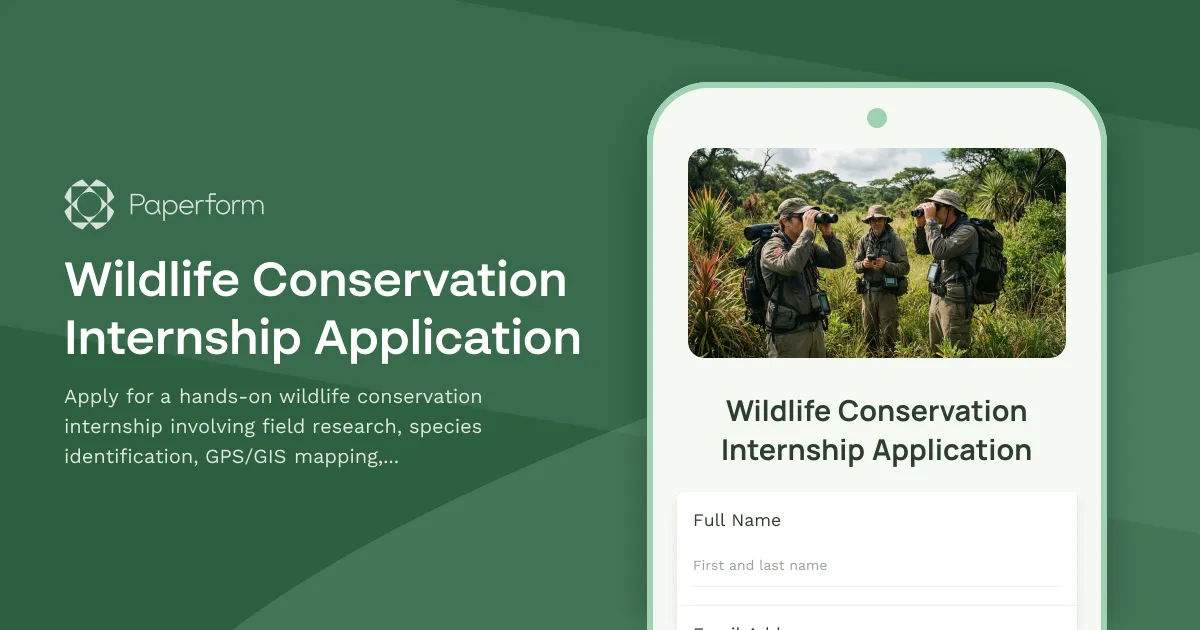
Wildlife Conservation Internship Application Form
Wildlife conservation organisations need a streamlined way to evaluate candidates for field research internships—and a generic job application just won't cut it. Our Wildlife Conservation Internship Application template is purpose-built for conservation groups, national parks, research stations, wildlife trusts and environmental NGOs seeking passionate interns ready for hands-on fieldwork.
This form template goes beyond standard résumé screening. It assesses technical skills like species identification, GPS/GIS mapping proficiency, habitat restoration experience and field research capabilities—all the specialist knowledge that determines whether a candidate can contribute meaningfully to your conservation projects from day one.
Why this form works for conservation programmes
Wildlife conservation internships are immersive, demanding roles that require a unique blend of scientific knowledge, physical stamina and genuine commitment to environmental stewardship. This Paperform template helps you identify candidates who have:
- Field research experience: Previous involvement in biodiversity surveys, wildlife monitoring or ecological data collection
- Species identification skills: Familiarity with local flora and fauna, taxonomic knowledge, and field guide proficiency
- Technical mapping abilities: GPS and GIS software experience for tracking wildlife movements, mapping habitat boundaries or recording survey coordinates
- Habitat restoration background: Hands-on work in reforestation, invasive species removal, wetland rehabilitation or ecosystem management
- Physical readiness: Comfort working outdoors in challenging conditions, remote locations and variable weather
The form includes conditional logic to dive deeper when candidates indicate relevant experience, and it collects portfolio materials, research samples and references—all in one organised submission that makes shortlisting faster and fairer.
Who this template is for
This form is ideal for:
- Wildlife conservation organisations recruiting field interns for research expeditions and monitoring programmes
- National parks and nature reserves seeking seasonal interns for habitat management and visitor education
- Environmental NGOs and trusts running citizen science projects, species recovery programmes or rewilding initiatives
- University research stations coordinating fieldwork internships for ecology, zoology or conservation biology students
- Ecotourism operators combining conservation work with responsible tourism experiences
- Zoos and aquariums offering field placement opportunities in partnership with wild populations
Automate internship workflows with Stepper
Once applications land in Paperform, you can use Stepper to build an AI-native workflow that keeps your recruitment process moving:
- Automatically score applications based on required vs. preferred qualifications
- Route submissions to different reviewers depending on the candidate's area of interest (e.g., marine conservation vs. terrestrial ecology)
- Send conditional follow-ups: invite top candidates to schedule a video interview or request additional references
- Sync applicants into your HR system, Airtable project tracker or Notion hiring board
- Trigger welcome emails with pre-arrival reading, packing lists and field station logistics for accepted interns
With Stepper, your small conservation team can handle dozens of applications without drowning in admin, leaving more time for the fieldwork that matters.
Customise for your conservation mission
Every conservation programme has its own focus—whether that's protecting endangered species, restoring degraded ecosystems or engaging local communities in wildlife stewardship. Paperform's doc-style editor makes it simple to tailor this template:
- Add questions about specific taxa (birds, amphibians, pollinators) or ecosystems (coastal, grassland, forest) relevant to your projects
- Include conditional sections for specialised skills like camera trap deployment, acoustic monitoring, radio telemetry or drone operation
- Embed photos or videos of your field sites to give candidates a real sense of the environment and work
- Adjust start dates, programme length and stipend details to match your internship structure
- Integrate COVID-19 vaccination or health screening questions if required for remote field stations
You can also collect application fees (to cover admin costs) or request deposits to confirm placement, all through Paperform's built-in Stripe, PayPal or Square integrations.
Trusted by conservation leaders
Paperform is SOC 2 Type II and GDPR compliant, so sensitive applicant data—passports, emergency contacts, medical information—is handled securely. Role-based permissions let you share applications with field supervisors, academic partners or board members without exposing personal details unnecessarily.
Whether you're a scrappy grassroots charity or a well-established international conservation charity, this template helps you find interns who are ready to get muddy, learn fast and make a real difference for wildlife and wild places.
Start using this Wildlife Conservation Internship Application template today and build the next generation of conservation professionals.



More templates like this
Environmental Science Field Internship Application
Apply for hands-on environmental science field internships with outdoor skills assessment, physical fitness acknowledgment, and research interest evaluation.
Regenerative Agriculture Internship Application
Apply for a regenerative agriculture internship focused on soil health assessment, carbon sequestration, rotational grazing, and climate-resilient farming practices.
Vertical Ocean Farming Internship Application
Apply for hands-on experience in regenerative ocean farming, seaweed cultivation, and marine permaculture. Join a team working on blue carbon sequestration and sustainable aquaculture solutions.
Aquatic Invasive Species Management Scholarship Application
A comprehensive scholarship application for students pursuing careers in aquatic invasive species management, with focus on ecology, rapid response, and conservation work.
Bioacoustic Species Monitoring Internship Application
Apply for a conservation technology internship focused on bioacoustic monitoring, audio signal processing, and endangered species detection using passive acoustic monitoring systems.
Carbon Offset Verification Internship Application
Apply for a carbon offset verification internship position. Demonstrate your knowledge of climate science, forestry carbon accounting, additionality assessment, and carbon registry platforms.
Climate Action Leadership Program Application
Apply for a transformative climate action leadership fellowship focused on sustainability, systems thinking, and policy advocacy. Designed for emerging leaders passionate about driving environmental change.
Climate Adaptation Consulting Internship Application
Apply for a climate adaptation consulting internship focused on vulnerability assessment, resilience planning, nature-based solutions, and community engagement.
Climate Adaptation Grant Application
Apply for climate adaptation funding with comprehensive vulnerability assessment, resilience strategies, stakeholder consultation records, and monitoring framework documentation.
Ecological Restoration Grant Application
Apply for funding to support ecological restoration projects including Indigenous fire practices, watershed restoration, habitat connectivity, and community-based natural resource management initiatives.
Environmental Conservation Grant Application
Apply for environmental conservation funding with detailed project plans, site mapping, species impact assessment, and community engagement strategy.
Green Chemistry Innovation Challenge Team Registration
Register your team for the Green Chemistry Innovation Challenge. Submit your problem statement, research approach, and commercialization potential to compete for funding and support.