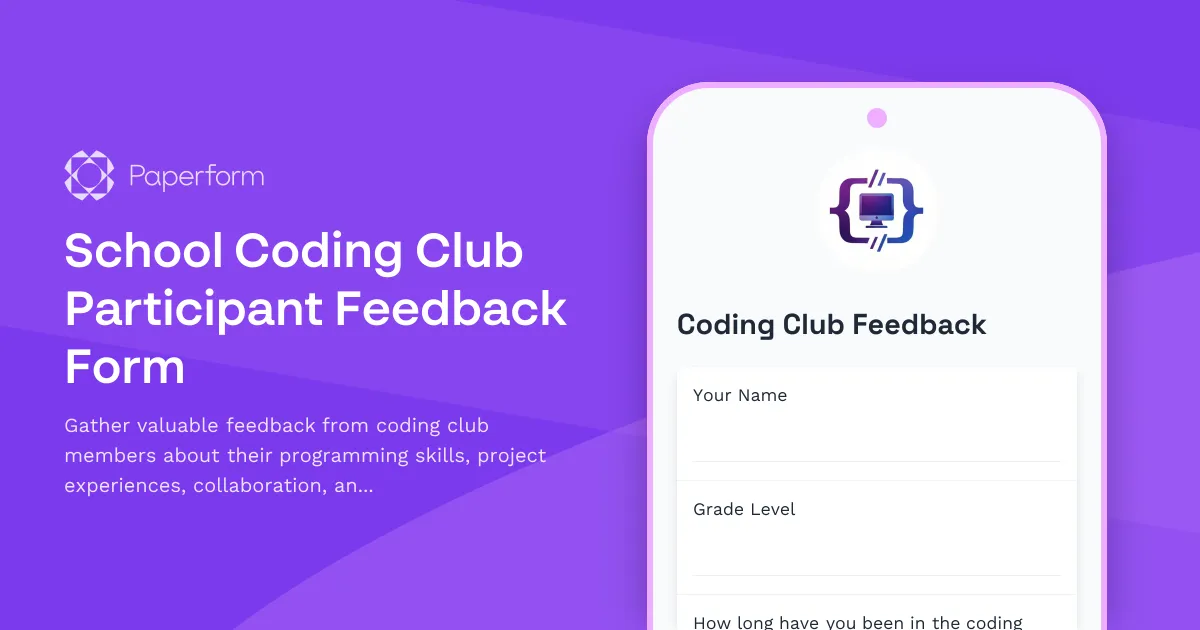
Build a Better Coding Club with Student Feedback
Running a successful school coding club means understanding what's working, what's not, and how to keep students engaged with programming. This School Coding Club Participant Feedback Form helps educators collect meaningful insights about skill progression, project creativity, peer collaboration, mentor effectiveness, and how the club influences students' interest in computer science.
Whether you're running an after-school program, a lunchtime coding session, or a competitive programming team, regular feedback from participants ensures your club evolves to meet students' needs and keeps them excited about technology.
What This Coding Club Feedback Template Includes
This template is designed specifically for K-12 and higher education coding clubs, capturing feedback across key areas:
- Programming skill progression – Rating scales and open feedback on how much students feel they've improved
- Project creativity and freedom – Assessment of autonomy and creative expression in club projects
- Peer collaboration quality – Evaluation of teamwork, pairing, and group project experiences
- Mentor and instructor support – Feedback on teaching effectiveness, availability, and encouragement
- Computer science interest development – Understanding how the club impacts career and academic interest in CS
- Overall experience and suggestions – Open-ended feedback for continuous improvement
Why Paperform for Educational Feedback?
Paperform makes it easy for teachers, club coordinators, and student leaders to create professional feedback forms that students actually want to fill out. The doc-style editor lets you add headings, images, and explanations inline, making your form feel more like a conversation than a survey.
Use conditional logic to ask follow-up questions based on responses (like asking students who rate collaboration low to share what could improve), and leverage AI Insights to quickly summarize hundreds of responses into actionable themes without reading every submission individually.
You can embed the form on your school website, share it via Google Classroom or email, and sync responses to Google Sheets for easy reporting. For clubs across multiple schools or campuses, use Stepper (stepper.io) to automate follow-up actions—like flagging low satisfaction scores for immediate review or automatically compiling end-of-semester reports.
With Paperform's friendly interface, GDPR compliance, and flexibility, you'll get better feedback and spend less time wrestling with clunky survey tools—leaving more time to focus on what matters: inspiring the next generation of coders.
More templates like this
Educational Game-Based Learning Feedback Form
Gather comprehensive feedback on educational games with questions covering game mechanics, learning outcomes, difficulty progression, engagement levels, and knowledge retention to improve game-based learning experiences.
Peer Tutoring Program Evaluation Form
Comprehensive evaluation form for peer tutoring programs that measures tutor quality, scheduling flexibility, subject coverage, and academic improvement to enhance student learning outcomes.
Classroom Technology Integration Survey
A comprehensive survey to evaluate how students experience technology in the classroom, including interactive tools, digital platforms, online resources, and tech support effectiveness.
College Academic Probation Support Program Feedback Survey
A comprehensive feedback survey designed to evaluate academic probation support programs, including advisor effectiveness, study skills resources, mental health support, and student success outcomes.
College Accelerated Degree Program Student Survey
Gather comprehensive feedback from students enrolled in accelerated degree programs about course intensity, support services, time management, academic quality, and overall satisfaction with their experience.
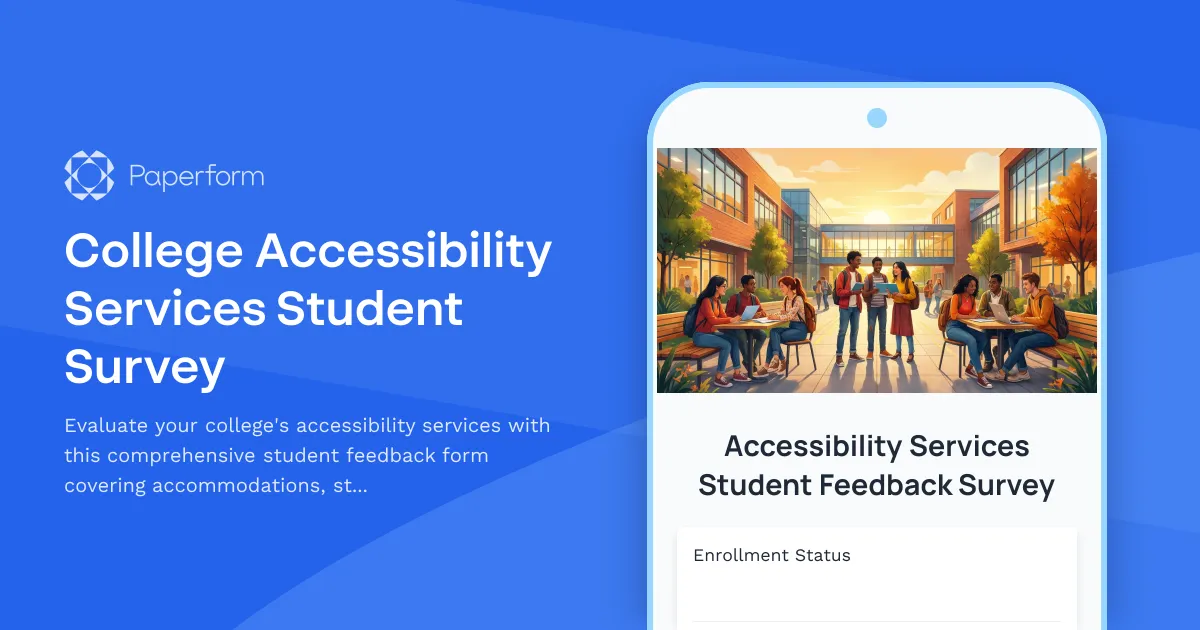
College Accessibility Services Student Survey
Evaluate your college's accessibility services with this comprehensive student feedback form covering accommodations, staff support, assistive technology, testing arrangements, and advocacy effectiveness.
College Career Services Satisfaction Survey
Evaluate your career services experience including resume assistance, interview prep, job fairs, employer connections, and alumni networking to help improve student outcomes.
College Entrepreneurship Course Evaluation
A comprehensive evaluation form for entrepreneurship course participants to assess course effectiveness, business development skills, pitch presentation capabilities, mentor engagement, and venture launch readiness.

College Peer Review Writing Workshop Evaluation
Evaluate peer review writing workshops with this comprehensive feedback form. Assess feedback quality, revision improvements, critical reading skills, collaborative learning value, and writing confidence development.
Design Thinking Classroom Project Feedback Form
Evaluate student development in design thinking skills including empathy, ideation, prototyping, user feedback integration, and problem-solving confidence through comprehensive project assessment.
Dual Language Immersion Program Parent Survey
Gather comprehensive feedback from parents about their child's dual language immersion experience, including language development, cultural growth, academic progress, and program satisfaction.
Educational Augmented Reality Lesson Feedback Form
Gather student feedback on AR-enhanced lessons to measure technology integration effectiveness, visual engagement, interactivity, technical challenges, and learning outcomes.