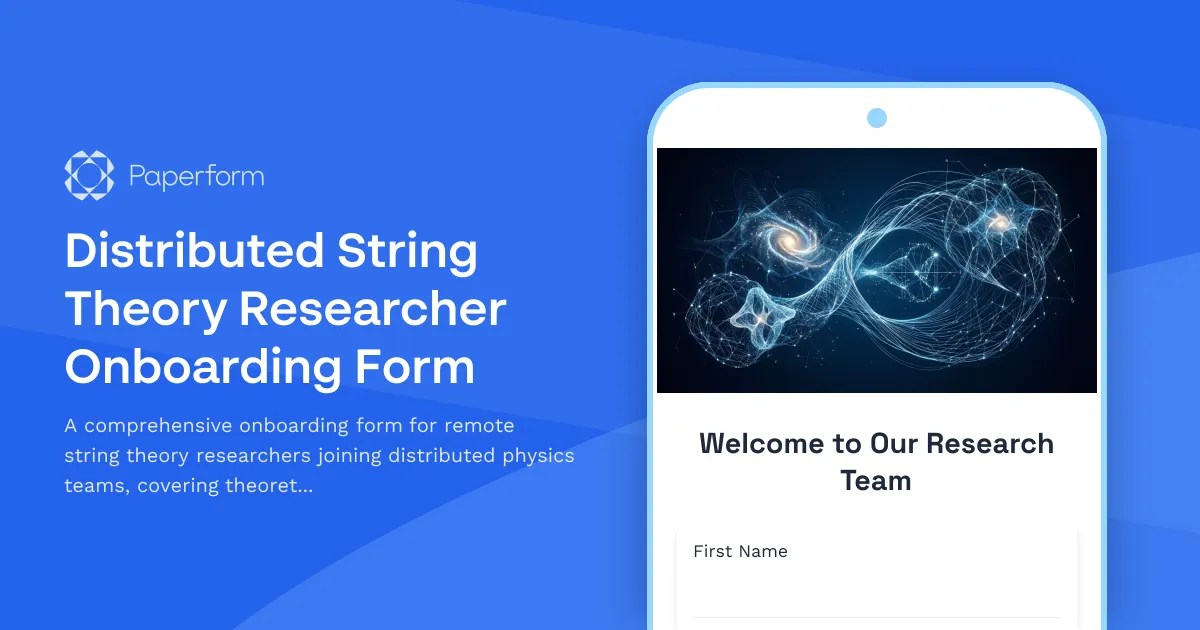
Streamline Your String Theory Research Team Onboarding
Bringing a new theoretical physicist onto a distributed research team requires careful coordination across multiple platforms, access credentials, and specialized computational resources. This Distributed String Theory Researcher Onboarding Form template is designed specifically for physics departments, research institutions, and collaborative theory groups working across geographic boundaries.
Why Paperform for Academic Research Onboarding?
Modern theoretical physics research demands seamless integration across arXiv preprint servers, mathematical collaboration platforms like Overleaf, and high-performance quantum mechanics computational clusters. This template captures all essential onboarding information in one streamlined workflow—from software proficiency assessments to hardware requirements—eliminating the email chains and fragmented spreadsheets that slow down researcher productivity.
With Paperform's conditional logic, the form adapts based on the researcher's specialization (M-theory, AdS/CFT, supersymmetry, etc.) to request only relevant software and resource access. This ensures your IT and research administration teams get precisely the information they need without overwhelming new team members.
Automate Research Team Workflows with Stepper
Connect this form to Stepper to automatically provision access credentials, send welcome packets to the right department heads, create calendar invites for orientation sessions, and track onboarding progress across your distributed team. Stepper can trigger email sequences, update your institution's HR system, and notify principal investigators when their new researcher completes key onboarding milestones.
For institutions managing NDAs, collaboration agreements, or IP acknowledgments, pair this template with Papersign to collect legally binding eSignatures on research agreements immediately after onboarding form submission.
Perfect for Research Institutions and Physics Departments
This template is ideal for university physics departments, national laboratories, research consortia, and private theoretical physics institutes managing remote or hybrid research teams. Whether you're onboarding postdocs, visiting researchers, or collaborative faculty, this form ensures consistent, professional first impressions while capturing the technical details that matter for high-energy theoretical physics research.

More templates like this
Distributed Astroparticle Physicist Onboarding Form
A comprehensive onboarding form for astroparticle physicists joining distributed research teams, covering particle detector data access, analysis tools, collaboration platforms, and safety protocols.
Distributed Neutrino Physicist Onboarding Form
A comprehensive remote onboarding form for neutrino physicists joining distributed research collaborations, covering data access, analysis tools, safety protocols, and international collaboration systems.
Remote Cosmic Ray Researcher Onboarding Form
A comprehensive onboarding form for remote cosmic ray researchers joining particle detector array teams, covering data access, analysis tools, collaboration platforms, and high-altitude research protocols.
Additive Manufacturing Conference Abstract Submission Form
Submit your research abstract on additive manufacturing, 3D printing parameters, mechanical testing results, and application case studies to our conference.
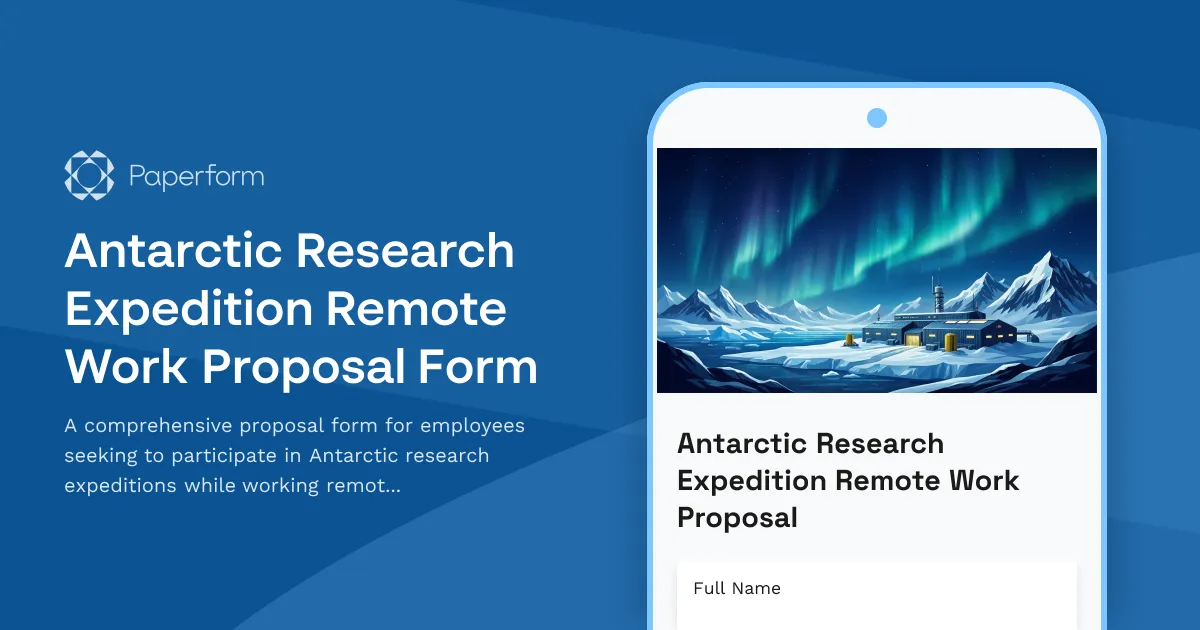
Antarctic Research Expedition Remote Work Proposal Form
A comprehensive proposal form for employees seeking to participate in Antarctic research expeditions while working remotely, covering extreme environment preparation, scientific involvement, and extended isolation protocols.
Chemical Engineering Conference Reactor Design Paper Submission
Submit your reactor design research paper with process simulation data, optimization parameters, and scale-up feasibility analysis to our chemical engineering conference.
Chemistry Research Symposium Poster Abstract Submission
Submit your chemistry research poster abstract with molecular structures, reaction conditions, and yield data for conference consideration.
Data Science Conference Paper Submission Form
A comprehensive submission form for data science conference papers, capturing algorithm details, training dataset information, model performance metrics, and feature importance analysis.

Quantum Computing Scholarship Nomination Form
A comprehensive nomination form for quantum computing scholarships, designed for academic institutions and research programs to identify promising students in quantum algorithm development and emerging technology research.
Remote Exoplanet Researcher Onboarding Form
A comprehensive onboarding form for remote exoplanet researchers to set up telescope data access, spectral analysis software, planetary characterization tools, and international observatory collaboration protocols.

Remote Paleontologist Onboarding Form
Comprehensive digital onboarding for remote paleontologists including fossil database access, excavation coordination, lab procedures, and research collaboration setup.

Research Assistant Skills Gap Assessment
Evaluate research assistant competencies across literature review, data collection, statistical analysis, laboratory techniques, and documentation to identify training needs and development opportunities.