Typeform vs Zoho Forms: Which Is Better in 2026?
Typeform and Zoho Forms occupy opposite corners of the form builder market. Typeform is the design-first, conversational form builder that charges premium prices for a premium experience -- one question at a time, beautiful transitions, and forms that feel like conversations. Zoho Forms is the practical, ecosystem-integrated form builder that delivers raw functionality at a fraction of the cost -- traditional layout, deep Zoho ecosystem integration, and submission limits so generous they make Typeform's pricing look aggressive.
The price difference is the headline: Typeform Basic costs $29/month for 100 responses. Zoho Forms Basic costs $10/month for 10,000 submissions. That's a 100x difference in submission volume for less than half the price. Whether the Typeform premium is justified depends entirely on whether its conversational design and aesthetic polish matter more to you than Zoho's volume, value, and ecosystem connectivity.
Quick Verdict
Choose Typeform if:
- Conversational, one-question-at-a-time design is essential to your brand
- Visual polish and respondent experience are top priorities
- You need broad third-party integrations (Zapier, HubSpot, Slack)
- Low-volume, high-quality interactions are your use case
Choose Zoho Forms if:
- You're already in the Zoho ecosystem (CRM, Desk, Analytics)
- Submission volume matters and budget is a concern
- You need traditional business forms (registrations, orders, applications)
- You want approval workflows and team collaboration features
Feature Comparison
Typeform leads in design and experience; Zoho Forms leads in functionality and ecosystem depth. The feature table reveals platforms built for different users with different priorities.
| Feature | Typeform | Zoho Forms |
|---|---|---|
| Form Building | ||
| Document-style editor | No | No |
| AI form creation | Yes | Yes basic |
| Field types | 20+ | Yes |
| File uploads | Yes basic | No |
| Multi-page forms | Yes basic | Yes |
| Guided mode (one question at a time) | Yes | No |
| Conditional logic | Yes basic | Yes |
| Calculations field | Yes plus | Yes basic |
| AI follow-up questions | Yes business | No |
| Scoring | Yes plus | No |
| Answer piping | Yes basic | Yes basic |
| Pre-filling and hidden fields | Yes basic | Yes |
| Save and resume | No | Yes basic |
| Auto-close by number | Yes basic | Yes |
| Auto-close by date | Yes basic | Yes |
| Appointment/booking field | Yes basic | No |
| Signature field | No | Yes |
| Color picker field | No | No |
| Video questions | Yes basic | No |
| AI calculations assistant | No | No |
| API-powered dropdowns | No | No |
| Google address search | No | No |
| Payments | ||
| Stripe payments | Yes basic | No |
| PayPal payments | No | No |
| Square payments | No | No |
| Braintree payments | No | No |
| Google Pay | No | No |
| Product sales (eCommerce) | No | No |
| Subscriptions | Yes basic | No |
| Coupons and discounts | No | No |
| Custom pricing rules | No | No |
| Tax calculations | No | No |
| Quotes/invoices | No | Yes standard |
| Refunds | No | No |
| 3D Secure | Yes basic | No |
| Stripe | No | Yes |
| PayPal | No | Yes |
| Square | No | No |
| Braintree | No | No |
| Product sales | No | Yes basic |
| Coupons | No | No |
| Custom pricing | No | Yes basic |
| Design & Customization | ||
| Template gallery | 1,500+ | Yes |
| Rich media (images, GIFs, videos) | Yes | No |
| Unsplash and Giphy integration | Yes | No |
| Language translation | Yes basic | Yes standard |
| Advanced theming | Yes plus | Yes basic |
| Custom form URL | Yes plus | No |
| Custom domains | No | No |
| Custom HTML & CSS | Yes business | No |
| Remove branding | Yes plus | Yes basic |
| Custom email domains | No | No |
| Rich media | No | Yes |
| Unsplash/Giphy | No | No |
| Image editor | No | No |
| Adobe CC | No | No |
| Custom HTML/CSS | No | Yes standard |
| Analytics | ||
| Submission results and reports | Yes | No |
| AI report insights | Yes business | No |
| Drop-off analysis | Yes business | No |
| Google Analytics & Facebook Pixel | Yes basic | No |
| Custom analytics scripts | Yes basic | No |
| Partial submissions | Yes plus | No |
| Submission results | No | Yes |
| AI insights | No | No |
| Form analytics | No | Yes standard |
| GA/FB Pixel | No | No |
| Custom scripts | No | No |
| Collaboration | ||
| Multi-user accounts | Yes plus | No |
| User permissions and management | Yes plus | No |
| Advanced permissions & admin | Yes enterprise | No |
| Form sharing (templates) | Yes | No |
| Workspace organization | Yes | No |
| Multi-user | No | Yes standard |
| Permissions | No | Yes standard |
| Advanced permissions | No | Yes professional |
| Form sharing | No | Yes |
| Spaces/tags | No | No |
| Security | ||
| SOC 2 Type II | Yes | No |
| GDPR compliant | Yes | No |
| HIPAA compliant | Yes enterprise | No |
| SSL encryption | Yes | No |
| Two-factor authentication | Yes | No |
| SSO (SAML) | Yes enterprise | No |
| reCAPTCHA | Yes business | Yes |
| ISO 27001 | Yes | No |
| PCI DSS | Yes | No |
| SOC 2 | No | Yes |
| GDPR | No | Yes |
| SSL | No | Yes |
| 2FA | No | Yes |
| Enforce 2FA | No | No |
| SSO SAML | No | Yes professional |
| Data residency | No | Yes |
| Custom S3 | No | No |
| Integrations & API | ||
| Native integrations | 120+ (basic) | No |
| Zapier | Yes basic | Yes basic |
| Make (Integromat) | Yes basic | No |
| Webhooks | Yes basic | Yes standard |
| API | Yes basic | No |
| WordPress plugin | Yes | No |
| Embed options | Yes | No |
| 2000+ | No | No |
| Standard API | No | Yes basic |
| Business API | No | No |
| WordPress | No | Yes |
| oEmbed | No | Yes |
Where Typeform Wins
Conversational Form Experience
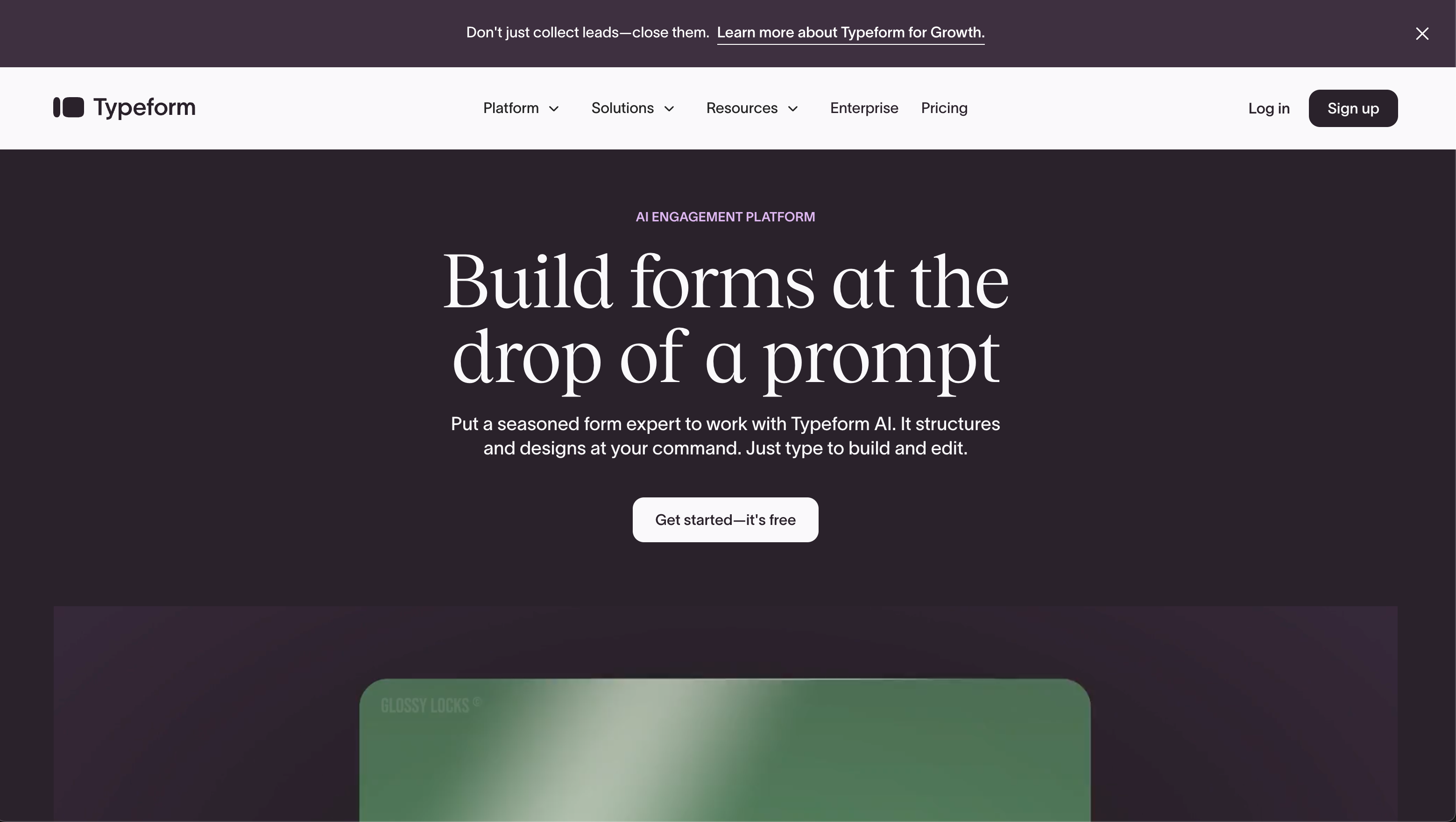
Typeform's one-question-at-a-time format is its defining feature and competitive moat. Each question appears alone on screen with smooth transitions, creating an experience that feels like a guided conversation rather than a form to fill out. This format consistently achieves higher completion rates on surveys and feedback forms compared to traditional multi-field layouts. Zoho Forms uses a conventional all-fields-on-page layout -- functional and familiar, but not engaging in the same way. For forms where the respondent experience directly impacts data quality (customer feedback, user research, NPS surveys), Typeform's conversational format has a proven edge.
Superior Design and Aesthetics
Typeform's design system is premium. Custom fonts, background images and videos, colour themes, layout options, and transition effects create forms that feel like branded digital experiences. The visual output is polished enough to embed on high-end marketing sites without looking out of place. Zoho Forms produces clean but utilitarian output -- you can add logos and change colours, but the forms look like business tools, not designed experiences. For consumer-facing brands, creative agencies, and anyone where visual presentation is a conversion factor, Typeform's aesthetics are in a different category.
Broader Third-Party Integration Ecosystem
Typeform connects to 120+ tools natively, including HubSpot, Salesforce, Slack, Google Sheets, Mailchimp, Notion, Airtable, and many more. Its Zapier and Make integrations are well-maintained and extensively documented. Zoho Forms integrates deeply with Zoho's ecosystem but has a thinner third-party integration list. If your tech stack is mostly non-Zoho tools, Typeform's integration breadth means less middleware and more direct connections. The advantage reverses if you're in the Zoho ecosystem -- but for diverse tech stacks, Typeform connects more broadly.
Brand Recognition
Typeform is one of the most recognised names in forms and surveys. Respondents are familiar with the format, which reduces friction. The platform's market position also means abundant support resources, community knowledge, and third-party tutorials. Zoho Forms is known within the Zoho ecosystem but lacks the standalone brand recognition of Typeform. For teams where vendor recognition matters (enterprise procurement, client-facing tools), Typeform carries more market weight.
Where Zoho Forms Wins
Dramatically Better Pricing
The pricing gap is staggering. Zoho Forms Basic costs $10/month for 10,000 submissions. Typeform Basic costs $29/month for 100 responses. That's 100x more submissions for 65% less money. Even at higher tiers, the gap persists: Zoho Professional ($25/month) gives you 100,000 submissions; Typeform Plus ($59/month) gives you 1,000 responses. For any team where submission volume matters -- lead capture campaigns, event registrations, feedback programmes, data collection at scale -- Zoho's pricing makes Typeform look punitive. The value equation is not close.
Zoho Ecosystem Integration
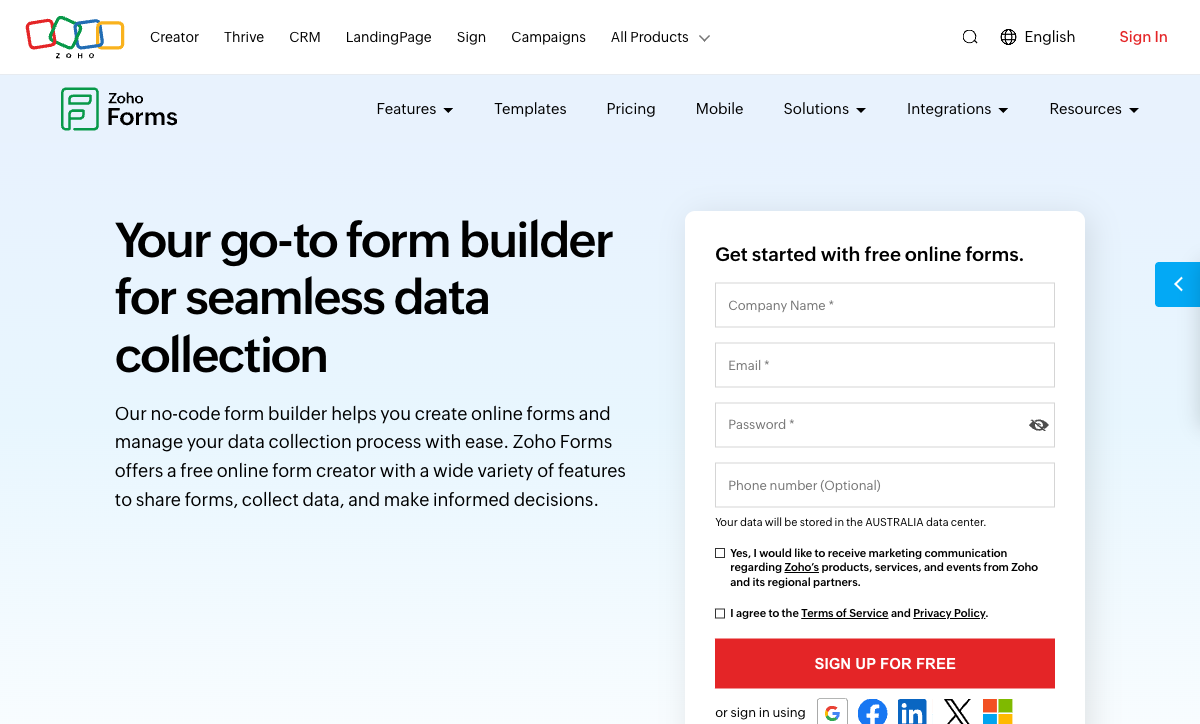
Zoho Forms connects natively to Zoho's 50+ business applications: Zoho CRM (form submissions create leads and contacts), Zoho Desk (form responses create support tickets), Zoho Analytics (form data feeds dashboards), Zoho Campaigns (form contacts join email lists), Zoho Projects (form submissions create tasks), and Zoho Sign (form flows include e-signatures). For organisations running on Zoho, Forms becomes the data collection layer for their entire business stack -- no Zapier, no middleware, no API configuration. This ecosystem depth is Zoho Forms' strongest differentiator and something Typeform can't replicate.
Approval Workflows
Zoho Forms includes built-in approval workflows -- form submissions can be routed to managers, team leads, or department heads for review and approval before processing. Multi-step approvals, conditional routing, and approval notifications are all native. Typeform has no approval workflow capability. For business processes that require human review (leave requests, expense approvals, procurement forms, content approvals), Zoho Forms handles the workflow natively while Typeform requires external tools.
Offline Data Collection
Zoho Forms supports offline form access through its mobile app -- collect data without internet connectivity and sync when reconnected. Field workers, event staff, and teams in areas with unreliable connectivity can use forms regardless of network availability. Typeform is entirely web-based with no offline capability. For teams collecting data at trade shows, construction sites, remote locations, or anywhere with spotty internet, Zoho's offline support is a practical advantage.
Payment Collection
Zoho Forms integrates with Stripe, PayPal, Razorpay, and other payment gateways for collecting payments through forms. Typeform supports Stripe as a field type but lacks the gateway variety and payment workflow depth of Zoho Forms. For order forms, donation pages, and event registration with payment, Zoho Forms provides more payment flexibility at a dramatically lower price point.
Where Typeform Falls Short
- Punishing response limits: 100 responses on the $29/month plan. Marketing campaigns, feedback programmes, and any form with moderate traffic can burn through this in hours.
- No approval workflows: Form submissions land in a results dashboard. No routing, no approval chains, no multi-step review processes. Business process forms need external tools.
- Stripe-only payments: Payment collection is limited to Stripe. No PayPal, no regional gateways, no payment workflow depth.
- No offline capability: Entirely web-based. No offline form access, no mobile app for field data collection.
- Venture-capital pricing pressure: $187 million raised. The low response limits and escalating pricing reflect investor return requirements, not value-based pricing. Users pay for the company's fundraising, not just the product's capability.
- Conversational format limitations: The one-question-at-a-time format works beautifully for surveys but poorly for complex forms where users need to see and navigate multiple fields (order forms, applications, multi-section registrations).
Where Zoho Forms Falls Short
- Utilitarian design: Forms are functional but visually basic. No conversational format, no premium transitions, no design system that makes forms feel like branded experiences. The output looks like a business tool, not a designed touchpoint.
- Ecosystem dependency: Zoho Forms delivers maximum value within the Zoho ecosystem. If you don't use Zoho CRM, Desk, or Analytics, you're leaving its strongest features unused.
- Thinner third-party integrations: Outside the Zoho ecosystem, native integrations are limited. Non-Zoho tech stacks need Zapier or webhooks for most connections.
- Less intuitive builder: The form editor is capable but less polished than Typeform's. Learning to use advanced features (workflows, conditional logic, integrations) takes more effort.
- Smaller community and support resources: Fewer tutorials, community forums, and third-party resources compared to Typeform. Getting help with niche configurations can take longer.
Pricing Comparison
This is where the comparison gets dramatic. The price-to-submission ratio difference between these platforms is among the largest in the form builder market.
| Tier | Typeform | Zoho Forms | Key Difference |
|---|---|---|---|
| Free | Unlimited forms, 10 responses/mo, Typeform branding | 3 forms, 500 submissions/mo, Zoho branding | Zoho: 50x more free submissions; Typeform: unlimited form creation |
| ~$10-29/mo | Basic: $29/mo -- 100 responses, logic jumps, hidden fields | Basic: $10/mo -- 10,000 submissions, 10 forms, payments | Zoho: 100x more submissions at 65% lower price |
| ~$25-59/mo | Plus: $59/mo -- 1,000 responses, remove branding | Standard: $25/mo -- 25,000 submissions, 50 forms, workflows | Zoho: 25x more submissions at less than half the price |
| ~$59-99/mo | Business: $99/mo -- 10,000 responses, drop-off analysis | Professional: $50/mo -- 75,000 submissions, unlimited forms | Zoho: 7.5x more submissions at half the price, with more features |
Typeform
Zoho Forms
| Product | Plan | Monthly Price | Annual Price (per month) | Free Plan | Free Trial | Limits |
|---|---|---|---|---|---|---|
| Typeform | Free | Free | Free | Yes | No | forms: 10, submissions: 10/month, users: 1 |
| Typeform | Basic | $39/mo | $28/mo billed annually | forms: Unlimited, submissions: 100/month, users: 1 | ||
| Typeform | Plus | $79/mo | $56/mo billed annually | forms: Unlimited, submissions: 1,000/month, users: 3 | ||
| Typeform | Business | $129/mo | $91/mo billed annually | forms: Unlimited, submissions: 10,000/month, users: 5 | ||
| Typeform | Growth Pro | $379/mo | $266/mo billed annually | forms: Unlimited, submissions: Expanded, users: Expanded | ||
| Zoho Forms | Free | Free | Free | Yes | 15 days | forms: 3, submissions: 500/month, storage: 200 MB, users: 1 |
| Zoho Forms | Basic | $12/mo | $10/mo billed annually | forms: Unlimited, submissions: 10,000/month, storage: 500 MB, users: 1 | ||
| Zoho Forms | Standard | $30/mo | $25/mo billed annually | forms: Unlimited, submissions: 25,000/month, storage: 2 GB, users: 10 | ||
| Zoho Forms | Professional | $60/mo | $50/mo billed annually | forms: Unlimited, submissions: 75,000/month, storage: 5 GB, users: 25 | ||
| Zoho Forms | Premium | $110/mo | $90/mo billed annually | forms: Unlimited, submissions: 150,000/month, storage: 10 GB, users: 100 |
What Users Say
Typeform averages 4.5/5 on G2 with thousands of reviews. Users consistently praise the conversational experience and design quality while criticising the response limits and pricing. "Beautiful but expensive" is the recurring theme. Zoho Forms averages around 4.3/5 on G2 with fewer reviews. Users appreciate the Zoho ecosystem integration and pricing value but note the less polished interface and steeper learning curve for advanced features.
The review patterns reveal the core trade-off clearly. Typeform users pay for experience quality and get frustrated by volume limits. Zoho Forms users get volume and ecosystem value but wish the interface were more polished. Neither set of users is wrong -- they're optimising for different things.
Consider Paperform: Design Quality at Fair Pricing
If you want Typeform's design polish without the punishing response limits, Paperform delivers premium visual quality at reasonable volume. Starting at $24/month, Paperform's document-style editor creates forms that look like designed landing pages -- with 5 payment gateways (Stripe, PayPal, Square, Braintree, Google Pay) and an Excel-style calculation engine that neither Typeform nor Zoho Forms can match.
Paperform bridges the gap between Typeform's aesthetics and Zoho's practicality. Forms look professional (not utilitarian), pricing doesn't punish growth (competitive response limits), and the calculation engine handles dynamic pricing, quiz scoring, and conditional logic that flows through emails, integrations, and success pages. Bootstrapped and profitable since 2016 -- no VC-driven pricing pressure. See our Paperform vs Typeform and Paperform vs Zoho Forms comparisons.
The Verdict
Typeform is the right choice when design and respondent experience are the primary goals. The conversational format creates surveys and forms that respondents enjoy completing, which translates to higher completion rates and better data quality. If your forms are consumer-facing brand touchpoints where visual quality matters -- NPS surveys, user research, customer feedback, branded lead capture -- Typeform's design premium is worth paying. Just budget for the response limits.
Zoho Forms is the right choice when practical value and ecosystem integration matter most. The pricing is dramatically more generous (100x more submissions at entry tier), the Zoho ecosystem integration eliminates middleware for Zoho-native organisations, and features like approval workflows, offline forms, and multiple payment gateways serve real business needs that Typeform doesn't address. If your forms are operational tools rather than brand experiences, Zoho Forms delivers far more capability per dollar.
The choice comes down to a simple question: are you optimising for how your forms look and feel, or for what they do and what they cost? Typeform answers the first question. Zoho Forms answers the second. For a platform that answers both, see our full best form builders ranking.
Frequently Asked Questions
Is Zoho Forms a good alternative to Typeform?
It depends on what you value. Zoho Forms is a competent form builder at a fraction of Typeform's price -- its Basic plan ($10/month) gives you 10,000 submissions while Typeform's Basic plan ($29/month) gives you 100 responses. That's 100x more submissions for 65% less money. However, Zoho Forms uses a traditional multi-field layout, not Typeform's conversational one-question-at-a-time format. If you chose Typeform specifically for the conversational experience and design aesthetics, Zoho Forms won't replicate that. If you chose Typeform because you needed a form builder and it seemed popular, Zoho Forms delivers more practical value per dollar.
Do I need to use other Zoho products to benefit from Zoho Forms?
No, but you'll get more value if you do. Zoho Forms works as a standalone form builder and integrates with non-Zoho tools via Zapier and webhooks. However, its deepest integrations are with Zoho's own ecosystem: Zoho CRM, Zoho Desk, Zoho Analytics, Zoho Campaigns, Zoho Projects, and others. If your organisation already uses Zoho products, Forms becomes the data collection layer that feeds your entire business stack natively. If you don't use Zoho, the form builder is still functional, but you're paying for ecosystem integration you won't use.
Which has better design: Typeform or Zoho Forms?
Typeform wins on design, and it's not close. Typeform's conversational format, custom fonts, background images, smooth transitions, and premium visual polish create forms that feel like designed experiences. Zoho Forms produces functional but visually utilitarian forms -- clean fields on a page with basic styling options. You can customise colours and add logos in Zoho Forms, but the output looks like a business form, not a branded experience. For customer-facing forms where visual quality impacts perception and completion rates, Typeform's design is meaningfully superior. For internal or functional forms where aesthetics are secondary, Zoho's design is perfectly adequate.
Why is Typeform so much more expensive than Zoho Forms?
Typeform has raised over $187 million in venture capital, which creates pressure to maximise revenue per user. Its pricing reflects that: low response limits (100 on the $29/month plan) force upgrades as usage grows. Zoho is a profitable, privately held company with 50+ products -- Forms doesn't need to carry the company's growth targets. It can be priced as a utility ($10/month for 10,000 submissions) rather than a premium product. Typeform's price buys better design and conversational UX; Zoho's price buys raw functionality and volume. The 100x submission gap at entry tier pricing reveals how differently these companies think about value delivery.
Sources & References
- Typeform Alternatives: Best Form Builders for 2026 — Zapier, 2025
- Zoho Forms Review: Features, Pricing, and Alternatives — G2, 2026
Last updated March 21, 2026
Ready to try Paperform?
Create beautiful forms, payment pages, and workflows — no code required.