Typeform vs WPForms: Which Is Better in 2026?
Typeform (founded 2012, Barcelona, $193M in VC funding) made its name with beautiful one-question-at-a-time conversational forms. WPForms (founded 2016 by Syed Balkhi) is a beginner-friendly WordPress form plugin used by 6 million+ sites. They represent opposite ends of the form builder spectrum: Typeform prioritises design and experience; WPForms prioritises simplicity and WordPress integration.
The choice often comes down to context. If forms are a centrepiece of your user experience (quizzes, onboarding, lead qualification), Typeform's design polish matters. If forms are a utility on your WordPress site (contact, registration, payment), WPForms gets the job done faster and cheaper.
Quick Verdict
Choose Typeform if:
- Form design and user experience are top priorities
- You're building conversational quizzes, surveys, or onboarding flows
- Your forms are platform-independent (not just WordPress)
- Higher completion rates justify the premium cost
Choose WPForms if:
- Your website runs on WordPress
- You need simple contact, registration, or payment forms
- Budget matters and you need cost-effective forms
- You want forms that match your WordPress theme natively
Feature Comparison
| Feature | Typeform | WPForms |
|---|---|---|
| Form Building | ||
| Document-style editor | No | No |
| AI form creation | Yes | Yes basic |
| Field types | 20+ | Yes basic |
| File uploads | Yes basic | No |
| Multi-page forms | Yes basic | Yes basic |
| Guided mode (one question at a time) | Yes | Yes pro |
| Conditional logic | Yes basic | Yes basic |
| Calculations field | Yes plus | Yes pro |
| AI follow-up questions | Yes business | No |
| Scoring | Yes plus | Yes pro |
| Answer piping | Yes basic | No |
| Pre-filling and hidden fields | Yes basic | Yes basic |
| Save and resume | No | Yes pro |
| Auto-close by number | Yes basic | Yes basic |
| Auto-close by date | Yes basic | Yes basic |
| Appointment/booking field | Yes basic | No |
| Signature field | No | Yes pro |
| Color picker field | No | No |
| Video questions | Yes basic | No |
| AI calculations assistant | No | No |
| API-powered dropdowns | No | No |
| Google address search | No | Yes pro |
| Payments | ||
| Stripe payments | Yes basic | Yes pro |
| PayPal payments | No | Yes pro |
| Square payments | No | Yes pro |
| Braintree payments | No | No |
| Google Pay | No | No |
| Product sales (eCommerce) | No | No |
| Subscriptions | Yes basic | Yes pro |
| Coupons and discounts | No | Yes pro |
| Custom pricing rules | No | Yes pro |
| Tax calculations | No | No |
| Quotes/invoices | No | No |
| Refunds | No | No |
| 3D Secure | Yes basic | No |
| Design & Customization | ||
| Template gallery | 1,500+ | Yes pro |
| Rich media (images, GIFs, videos) | Yes | Yes basic |
| Unsplash and Giphy integration | Yes | No |
| Language translation | Yes basic | Yes basic |
| Advanced theming | Yes plus | Yes basic |
| Custom form URL | Yes plus | Yes pro |
| Custom domains | No | Yes basic |
| Custom HTML & CSS | Yes business | Yes basic |
| Remove branding | Yes plus | Yes basic |
| Custom email domains | No | No |
| Image editor | No | No |
| Adobe Creative Cloud | No | No |
| Analytics | ||
| Submission results and reports | Yes | Yes basic |
| AI report insights | Yes business | No |
| Drop-off analysis | Yes business | No |
| Google Analytics & Facebook Pixel | Yes basic | No |
| Custom analytics scripts | Yes basic | No |
| Partial submissions | Yes plus | Yes pro |
| Paperform analytics | No | No |
| Collaboration | ||
| Multi-user accounts | Yes plus | Yes basic |
| User permissions and management | Yes plus | Yes pro |
| Advanced permissions & admin | Yes enterprise | Yes elite |
| Form sharing (templates) | Yes | Yes basic |
| Workspace organization | Yes | No |
| Spaces and tag management | No | No |
| Security | ||
| SOC 2 Type II | Yes | No |
| GDPR compliant | Yes | Yes basic |
| HIPAA compliant | Yes enterprise | No |
| SSL encryption | Yes | Yes basic |
| Two-factor authentication | Yes | No |
| SSO (SAML) | Yes enterprise | No |
| reCAPTCHA | Yes business | Yes basic |
| ISO 27001 | Yes | No |
| PCI DSS | Yes | No |
| Enforce 2FA for all users | No | No |
| Local data residency | No | Yes |
| Custom S3 storage | No | No |
| Integrations & API | ||
| Native integrations | 120+ (basic) | No |
| Zapier | Yes basic | Yes pro |
| Make (Integromat) | Yes basic | Yes pro |
| Webhooks | Yes basic | Yes elite |
| API | Yes basic | No |
| WordPress plugin | Yes | Yes |
| Embed options | Yes | No |
| 2000+ integrations | No | Yes pro |
| Standard API | No | No |
| Business API | No | No |
| oEmbed support | No | No |
Where Typeform Wins
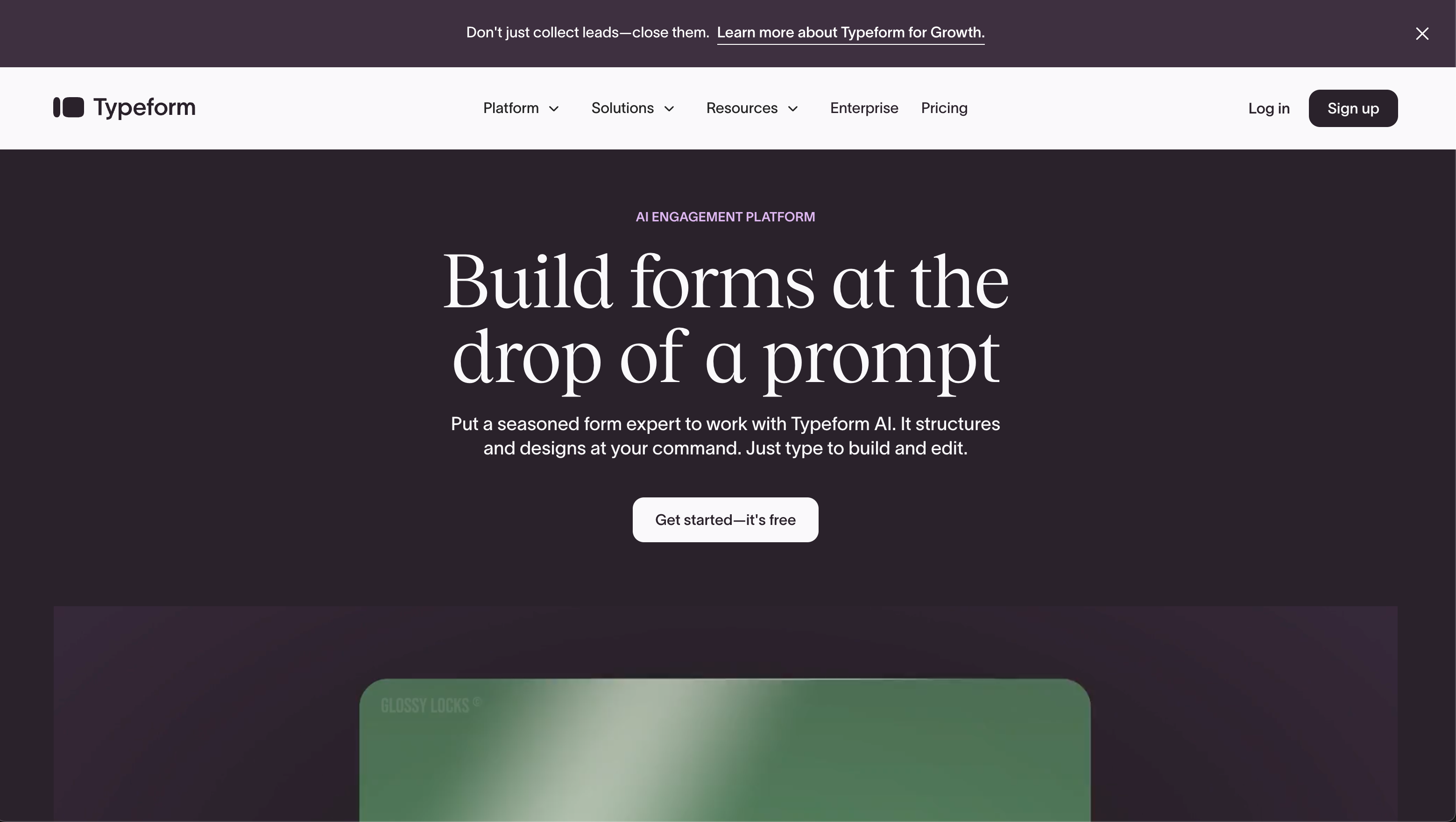
Design and User Experience
Typeform's conversational format is genuinely beautiful. One question at a time, smooth transitions, full-screen layouts, custom branding, and an experience that feels more like a chat than a form. For user-facing interactions where engagement matters — onboarding flows, product quizzes, brand surveys — Typeform's design polish directly impacts completion rates. WPForms produces functional forms, but they're standard multi-field layouts with no design ambition.
Platform Independence
Typeform works anywhere — embed on any website (WordPress, Shopify, Webflow, Squarespace), share as standalone links, or use custom domains. WPForms only works on WordPress. If your web presence spans multiple platforms, or if you don't use WordPress at all, Typeform is the only option of the two.
Conversational Logic and Branching
Typeform's Logic Jumps create personalised conversational paths — respondents see different questions based on their answers, creating a tailored experience for each user. The one-question-at-a-time format makes branching feel natural rather than technical. WPForms has conditional show/hide fields, but the standard form layout makes branching less experiential and more utilitarian.
Higher Completion Rates
The conversational format consistently produces higher completion rates than traditional forms, particularly for longer surveys (10+ questions). By showing one question at a time and removing the visual overwhelm of a long form, Typeform reduces abandonment. For lead qualification, customer feedback, and any scenario where every response counts, this completion rate advantage can justify the price premium.
Where WPForms Wins
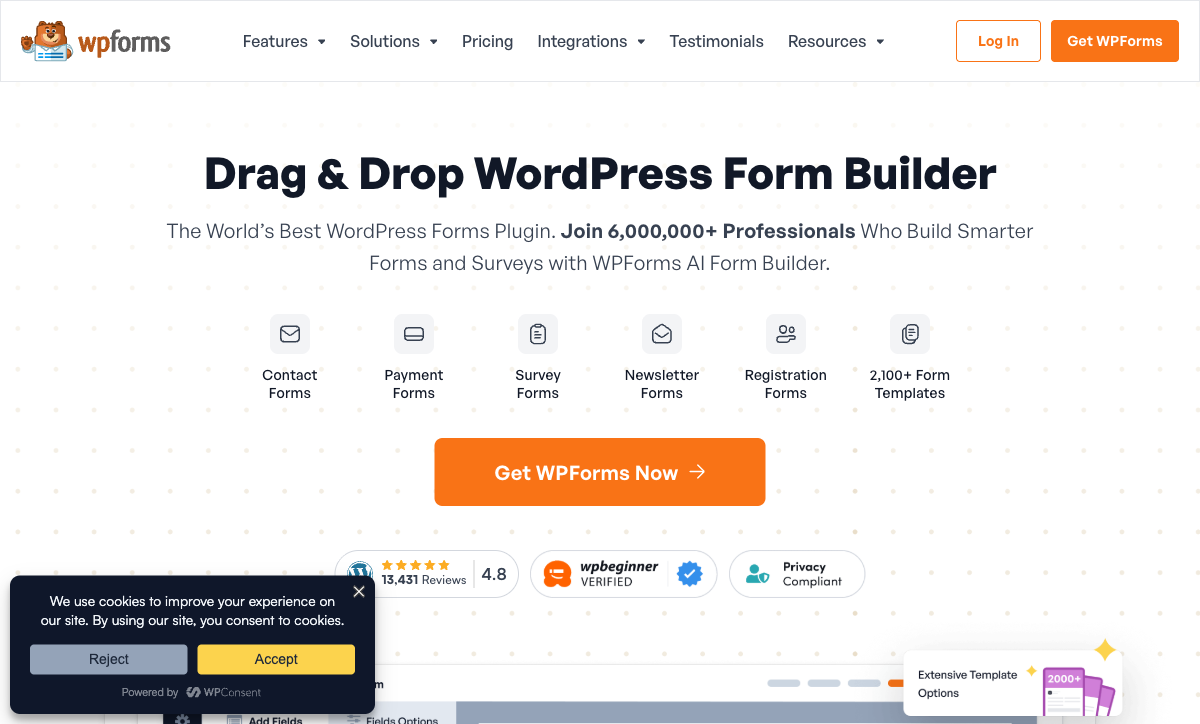
WordPress-Native Integration
WPForms renders natively within WordPress — no iframes, no external containers, no third-party branding. Forms match your theme, appear inline with page content, and store submissions in your WordPress database. For WordPress site owners who want forms that feel like part of their site rather than an embedded widget, WPForms is seamless.
Cost-Effectiveness
WPForms Lite is free for basic contact forms. WPForms Pro ($199/year) includes conditional logic, payment fields, file uploads, and unlimited submissions. Typeform's Basic plan ($25/month, $300/year) limits you to 100 responses per month. WPForms Pro costs less per year than Typeform's cheapest plan — and includes unlimited responses. For WordPress sites that need reliable forms without a premium price tag, WPForms delivers substantially more value per dollar.
Payment Collection
WPForms Pro supports Stripe and PayPal payment fields — order forms, donations, event fees. Typeform's payment collection is available on its Plus plan ($50/month) via Stripe only. WPForms handles payments at a fraction of the cost, making it more practical for small businesses and WordPress eCommerce.
Simplicity for Basic Forms
For a contact form, a registration page, or a feedback form, WPForms is faster to set up. Pre-built templates, drag-and-drop fields, embed with a shortcode. Typeform's conversational format is overkill for a 3-field contact form — the one-question-at-a-time approach actually makes simple forms feel slower. WPForms matches the task to the tool.
Where Both Fall Short
- No calculation engine: Neither supports dynamic pricing, conditional math, or scored assessments with computed outcomes.
- No e-signatures: Neither offers built-in e-signature collection.
- Response limits (Typeform): Typeform's response caps ($25/month for 100 responses) make it expensive at scale. WPForms has no response limits, but is WordPress-only.
- VC funding risk (Typeform): $193M in venture capital means Typeform needs to show returns. Pricing has increased steadily — a concern for long-term budget planning.
Pricing Comparison
Typeform
WPForms
| Product | Plan | Monthly Price | Annual Price (per month) | Free Plan | Free Trial | Limits |
|---|---|---|---|---|---|---|
| Typeform | Free | Free | Free | Yes | No | forms: 10, submissions: 10/month, users: 1 |
| Typeform | Basic | $39/mo | $28/mo billed annually | forms: Unlimited, submissions: 100/month, users: 1 | ||
| Typeform | Plus | $79/mo | $56/mo billed annually | forms: Unlimited, submissions: 1,000/month, users: 3 | ||
| Typeform | Business | $129/mo | $91/mo billed annually | forms: Unlimited, submissions: 10,000/month, users: 5 | ||
| Typeform | Growth Pro | $379/mo | $266/mo billed annually | forms: Unlimited, submissions: Expanded, users: Expanded | ||
| WPForms | Lite (Free) | Free | Free | Yes | 14 days | forms: Unlimited, submissions: Unlimited, users: Unlimited |
| WPForms | Basic | Not listed | $4.13/mo billed annually | forms: Unlimited, submissions: Unlimited, users: Unlimited | ||
| WPForms | Plus | Not listed | $8.29/mo billed annually | forms: Unlimited, submissions: Unlimited, users: Unlimited | ||
| WPForms | Pro | Not listed | $16.63/mo billed annually | forms: Unlimited, submissions: Unlimited, users: Unlimited | ||
| WPForms | Elite | Not listed | $24.96/mo billed annually | forms: Unlimited, submissions: Unlimited, users: Unlimited |
Typeform: Basic $25/month (100 responses), Plus $50/month (1,000 responses), Business $83/month (10,000 responses). WPForms: Lite free, Pro $199/year (unlimited). For most WordPress site owners, WPForms is the better financial proposition. Typeform's pricing only makes sense when the design experience directly generates enough value (leads, conversions, engagement) to offset the premium.
User Ratings
The Verdict
Use Typeform when form design is a strategic asset — product quizzes, brand surveys, lead qualification flows, onboarding experiences. The conversational format and design polish justify the premium when engagement directly impacts business outcomes.
Use WPForms when forms are a WordPress utility — contact pages, registrations, payment collection, newsletter signups. It's cheaper, simpler, WordPress-native, and handles the everyday form needs that don't require a design-forward experience.
For alternatives that combine design quality with WordPress compatibility and unlimited responses, see the complete form builder ranking.
Consider Paperform
If you want Typeform's design quality without the response limits and VC-driven pricing, Paperform offers a document-style editor that produces beautiful forms with no response caps on any plan. It embeds on WordPress and every other platform, includes five payment gateways, an Excel-style calculation engine, and e-signatures. Bootstrapped and profitable since 2016 — stable pricing you can plan around.
Try Paperform free | Paperform vs Typeform | Paperform vs WPForms
Frequently Asked Questions
Can I embed Typeform on WordPress?
Yes. Typeform provides embed codes and a WordPress plugin for embedding forms on WordPress sites. However, Typeform renders in its own container — your WordPress theme's styling doesn't apply, and the one-question-at-a-time format takes over the page experience. WPForms renders natively within WordPress, matching your theme and appearing inline with page content. If you want forms that feel like part of your WordPress site, WPForms is more seamless. If you want the Typeform conversational experience, embedding works but feels like a site-within-a-site.
Which is better for lead generation?
Typeform's conversational format typically produces higher completion rates for multi-step lead qualification forms — the one-question-at-a-time approach reduces abandonment. WPForms is better for simple contact forms and quick lead capture where speed matters more than engagement. For longer qualification forms (10+ questions), Typeform's format advantage is real. For short forms (name, email, message), WPForms is faster and simpler.
Which is more expensive?
Typeform is significantly more expensive. Its Basic plan ($25/month) limits you to 100 responses/month across 10 forms. WPForms Lite is free for basic forms; WPForms Pro ($199/year, roughly $17/month) includes conditional logic, payments, and unlimited submissions. Typeform's Plus plan ($50/month) for 1,000 responses costs more than WPForms Pro covers in a year. Unless you specifically need Typeform's conversational design, WPForms delivers better cost-per-form value.
Which has better conditional logic?
Typeform's Logic Jumps create branching conversational flows — different questions appear based on previous answers, creating personalised form experiences. WPForms' conditional logic shows/hides fields on the same page based on selections. Both work, but Typeform's approach is more dynamic because each question is a full-screen step. For multi-path qualification flows, Typeform is more elegant. For simple show/hide field logic on a standard form, WPForms is sufficient.
Sources & References
- Best Online Form Builder to Use in 2026 — Top 20 Tools — EmailToolTester, 2026
- Typeform vs WPForms: Feature Comparison — G2, 2026
Last updated March 21, 2026
Ready to try Paperform?
Create beautiful forms, payment pages, and workflows — no code required.