SurveyMonkey vs WPForms: Which Is Better in 2026?
These two tools serve almost entirely different purposes. SurveyMonkey (founded 1999) is a dedicated survey research platform — purpose-built for customer satisfaction surveys, NPS measurement, market research, and statistical analysis. WPForms (founded 2016) is a WordPress form plugin — purpose-built for contact forms, lead capture, registration pages, and payment collection on WordPress websites.
Comparing them is like comparing a research lab to a front desk. Both collect data, but the context, workflow, and output are fundamentally different. The right choice depends entirely on what you're building.
Quick Verdict
Choose SurveyMonkey if:
- You need professional survey research (NPS, CSAT, market research)
- Statistical analysis, benchmarking, and reporting matter
- You need question randomisation and advanced skip logic
- Your surveys live outside WordPress
Choose WPForms if:
- You need forms on a WordPress website
- Contact forms, lead capture, or registration are the priority
- You want payment collection via Stripe or PayPal
- You want forms that match your WordPress theme
Feature Comparison
| Feature | SurveyMonkey | WPForms |
|---|---|---|
| Form Building | ||
| Document-style editor | No | No |
| AI form creation | Yes | Yes basic |
| Field types | 15+ | Yes basic |
| Multi-page forms | Yes | Yes basic |
| Guided mode (one question at a time) | Yes | Yes pro |
| Conditional logic | Yes Individual Standard | Yes basic |
| Calculations field | No | Yes pro |
| AI calculations assistant | No | No |
| Scoring | Yes | Yes pro |
| Answer piping | Yes Individual Standard | No |
| Pre-filling and hidden fields | Yes Individual Standard | Yes basic |
| Save and resume | Yes Individual Standard | Yes pro |
| Auto-close by number | Yes Individual Standard | Yes basic |
| Auto-close by date | Yes Individual Standard | Yes basic |
| Appointment/booking field | No | No |
| Signature field | No | Yes pro |
| Color picker field | No | No |
| API-powered dropdowns | No | No |
| Google address search | No | Yes pro |
| File uploads | Yes | No |
| Payments | ||
| Stripe payments | Yes Individual Advantage | Yes pro |
| PayPal payments | Yes Individual Advantage | Yes pro |
| Square payments | No | Yes pro |
| Braintree payments | No | No |
| Google Pay | No | No |
| Product sales (eCommerce) | No | No |
| Subscriptions | No | Yes pro |
| Coupons and discounts | No | Yes pro |
| Custom pricing rules | No | Yes pro |
| Tax calculations | No | No |
| Quotes/invoices | No | No |
| Refunds | No | No |
| 3D Secure | No | No |
| Design & Customization | ||
| Template gallery | 500+ | Yes pro |
| Rich media (images, GIFs, videos) | Yes | Yes basic |
| Unsplash and Giphy integration | No | No |
| Image editor | No | No |
| Adobe Creative Cloud | No | No |
| Language translation | Yes Individual Premier | Yes basic |
| Advanced theming | Yes Individual Standard | Yes basic |
| Custom form URL | Yes Individual Standard | Yes pro |
| Custom domains | No | Yes basic |
| Custom HTML & CSS | No | Yes basic |
| Remove branding | Yes Individual Standard | Yes basic |
| Custom email domains | No | No |
| Analytics | ||
| Submission results and reports | Yes | Yes basic |
| AI report insights | Yes Individual Standard | No |
| Paperform analytics | No | No |
| Google Analytics & Facebook Pixel | No | No |
| Custom analytics scripts | No | No |
| Partial submissions | Yes Individual Standard | Yes pro |
| Collaboration | ||
| Multi-user accounts | Yes Team Advantage | Yes basic |
| User permissions and management | Yes Team Advantage | Yes pro |
| Advanced permissions & admin | Yes enterprise | Yes elite |
| Form sharing (templates) | Yes Team Advantage | Yes basic |
| Spaces and tag management | No | No |
| Security | ||
| SOC 2 Type II | Yes | No |
| GDPR compliant | Yes | Yes basic |
| SSL encryption | Yes | Yes basic |
| Two-factor authentication | Yes | No |
| Enforce 2FA for all users | Yes enterprise | No |
| SSO (SAML) | Yes enterprise | No |
| reCAPTCHA | Yes | Yes basic |
| Local data residency | Yes enterprise | Yes |
| Custom S3 storage (BYO) | No | No |
| Custom S3 storage | No | No |
| Integrations & API | ||
| Native integrations | 200+ | No |
| Zapier | Yes | Yes pro |
| Make (Integromat) | Yes | Yes pro |
| Webhooks | Yes Individual Standard | Yes elite |
| Standard API | Yes Individual Standard | No |
| Business API | Yes enterprise | No |
| WordPress plugin | No | Yes |
| oEmbed support | No | No |
| 2000+ integrations | No | Yes pro |
Where SurveyMonkey Wins

Survey Research Capabilities
SurveyMonkey is a 25-year-old survey research company. It shows: question banks with pre-validated questions, skip logic with multiple branching paths, question randomisation to reduce bias, quota management, and response quality filters. WPForms has basic survey addon fields but no research methodology built in. For serious survey work — employee engagement, customer research, academic studies — SurveyMonkey is in a different league.
Analytics and Reporting
Built-in cross-tabulation, sentiment analysis, word clouds, statistical significance testing, and benchmark comparisons against industry data. SurveyMonkey's analysis tools let you derive insights without exporting to a spreadsheet. WPForms shows submission entries in a WordPress table — useful for record-keeping but not for analysis. For data-driven decision-making, SurveyMonkey's analytics are a core advantage.
Platform Independence
SurveyMonkey works anywhere — web, mobile, email, social media, QR codes, embedded on any website. WPForms only works on WordPress. If you don't have a WordPress site, WPForms isn't an option. SurveyMonkey reaches respondents wherever they are, regardless of your website platform.
Where WPForms Wins
Native WordPress Integration
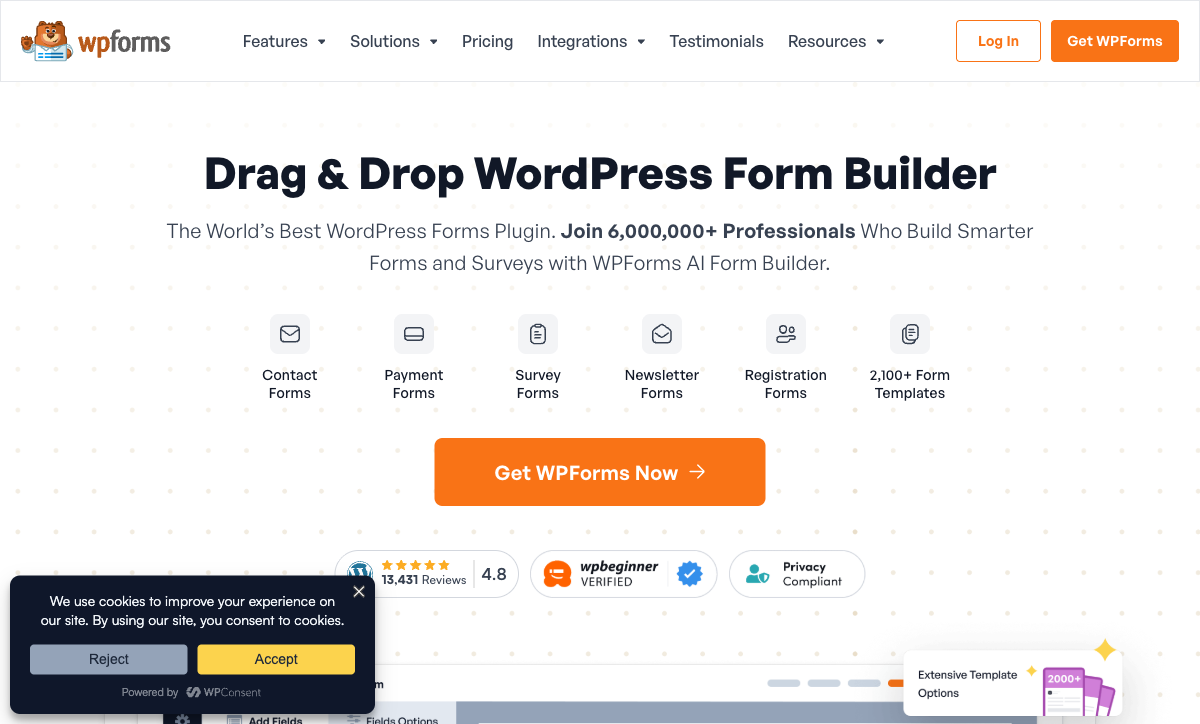
WPForms renders forms natively within WordPress — no iframes, no external domains, no third-party branding. Forms inherit your theme's styling, appear in your page builder, and store submissions in your WordPress database. For WordPress site owners, this native integration means forms are part of your site, not embedded from somewhere else.
Payment Collection
WPForms Pro supports Stripe and PayPal payment fields — order forms, donation pages, registration with fees. SurveyMonkey is a survey tool with no payment processing. If your WordPress site needs to collect money through forms, WPForms handles it directly. SurveyMonkey can't.
Cost-Effectiveness for WordPress Sites
WPForms Lite is free and handles basic contact forms. WPForms Pro at $199/year covers everything most WordPress sites need — payments, conditional logic, file uploads, user registration. SurveyMonkey's Individual Advantage plan costs $39/month ($468/year) and focuses on survey features, not website forms. For WordPress-specific form needs, WPForms delivers more relevant value at a lower price.
Beginner-Friendly Form Building
WPForms' drag-and-drop builder is genuinely simple — pre-built templates for contact forms, registration, feedback, and payments get you started in minutes. SurveyMonkey's builder is designed for survey researchers and includes options (question randomisation, branching, quotas) that add complexity non-researchers don't need. For simple website forms, WPForms has the lower learning curve.
Where Both Fall Short
- No calculation engine: Neither supports dynamic pricing, conditional math, or scored assessments with computed outcomes.
- No e-signatures: Neither offers built-in e-signature collection.
- Platform constraints: WPForms only works on WordPress. SurveyMonkey is survey-focused and weak for general-purpose forms. Neither is a versatile all-in-one form platform.
- Limited design ambition: WPForms matches your WordPress theme (which may or may not be well-designed). SurveyMonkey's forms look like SurveyMonkey. Neither creates standout visual experiences.
Pricing Comparison
SurveyMonkey
WPForms
| Product | Plan | Monthly Price | Annual Price (per month) | Free Plan | Free Trial | Limits |
|---|---|---|---|---|---|---|
| SurveyMonkey | Basic (Free) | Free | Free | Yes | No | forms: Unlimited, submissions: 25 per survey, storage: N/A, users: 1 |
| SurveyMonkey | Individual Standard | $99/mo | $39/mo billed annually | forms: Unlimited, submissions: 1,000 per month, storage: N/A, users: 1 | ||
| SurveyMonkey | Individual Advantage | Free | $32/mo billed annually | forms: Unlimited, submissions: 15,000 per year, storage: N/A, users: 1 | ||
| SurveyMonkey | Individual Premier | Free | $99/mo billed annually | forms: Unlimited, submissions: 40,000 per year, storage: N/A, users: 1 | ||
| SurveyMonkey | Team Advantage | Free | $30/mo billed annually | forms: Unlimited, submissions: 50,000 per year (shared), storage: N/A, users: 3 minimum | ||
| SurveyMonkey | Team Premier | Free | $92/mo billed annually | forms: Unlimited, submissions: 100,000 per year (shared), storage: N/A, users: 3 minimum | ||
| WPForms | Lite (Free) | Free | Free | Yes | 14 days | forms: Unlimited, submissions: Unlimited, users: Unlimited |
| WPForms | Basic | Not listed | $4.13/mo billed annually | forms: Unlimited, submissions: Unlimited, users: Unlimited | ||
| WPForms | Plus | Not listed | $8.29/mo billed annually | forms: Unlimited, submissions: Unlimited, users: Unlimited | ||
| WPForms | Pro | Not listed | $16.63/mo billed annually | forms: Unlimited, submissions: Unlimited, users: Unlimited | ||
| WPForms | Elite | Not listed | $24.96/mo billed annually | forms: Unlimited, submissions: Unlimited, users: Unlimited |
SurveyMonkey's free tier limits you to 10 questions per survey and 25 responses per survey — barely usable. Paid plans start at $25/month (Individual Standard). WPForms Lite is free with basic form fields; Pro starts at $199/year. For most users, WPForms offers better value per dollar for website forms, while SurveyMonkey's cost is justified only when you need its research-grade survey features.
User Ratings
The Verdict
Use SurveyMonkey for survey research — customer satisfaction, NPS, employee engagement, market research, academic studies. Its analytics, question banks, and research methodology features are purpose-built for this work.
Use WPForms for WordPress website forms — contact pages, lead capture, registration, payment collection. Its native WordPress integration and beginner-friendly builder make it the standard choice for WordPress form needs.
Many businesses use both: WPForms for their WordPress site, SurveyMonkey for periodic research surveys. They complement rather than compete. For a single tool that handles both use cases, see the complete form builder ranking.
Consider Paperform
If you want one platform that handles both website forms and surveys, Paperform combines WPForms-quality website embedding (works on WordPress and every other platform) with survey capabilities, five payment gateways, an Excel-style calculation engine, and e-signatures. No WordPress dependency, no survey-only limitation. Bootstrapped and profitable since 2016.
Try Paperform free | SurveyMonkey alternatives | WPForms alternatives
Frequently Asked Questions
Can I embed SurveyMonkey surveys on WordPress?
Yes, SurveyMonkey provides embed codes for WordPress. However, the survey renders in an iframe with SurveyMonkey's branding (on free/basic plans) and won't match your WordPress theme's styling. WPForms renders natively within WordPress — no iframes, no external branding, full theme integration. If your forms live on a WordPress site and need to look native, WPForms is the better approach. If you specifically need survey research features (skip logic, question randomisation, benchmarks), SurveyMonkey is worth the branding trade-off.
Which is better for contact forms on a website?
WPForms, definitively. It was built for exactly this use case — simple contact forms, lead capture, newsletter signups, and registration forms on WordPress websites. SurveyMonkey is a survey research platform, not a website form tool. Using SurveyMonkey for a contact form is like using a microscope to read a book — technically possible but wildly over-engineered for the task.
Which has better analytics?
SurveyMonkey is far ahead on analytics. It offers built-in statistical analysis, cross-tabulation, sentiment analysis, word clouds, benchmarking against industry data, and exportable reports. WPForms provides basic submission counts and entry management within WordPress. If survey data analysis is a core need, SurveyMonkey is purpose-built for it. WPForms users typically export data to Google Sheets or Excel for analysis.
Do I need both tools?
Potentially, yes. Many WordPress site owners use WPForms for website forms (contact, registration, payments) and SurveyMonkey for dedicated research surveys (customer satisfaction, NPS, market research). The two tools serve different purposes and don't directly compete in most practical scenarios. If you need one tool for everything, neither is the right answer — consider a platform like Paperform or Jotform that handles both forms and surveys.
Sources & References
- Best Online Form Builder to Use in 2026 — Top 20 Tools — EmailToolTester, 2026
- SurveyMonkey vs WPForms: Feature Comparison — G2, 2026
Last updated March 21, 2026
Ready to try Paperform?
Create beautiful forms, payment pages, and workflows — no code required.