Paperform vs Google Forms: Which Is Better in 2026?
Comparing these two on quality misses the point. Google Forms is free, with unlimited forms and unlimited responses. Paperform is a paid form builder starting at $29/month. The more useful question is when do you need to upgrade from Google Forms to a dedicated form builder?
Google Forms is a data-collection tool bundled into Google Workspace. It collects answers, and it does that for free. Paperform is a document-style form builder with five payment gateways, Excel-style calculations, e-signatures, conditional logic, and 2,000+ integrations. This comparison maps the line where Google Forms stops being enough and Paperform's extra capabilities start to earn their cost.
Quick Verdict
Choose Paperform if:
- You need to collect payments through forms (Google Forms cannot)
- You want branded, professional forms on your own domain
- You need conditional logic beyond basic section branching
- You need calculations, e-signatures, or workflow automation
- You need integrations with CRMs, marketing tools, or business apps
Choose Google Forms if:
- You need unlimited free forms and responses with zero budget
- Your forms are internal surveys, feedback, or classroom quizzes
- Google Sheets is your only required integration
- Brand appearance and customisation don't matter
- You need real-time multi-user form editing (Google Docs-style)
Feature Comparison
Side-by-side across every feature category. Paperform is highlighted for reference.
| Feature | Paperform | Google Forms |
|---|---|---|
| Form Building | ||
| Document-style editor | Yes | No |
| AI form creation | Yes | Yes |
| Field types | 26+ | 11 |
| File uploads | Yes | Yes |
| Multi-page forms | Yes | Yes |
| Guided mode (one question at a time) | Yes | No |
| Conditional logic | Yes | Yes |
| Calculations field | Yes essentials | No |
| AI calculations assistant | Yes essentials | No |
| Scoring | Yes essentials | Yes |
| Answer piping | Yes | No |
| Pre-filling and hidden fields | Yes essentials | Yes |
| Save and resume | Yes | No |
| Auto-close by number | Yes essentials | Yes |
| Auto-close by date | Yes pro | Yes |
| Appointment/booking field | Yes | No |
| Signature field | Yes | No |
| Color picker field | Yes | No |
| API-powered dropdowns | Yes business | No |
| Google address search | Yes business | No |
| Payments | ||
| Stripe payments | Yes | No |
| PayPal payments | Yes | No |
| Square payments | Yes | No |
| Braintree payments | Yes | No |
| Google Pay | Yes | No |
| Product sales (eCommerce) | Yes essentials | No |
| Subscriptions | Yes essentials | No |
| Coupons and discounts | Yes essentials | No |
| Custom pricing rules | Yes essentials | No |
| Tax calculations | Yes | No |
| Quotes/invoices | Yes | No |
| Refunds | Yes | No |
| 3D Secure | Yes | No |
| Design & Customization | ||
| Template gallery | 30,000+ | 20+ |
| Rich media (images, GIFs, videos) | Yes | Yes |
| Unsplash and Giphy integration | Yes | No |
| Image editor | Yes | No |
| Adobe Creative Cloud | Yes | No |
| Language translation | Yes | No |
| Advanced theming | Yes pro | No |
| Custom form URL | Yes pro | No |
| Custom domains | Yes pro | No |
| Custom HTML & CSS | Yes pro | No |
| Remove branding | Yes pro | No |
| Custom email domains | Yes business | Yes Business Starter |
| Analytics | ||
| Submission results and reports | Yes | Yes |
| AI report insights | Yes pro | Yes Business Standard |
| Paperform analytics | Yes pro | No |
| Drop-off analysis | Yes pro | No |
| Google Analytics & Facebook Pixel | Yes essentials | No |
| Custom analytics scripts | Yes pro | No |
| Partial submissions | Yes pro | No |
| Collaboration | ||
| Multi-user accounts | Yes pro | Yes |
| User permissions and management | Yes pro | Yes |
| Advanced permissions & admin | Yes enterprise | Yes Business Starter |
| Form sharing (templates) | Yes | Yes |
| Spaces and tag management | Yes | No |
| Security | ||
| SOC 2 Type II | Yes | Yes |
| GDPR compliant | Yes | Yes |
| SSL encryption | Yes | Yes |
| Two-factor authentication | Yes | Yes |
| Enforce 2FA for all users | Yes business | Yes Business Starter |
| SSO (SAML) | Yes business | Yes Business Plus |
| reCAPTCHA | Yes | No |
| Local data residency | Yes enterprise | Yes Business Plus |
| Custom S3 storage (BYO) | Yes business | No |
| Integrations & API | ||
| Native integrations | 2,000+ | No |
| Zapier | Yes | Yes |
| Make (Integromat) | Yes | Yes |
| Webhooks | Yes pro | No |
| Standard API | Yes pro | Yes |
| Business API | Yes business | No |
| WordPress plugin | Yes | No |
| oEmbed support | Yes | No |
Where Paperform Wins
Payment Processing (Google Forms Has None)
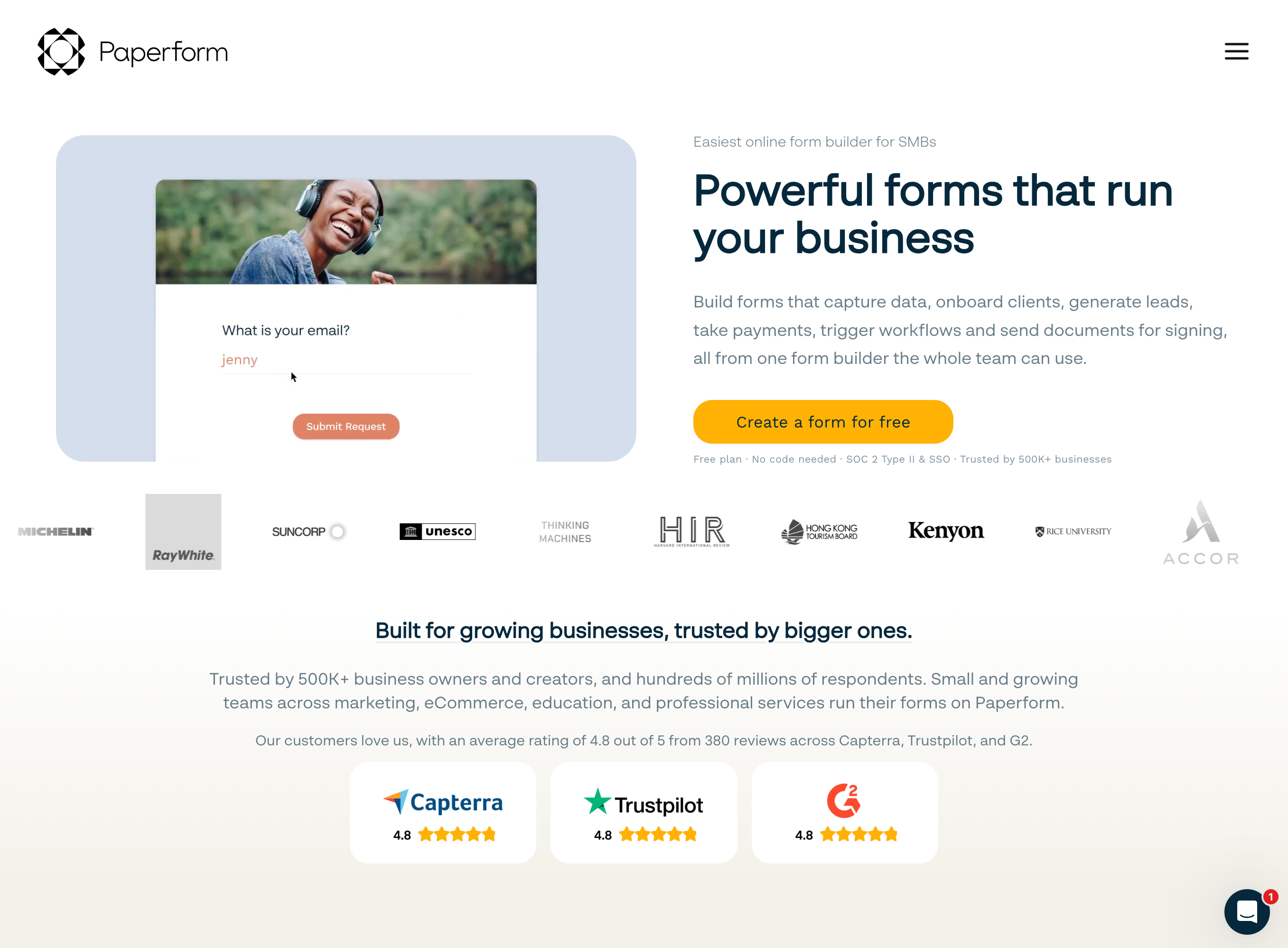
This is the biggest gap. Google Forms has zero payment capability: no Stripe, no PayPal, no payment fields of any kind. Despite being made by Google, it cannot collect a single dollar. Paperform connects five payment gateways (Stripe, PayPal, Square, Braintree, and Google Pay) on every plan including free, with full eCommerce features: product management, subscriptions, coupons, discount codes, tax calculations, and refund processing. If your forms need to collect money, Google Forms isn't an option.
That gap eliminates whole categories of use case. Order forms, booking payments, donation pages, event ticket sales, client deposit collection, subscription sign-ups, and product purchases all need payment processing that Google Forms can't provide at any tier.
The Calculation Engine
Paperform's Excel-style calculations have no equivalent in Google Forms. These go beyond simple conditionals: they're formulas that compute dynamic pricing, risk scores, quiz results, tax amounts, and conditional totals. Calculations in Paperform also drive logic across questions, pages, emails, integrations, and success pages, so they run through the whole platform rather than sitting off to one side as a single feature.
A photographer can build a session pricing calculator that works out package costs from hours, locations, and add-ons. An agency can generate dynamic quotes where the total updates in real time as clients select services. A SaaS company can create an interactive plan configurator. A nonprofit can build a donation form with suggested amounts based on income brackets. Google Forms can assign point values to quiz questions for auto-grading, but it can't compute anything dynamically from user input, and that limit is what separates a data-collection tool from a business tool.
Design and Branding
Google Forms gives you a header image, a theme colour, a background colour, and four fonts. That's the entire customisation surface. Google branding is always present, forms always live on docs.google.com, and every Google Form looks like a Google Form. There's no custom CSS, no custom domains, no way to remove or replace Google's branding, and no ability to match your company's visual identity beyond a colour accent.
Paperform's document-style editor creates forms that look like designed landing pages, with custom fonts, colours, images, videos, GIFs, Unsplash and Giphy integration, custom HTML/CSS, custom domains, and complete brand control. Forms can be embedded on your site or hosted on your own domain with your own branding. For any client-facing or public-facing form, the visual gap is large: a respondent can tell at a glance whether they're filling out a generic Google Form or a branded page that belongs to your business.
Conditional Logic and Workflows
Google Forms supports section-level branching: "if the user picks Option A, skip to Section 3." That's it. You cannot show or hide individual questions, chain multiple conditions, or trigger different actions based on complex logic. Paperform supports question-level conditional logic that controls visibility of individual fields, pages, emails, calculations, and success page content.
Beyond logic, Paperform includes Papersign (e-signatures for contracts and consent forms) and Stepper (multi-step workflow automation) at no additional cost. A single client intake submission can collect information, calculate a quote, generate a contract, capture an e-signature, process a deposit payment, and trigger a CRM workflow. Google Forms collects the information; everything after that requires separate tools.
Integrations Beyond Google
Google Forms integrates seamlessly with Google Sheets, Google Drive, and Google Classroom. Outside that ecosystem, you're on your own: no native CRM connections, no marketing tool integrations, no webhooks, no native Zapier triggers without add-ons. Connecting a Google Form to Salesforce, HubSpot, Mailchimp, or Slack requires either Zapier/Make (additional cost) or custom Google Apps Script development (technical skill).
Paperform offers 2,000+ integrations via native connections, Zapier, Make, webhooks, and a REST API. Form submissions can flow directly to CRMs (Salesforce, HubSpot, Pipedrive), email marketing platforms (Mailchimp, ActiveCampaign, ConvertKit), project management tools (Notion, Asana, Monday), Slack, Discord, and hundreds more, without custom code or extra subscriptions. For businesses that need form data to trigger real workflows, that integration depth is a decisive advantage.
Template Volume
Google Forms ships with approximately 20 built-in templates. Paperform offers 30,000+ professionally designed templates spanning eCommerce, bookings, payments, lead capture, client intake, registrations, and document workflows. The 1,500x gap tracks the feature gap: Paperform templates can include payment forms, calculators, and signature workflows, none of which Google Forms templates can offer because the platform doesn't support those features.
Where Google Forms Wins
Completely Free — Unlimited Everything
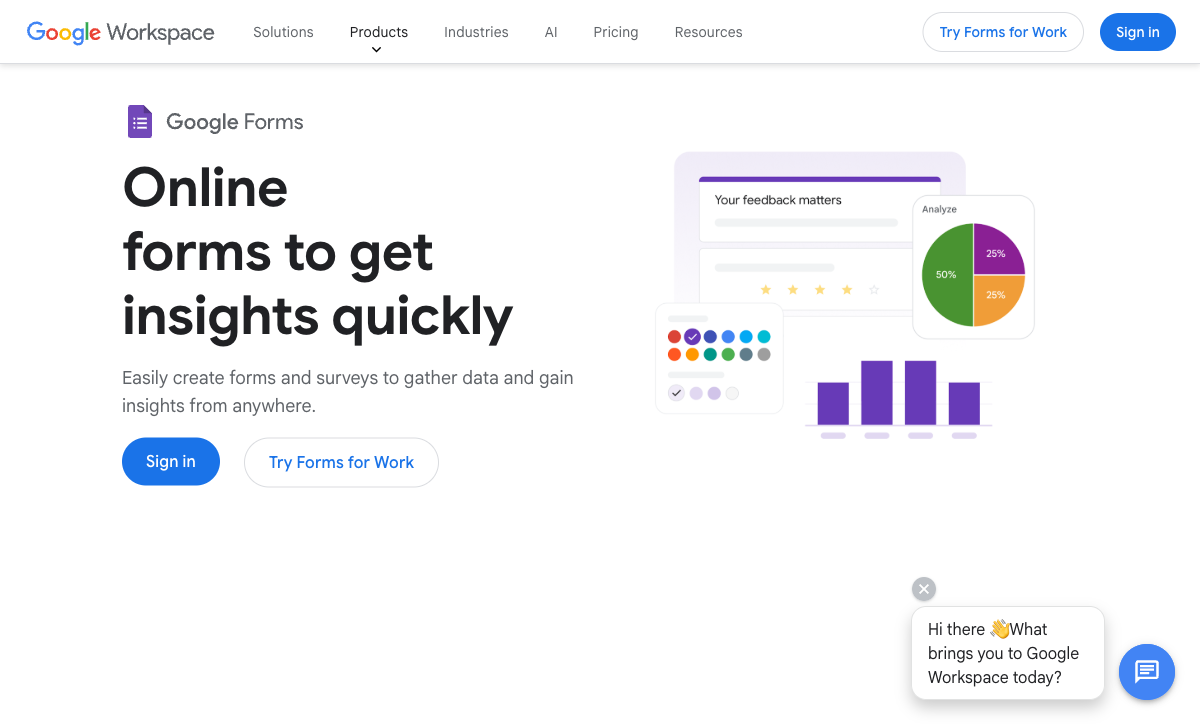
Google Forms is free for anyone with a Google account: unlimited forms, unlimited responses, unlimited collaborators, and 15GB of Google Drive storage (shared across all Google services). There are no paid tiers for form features, no response caps, and no feature gates. For organisations with zero budget and simple data collection needs, no competitor matches that value.
Paperform's free plan includes 30 submissions/month, generous for a paid platform but not unlimited. For high-volume, low-complexity use cases (employee pulse surveys, classroom quizzes, event RSVPs with hundreds of respondents), Google Forms' free unlimited tier is a real advantage.
Zero Learning Curve
Google Forms is consistently rated highest for ease of use across all review platforms (Capterra ease of use: 4.7/5, G2 ease of setup: 93%). Anyone who has used a Google product can create a form in minutes; there's genuinely nothing to learn. Paperform's document-style editor is more powerful but asks you to think about forms as pages rather than question lists, which takes some getting used to.
Native Google Workspace Integration
For organisations already built on Google Workspace, Forms is deeply embedded. Responses flow directly to Google Sheets with one click. Forms integrate natively with Google Classroom for educators, Google Drive for file management, and Google Calendar for scheduling. Teachers can assign quizzes directly from Classroom, grades sync automatically, and all data lives in the same ecosystem.
This ecosystem integration is seamless in a way third-party tools can't fully replicate. If your entire organisation runs on Google Workspace and Google Sheets is where all your data lives, the native connection is frictionless.
Real-Time Multi-User Editing
Multiple people can edit the same Google Form simultaneously, just like Google Docs. This real-time collaboration is best-in-class for form building and genuinely useful for teams that co-create surveys, feedback forms, or registration pages.
Quiz Auto-Grading
Google Forms' quiz mode, with point values, automatic grading, answer keys, and instant feedback, is well-designed and completely free. For educators in the Google Classroom ecosystem, it's a natural and effective tool that requires no additional software or cost.
Where Paperform Falls Short
- Not free for unlimited responses: Paperform's free plan includes 30 submissions/month. Google Forms offers unlimited responses at zero cost. For high-volume, low-complexity forms (employee pulse surveys with 500 responses, classroom quizzes with 200 students), Google Forms' free tier is genuinely hard to beat on volume alone.
- Requires learning a new tool: Paperform's document-style editor is more powerful, but it works differently, treating forms as pages rather than question lists. Google Forms is instantly familiar to anyone with a Google account. There's a real switching cost in time and team training, especially for non-technical users who are comfortable with Google's interface.
- Smaller ecosystem than Google: Google Workspace is used by billions. Paperform's community, third-party resources, tutorial library, and marketplace are smaller by orders of magnitude. Finding help, troubleshooting guides, and community answers is faster and easier for Google Forms.
- No real-time collaborative editing: Paperform supports multi-user accounts and permissions, but doesn't offer Google Docs-style simultaneous editing where multiple users edit the same form in real time. For teams that co-create forms collaboratively, this is a workflow gap.
- No native Google Classroom integration: For educators embedded in the Google Classroom ecosystem, Paperform cannot replicate the seamless assign-grade-sync workflow that Google Forms provides natively.
Where Google Forms Falls Short
- Zero payment processing: Despite being a Google product, Google Forms cannot collect payments: no Stripe, no PayPal, no payment fields. For comparison, Paperform includes five payment gateways on its free plan.
- No advanced conditional logic: Branching is limited to section-level jumps based on multiple choice or dropdown answers. You cannot show/hide individual questions, chain conditions, or apply logic to emails, calculations, or success pages.
- No branding or design control: Header image, theme colour, background colour, and four fonts make up the entire customisation surface. Google branding is always present. No custom CSS, no custom domains, no brand removal.
- ~11 field types: Short answer, paragraph, multiple choice, checkboxes, dropdown, file upload, linear scale, grids, date, and time. No signature, no appointment booking, no colour picker, no rating scales, no API-powered dropdowns. Paperform offers 26+.
- Walled garden integrations: Native connections are limited to Google Sheets, Drive, and Classroom. No CRM integrations, no marketing tools, no webhooks. Connecting to anything outside Google requires Zapier, Make, or custom Apps Script development.
- No analytics or tracking: Cannot add Google Analytics, Facebook Pixel, or custom tracking scripts. No drop-off analysis, no partial submission data, no conversion tracking. Forms are hosted on Google's domain, preventing any custom script injection.
- No eSignatures, workflow automation, or document generation: Google Forms is a data collection tool only. No Papersign equivalent, no Stepper equivalent, no way to turn form submissions into signed contracts or automated workflows.
- No save and resume: If a respondent closes a Google Form before submitting, all progress is lost (unless signed in to Google with the edit-after-submit option enabled). For longer forms or applications, this causes real abandonment. Paperform automatically saves progress so respondents can return later without requiring sign-in.
- Hasn't meaningfully evolved since launch: Google Forms was created in 2008 and its core feature set has barely changed. The addition of Gemini AI for form drafting is useful, but the underlying platform (field types, logic, design, integrations) is the same basic tool it was years ago, with little sign that Google plans to make Forms more capable.
Pricing Comparison

Google Forms is free. Paperform is not. The question is what you get for the money:
| Feature | Google Forms (Free) | Paperform Essentials ($29/mo) | What You Gain |
|---|---|---|---|
| Responses | Unlimited | 100/month | Google wins on volume; Paperform wins on everything else |
| Payments | None | 5 gateways, subscriptions, coupons | Revenue capability; Google Forms literally cannot collect money |
| Field types | ~11 | 26+ | Signatures, bookings, colour pickers, API dropdowns |
| Branding | Google-branded, 4 fonts | Full custom branding, CSS, domains | Professional appearance for client-facing forms |
| Integrations | Google Sheets + Zapier | 2,000+ native + Zapier + Make + webhooks | Direct CRM, marketing, and business app connections |
| Templates | ~20 | 30,000+ | Purpose-built templates for every industry and use case |
| Calculations | Quiz scoring only | Excel-style formulas across all fields | Dynamic pricing, risk scores, conditional totals |
All Paperform prices shown are annual billing rates. Monthly billing adds approximately 25-30%.
Paperform
Google Forms
| Product | Plan | Monthly Price | Annual Price (per month) | Free Plan | Free Trial | Limits |
|---|---|---|---|---|---|---|
| Paperform | Free | Free | Free | Yes | 14 days | forms: Unlimited, submissions: 30/month, storage: 100 submissions, users: 1, file uploads: 100 MB |
| Paperform | Essentials | $29/mo | $24/mo billed annually | forms: Unlimited, submissions: 100/month, storage: 1,000 submissions, users: 1, file uploads: 1 GB | ||
| Paperform | Pro | $59/mo | $49/mo billed annually | forms: Unlimited, submissions: 1,000/month, storage: 10,000 submissions, users: 3, file uploads: 10 GB | ||
| Paperform | Business | $129/mo | $99/mo billed annually | forms: Unlimited, submissions: 10,000/month, storage: 100,000 submissions, users: 5, file uploads: 100 GB | ||
| Google Forms | Free (Personal) | Free | Free | Yes | 14 days | forms: Unlimited, submissions: Unlimited, storage: 15 GB (shared across Google Drive), users: 1, file uploads: Included in 15 GB storage |
| Google Forms | Business Starter | $8.4/mo | $7/mo billed annually | forms: Unlimited, submissions: Unlimited, storage: 30 GB per user, users: Up to 300, file uploads: Included in storage | ||
| Google Forms | Business Standard | $16.8/mo | $14/mo billed annually | forms: Unlimited, submissions: Unlimited, storage: 2 TB per user, users: Up to 300, file uploads: Included in storage | ||
| Google Forms | Business Plus | $26.4/mo | $22/mo billed annually | forms: Unlimited, submissions: Unlimited, storage: 5 TB per user, users: Up to 300, file uploads: Included in storage |
What Users Say
Both platforms are well-reviewed, but for different reasons. Paperform averages 4.8/5 across ~498 reviews, with very high marks for customer support (4.7-4.9) and feature depth. Reviewers consistently praise the calculation engine, payment processing, and design flexibility.
Google Forms has 10,000+ reviews and the highest ease-of-use scores in the category (Capterra: 4.7/5, G2: 93% ease of setup). Recurring criticism centres on limited customisation, no payment capability, and the inability to integrate outside Google's ecosystem. As EmailToolTester's 2026 review noted, Google Forms is best suited for quick internal surveys rather than professional or commercial form needs. Most of the complaints surface only when people try to push it past what it was built to do.
See Them in Action
Who Should Choose What
| Use Case | Best Choice | Why |
|---|---|---|
| Internal team surveys | Google Forms | Free, unlimited, familiar; no reason to pay |
| Classroom quizzes | Google Forms | Native Classroom integration, auto-grading, free |
| Payment/order forms | Paperform | Google Forms has zero payment capability |
| Client intake forms | Paperform | Branding, conditional logic, CRM integration |
| Lead capture pages | Paperform | Custom domains, design control, marketing integrations |
| Booking/appointment forms | Paperform | Appointment field type, payment processing, calculations |
| Event RSVPs (free events) | Google Forms | Simple data collection, unlimited responses, free |
| Contracts/e-signatures | Paperform | Papersign built in; Google Forms has no signature capability |
The Verdict
Google Forms is the right choice when your needs are simple and your budget is zero. It handles internal surveys, classroom quizzes, event RSVPs, and quick feedback forms for free, with no setup, and it integrates natively with Google Sheets. If that's all you need, there's no reason to pay for anything else. Google Forms has been doing this since 2008, and billions of people already know how to use it.
Paperform earns its price the moment your forms need to do real work. Collecting payments, generating quotes, routing leads to a CRM, capturing signatures, building branded client-facing experiences, computing dynamic pricing: none of this is possible in Google Forms. Paperform delivers five payment gateways, Excel-style calculations that drive logic across questions, pages, emails, integrations, and success pages, 2,000+ integrations, e-signatures via Papersign, workflow automation via Stepper, and a design surface that turns forms into landing pages. At $29/month, it pays for itself with the first payment form or branded client experience.
Longevity is worth weighing too. Google Forms hasn't meaningfully evolved since it launched in 2008, and its core feature set is essentially unchanged. It's unlikely to add payments, advanced logic, or design tools, because those features sit against Google's "simple and free" positioning. Paperform, founded in 2016, is bootstrapped and profitable, with growth funded by revenue rather than investors. That keeps pricing rational and ships features based on customer needs rather than VC-scale growth targets, which makes Paperform the safer long-term bet for businesses that expect their form needs to grow.
The two platforms aren't really competitors. Google Forms is where you start, and Paperform is where you go when you outgrow it. For a broader view of options, see our complete Google Forms alternatives analysis or the full best form builders ranking.
Frequently Asked Questions
When should I upgrade from Google Forms to a dedicated form builder like Paperform?
Google Forms stops being enough the moment you need any of these: payment collection (Google Forms has zero payment capability), branded forms (you can't remove Google branding or use custom domains), advanced conditional logic (Google Forms only supports section-level branching, not question-level), calculations or dynamic pricing, or integrations beyond Google Sheets. If your forms are simple internal surveys or classroom quizzes, Google Forms is fine. Once forms become client-facing, revenue-generating, or workflow-critical, you need a dedicated form builder. Paperform covers all of these from its Essentials plan at $29/month.
Can Paperform connect to Google Sheets like Google Forms does?
Yes. Paperform connects to Google Sheets natively, so every form submission can automatically populate a spreadsheet, just like Google Forms. The difference is that Paperform also connects to 2,000+ other apps (CRMs, email marketing, payment processors, project management tools) via native integrations, Zapier, Make, and webhooks. Google Forms essentially connects to Google Sheets and nothing else without third-party workarounds via Apps Script or Zapier.
Is Google Forms safe enough for business use?
For basic data collection, yes. Google Forms inherits Google Workspace's enterprise-grade security (SOC 2, ISO 27001, HIPAA via Workspace). But "safe for business" goes beyond server security. Google Forms offers no CAPTCHA configuration, no partial submission tracking, no custom analytics, and no way to control where your form is hosted. Your forms live on docs.google.com with Google branding, which can undermine client trust. For internal surveys, Google Forms is secure enough. For client-facing forms that represent your brand, Paperform's custom domains, SSL, CAPTCHA, and brand control offer a more professional and trustworthy experience.
How do Paperform and Google Forms compare on design?
There's no real comparison. Google Forms offers a header image, a theme colour, a background colour, and four font choices. That's it. You cannot add custom CSS, remove Google branding, use a custom domain, or create forms that look like anything other than a Google Form. Paperform's document-style editor lets you build forms that look like designed landing pages, with custom fonts, colours, images, videos, GIFs, embedded media, custom HTML/CSS, and full brand control. If design matters to your use case, Paperform is in a completely different category.
Is the cost difference worth it when Google Forms is free?
Google Forms is free and unlimited, which is genuinely valuable for simple use cases. But "free" comes with real limitations: no payments, no branding, ~11 field types, no integrations outside Google, no analytics, and no conditional logic beyond section branching. Paperform starts at $29/month for 100 responses with five payment gateways, Excel-style calculations, 2,000+ integrations, custom branding, e-signatures, and conditional logic. If your forms generate revenue (payment forms, order pages, booking forms) or represent your brand to clients, the $29/month pays for itself immediately. If you only need internal surveys, Google Forms' free tier is hard to argue with.
Can Google Forms handle quizzes and assessments?
Yes, and this is one area where Google Forms genuinely performs well. Quiz mode includes point values per question, automatic grading, answer keys, and instant feedback. For educators already in the Google Classroom ecosystem, it's seamless and free. Paperform also supports scoring and quiz functionality, and adds Excel-style calculations that can compute weighted scores, conditional results, and dynamic feedback, which Google Forms can't do. For simple classroom quizzes, Google Forms is excellent. For assessments that need scoring logic, conditional outcomes, or payment processing (certification exams, paid courses), Paperform is more capable.
Sources & References
- Best Online Form Builder to Use in 2026 — Top 20 Tools — EmailToolTester, 2026
- Google Forms Full Tutorial (YouTube) — YouTube, 2025
- Paperform — Complete Beginners Guide (YouTube) — AppFind, 2025
Last updated June 25, 2026
Ready to try Paperform?
Create beautiful forms, payment pages, and workflows — no code required.