Paperform vs FormAssembly: Which Is Better in 2026?
Paperform and FormAssembly occupy different ends of the form builder market. Paperform is a general-purpose form builder with a document-style editor, five payment gateways, and an Excel-style calculation engine — designed for businesses of any size and tech stack. FormAssembly is an enterprise-focused platform built around the deepest Salesforce integration available, with FedRAMP and HIPAA compliance for regulated industries.
The honest assessment: FormAssembly is unbeatable for complex Salesforce data collection in compliance-heavy environments. For everything else, Paperform delivers more features at a lower price. The question is which category your use case falls into.
Quick Verdict
Choose Paperform if:
- You need a general-purpose form builder (not Salesforce-specific)
- You want a free plan or lower entry price ($24/mo vs $59/mo)
- You need payment processing (5 gateways vs limited options)
- You need calculations, design freedom, or 2,000+ integrations
- You want forms that look like designed landing pages
Choose FormAssembly if:
- You need deep Salesforce integration (native object mapping, multi-object sync)
- You need FedRAMP High authorisation for government use
- You need HIPAA + PCI DSS Level 1 + SOC 2 combined compliance
- You need data residency with government-grade security
Feature Comparison
Side-by-side across every feature category. Paperform is highlighted for reference.
| Feature | Paperform | FormAssembly |
|---|---|---|
| Form Building | ||
| Document-style editor | Yes | No |
| AI form creation | Yes | Yes explorer |
| Field types | 26+ | Yes explorer |
| File uploads | Yes | No |
| Multi-page forms | Yes | Yes explorer |
| Guided mode (one question at a time) | Yes | No |
| Conditional logic | Yes | Yes explorer |
| Calculations field | Yes essentials | Yes explorer |
| AI calculations assistant | Yes essentials | No |
| Scoring | Yes essentials | No |
| Answer piping | Yes | Yes explorer |
| Pre-filling and hidden fields | Yes essentials | Yes explorer |
| Save and resume | Yes | Yes explorer |
| Auto-close by number | Yes essentials | Yes explorer |
| Auto-close by date | Yes pro | Yes explorer |
| Appointment/booking field | Yes | No |
| Signature field | Yes | Yes explorer |
| Color picker field | Yes | No |
| API-powered dropdowns | Yes business | Yes team |
| Google address search | Yes business | No |
| Payments | ||
| Stripe payments | Yes | Yes explorer |
| PayPal payments | Yes | Yes explorer |
| Square payments | Yes | No |
| Braintree payments | Yes | No |
| Google Pay | Yes | No |
| Product sales (eCommerce) | Yes essentials | Yes explorer |
| Subscriptions | Yes essentials | No |
| Coupons and discounts | Yes essentials | No |
| Custom pricing rules | Yes essentials | Yes explorer |
| Tax calculations | Yes | No |
| Quotes/invoices | Yes | No |
| Refunds | Yes | No |
| 3D Secure | Yes | No |
| Design & Customization | ||
| Template gallery | 30,000+ | Yes explorer |
| Rich media (images, GIFs, videos) | Yes | Yes explorer |
| Unsplash and Giphy integration | Yes | No |
| Image editor | Yes | No |
| Adobe Creative Cloud | Yes | No |
| Language translation | Yes | No |
| Advanced theming | Yes pro | Yes team |
| Custom form URL | Yes pro | Yes explorer |
| Custom domains | Yes pro | No |
| Custom HTML & CSS | Yes pro | Yes team |
| Remove branding | Yes pro | Yes team |
| Custom email domains | Yes business | No |
| Analytics | ||
| Submission results and reports | Yes | Yes explorer |
| AI report insights | Yes pro | No |
| Paperform analytics | Yes pro | No |
| Drop-off analysis | Yes pro | No |
| Google Analytics & Facebook Pixel | Yes essentials | No |
| Custom analytics scripts | Yes pro | No |
| Partial submissions | Yes pro | No |
| Workflow analytics | No | Yes explorer |
| Collaboration | ||
| Multi-user accounts | Yes pro | Yes team |
| User permissions and management | Yes pro | Yes team |
| Advanced permissions & admin | Yes enterprise | Yes enterprise |
| Form sharing (templates) | Yes | Yes explorer |
| Spaces and tag management | Yes | No |
| Security | ||
| SOC 2 Type II | Yes | Yes explorer |
| GDPR compliant | Yes | Yes explorer |
| SSL encryption | Yes | Yes explorer |
| Two-factor authentication | Yes | Yes explorer |
| Enforce 2FA for all users | Yes business | Yes enterprise |
| SSO (SAML) | Yes business | Yes enterprise |
| reCAPTCHA | Yes | Yes explorer |
| Local data residency | Yes enterprise | Yes enterprise |
| Custom S3 storage (BYO) | Yes business | No |
| Integrations & API | ||
| Native integrations | 2,000+ | No |
| Zapier | Yes | No |
| Make (Integromat) | Yes | No |
| Webhooks | Yes pro | Yes explorer |
| Standard API | Yes pro | Yes explorer |
| Business API | Yes business | No |
| WordPress plugin | Yes | Yes explorer |
| oEmbed support | Yes | Yes explorer |
| 2000+ integrations | No | No |
Where Paperform Wins
Price and Accessibility
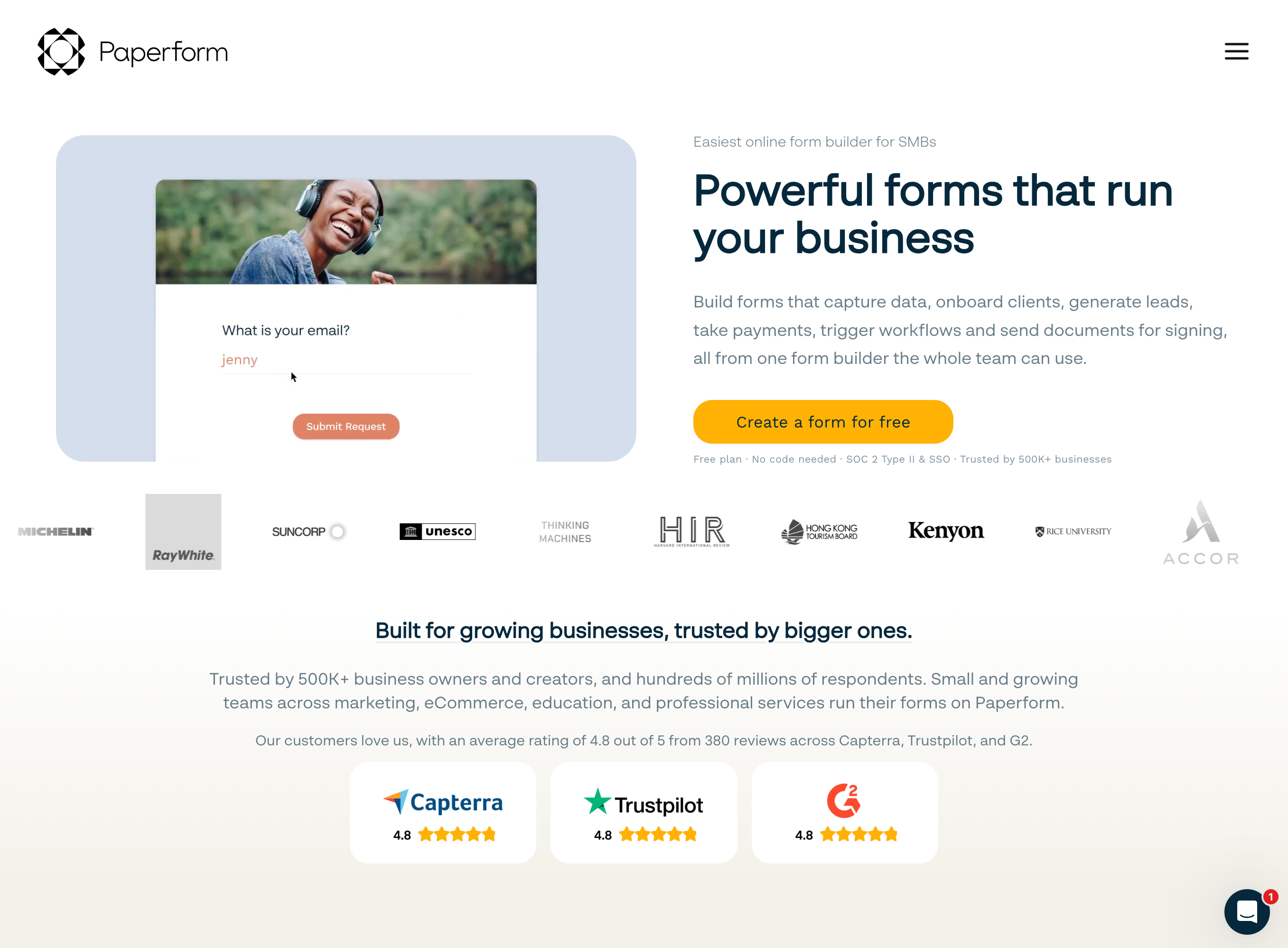
The pricing gap is significant. Paperform offers a permanent free plan with unlimited forms, 30 submissions/month, five payment gateways, calculations, and 2,000+ integrations. FormAssembly has no free plan — only a 14-day trial before you commit to $59/month. Paperform's Essentials plan at $24/month (annual) costs less than half of FormAssembly's Explorer, while including payment processing and eCommerce features that FormAssembly charges extra for. For any business not specifically needing Salesforce, Paperform delivers dramatically more value per dollar.
Payment Processing (5 Gateways vs 2)
Paperform connects Stripe, PayPal, Square, Braintree, and Google Pay on every plan, including free. Full eCommerce features — product management, subscriptions, coupons, discount codes, tax calculations, and refund processing — are included. FormAssembly supports Stripe and PayPal but lacks product management, advanced subscription handling, coupons, tax calculations, and refund processing. For any form that collects money, Paperform offers 2.5x the gateway options and substantially deeper eCommerce capabilities.
The Calculation Engine
Paperform's Excel-style calculations compute dynamic pricing, risk scores, quiz results, tax amounts, and conditional totals — driving logic across questions, pages, emails, integrations, and success pages. FormAssembly has basic form logic but nothing that computes values in real time or powers pricing dynamically. Paperform's AI calculations assistant helps non-technical users write complex formulas using natural language — FormAssembly's Fai AI creates forms but doesn't help with calculations.
Design Freedom
Paperform's document-style editor creates forms that look like professionally designed landing pages. Custom CSS, custom domains, Unsplash and Giphy integration, and advanced theming provide complete brand control. FormAssembly's design capabilities are limited — no document-style editor, no Unsplash/Giphy, no image editor, no custom domains. G2 reviews note the interface feels dated compared to modern form builders. For brand-conscious businesses, Paperform's design tools are materially better.
Integration Breadth (2,000+ vs ~20)
Paperform connects to 2,000+ apps via native connectors, Zapier, Make, webhooks, and a full REST API. FormAssembly has roughly 20 native integrations and no Zapier or Make support. Outside of Salesforce, FormAssembly's integration ecosystem is remarkably limited. If you use tools beyond Salesforce — marketing platforms, project management, accounting, communication — Paperform's integration breadth is a critical advantage.
This gap is most painful for organisations that use Salesforce alongside other tools. FormAssembly connects beautifully to Salesforce but struggles to simultaneously feed data into Slack, Google Sheets, Mailchimp, or other workflow tools. Paperform handles all of these connections from a single form submission.
Templates
Paperform offers 30,000+ professionally designed templates spanning eCommerce, bookings, payments, education, healthcare, and professional services. FormAssembly has a small template collection. The volume gap is amplified by the fact that Paperform templates include payment forms, calculators, and signature workflows that FormAssembly's templates can't match at the same depth.
Where FormAssembly Wins
Deepest Salesforce Integration Available
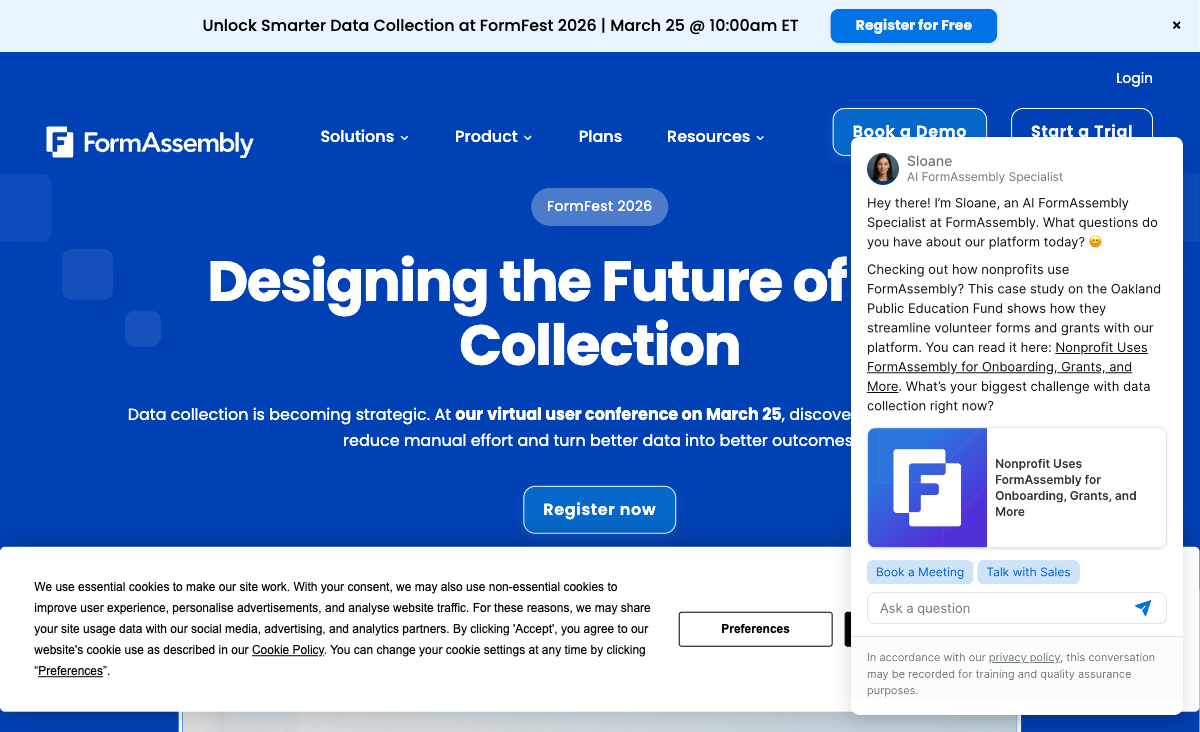
This is FormAssembly's genuine and decisive advantage. The advanced Salesforce connector supports native object mapping, multi-object sync, prefilling from Salesforce records, and Agentforce support. For complex Salesforce data models — where form submissions need to create or update multiple related objects simultaneously — FormAssembly's native connector is unmatched. No Zapier or middleware integration can replicate this level of Salesforce precision.
Compliance Breadth
FormAssembly offers the broadest compliance coverage in the form builder market: HIPAA with BAA, PCI DSS Level 1, SOC 2, GDPR, FERPA, and FedRAMP High. The FedRAMP High authorisation is unique among form builders — no other platform has it. For government agencies, healthcare organisations, higher education institutions, and financial services firms with multiple compliance requirements, FormAssembly's certifications are a genuine differentiator. Paperform offers SOC 2 Type II and GDPR but does not have HIPAA or FedRAMP.
Enterprise Social Proof
FormAssembly is trusted by Southwest Airlines, Amazon, CVS Health, Harvard University, and Big Brothers Big Sisters. Founded in 2006 — a decade before Paperform — FormAssembly has 20 years of enterprise track record. For organisations where vendor longevity and enterprise references matter in procurement, FormAssembly's customer list carries weight.
Fai AI Assistant
FormAssembly's Fai AI can create forms from natural language prompts, PDFs, images, and spreadsheets. The ability to import existing paper forms and convert them to digital forms automatically is useful for organisations digitising legacy processes. Paperform offers AI form creation from prompts, but Fai's PDF and image import capability is a differentiator for specific migration use cases.
Company Longevity
FormAssembly was founded in 2006 — 20 years of continuous operation in the form builder market. This longevity provides enterprise confidence: the company has survived multiple market cycles, built deep expertise in compliance, and established relationships with major customers (Southwest Airlines, Amazon, CVS Health, Harvard University). For procurement teams that evaluate vendor stability as a selection criterion, FormAssembly's two-decade track record is a meaningful trust signal compared to Paperform's 10 years (founded 2016).
Where Paperform Falls Short
- No native Salesforce integration: Paperform connects to Salesforce via Zapier, Make, and API — functional but not as deep as FormAssembly's native object mapping. For complex Salesforce data models, the middleware approach has limitations.
- No HIPAA, FedRAMP, or PCI DSS: Paperform's SOC 2 Type II covers general business compliance, but regulated industries (healthcare, government, finance) need certifications Paperform doesn't have.
- No PDF/image form import: Paperform's AI creates forms from prompts but can't import existing paper forms from PDFs or photos the way FormAssembly's Fai can.
- Smaller enterprise footprint: Paperform serves 500,000+ businesses but has fewer Fortune 500 logos than FormAssembly. In enterprise procurement, brand recognition matters.
Where FormAssembly Falls Short
- No free plan and expensive entry: $59/month with only a 14-day trial. Most competitors offer permanent free plans. For businesses evaluating form builders, the cost to experiment is high.
- Steep learning curve: G2 ease of use rated 4.1/5 — below average for form builders. The interface requires training, especially for non-technical users. Paperform's intuitive document-style editor and AI calculations assistant lower the learning curve.
- Tiny integration ecosystem: Roughly 20 native integrations with no Zapier or Make support. Outside of Salesforce, connectivity is severely limited. Paperform offers 2,000+ integrations.
- Limited design: No document-style editor, no Unsplash/Giphy, no image editor, no custom domains. Design capabilities feel dated. Forms are functional but not visually impressive.
- Limited payment processing: Only Stripe and PayPal. No Square, Braintree, or Google Pay. No product catalog, subscriptions with full billing, coupons, or refund processing.
- Salesforce dependency: FormAssembly's core value evaporates without Salesforce. The $59/month entry price is hard to justify when the deep Salesforce integration — the platform's primary differentiator — isn't needed.
- No AI calculations assistant: Fai creates forms but doesn't help build complex calculations or formulas within forms. Paperform's AI calculations assistant helps non-technical users write Excel-style formulas.
Pricing Comparison

Paperform is significantly more affordable at every tier, with the gap widening for non-Salesforce use cases:
| Tier | Paperform | FormAssembly | Key Difference |
|---|---|---|---|
| Free | Unlimited forms, 30 subs, 5 gateways, calculations | No free plan (14-day trial only) | Paperform offers a permanent free tier; FormAssembly doesn't |
| Entry Level | Essentials: $24/mo — payments, eCommerce, scoring | Explorer: $59/mo — Salesforce, 3 workflows, branding | Paperform costs 59% less with more payment options |
| Professional | Pro: $49/mo — CSS, analytics, API, 1K subs | Team: Custom pricing — remove branding, advanced workflows | Paperform Pro includes features FormAssembly gates behind custom pricing |
| Enterprise | Business: $99/mo — SSO, 10K subs, S3 | Enterprise: Custom — HIPAA, SLA, dedicated support | FormAssembly adds HIPAA/FedRAMP; Paperform adds volume and API |
Paperform prices are annual billing. FormAssembly's Explorer is $59/month; Team and Enterprise require contacting sales.
Paperform
FormAssembly
| Product | Plan | Monthly Price | Annual Price (per month) | Free Plan | Free Trial | Limits |
|---|---|---|---|---|---|---|
| Paperform | Free | Free | Free | Yes | 14 days | forms: Unlimited, submissions: 30/month, storage: 100 submissions, users: 1, file uploads: 100 MB |
| Paperform | Essentials | $29/mo | $24/mo billed annually | forms: Unlimited, submissions: 100/month, storage: 1,000 submissions, users: 1, file uploads: 1 GB | ||
| Paperform | Pro | $59/mo | $49/mo billed annually | forms: Unlimited, submissions: 1,000/month, storage: 10,000 submissions, users: 3, file uploads: 10 GB | ||
| Paperform | Business | $129/mo | $99/mo billed annually | forms: Unlimited, submissions: 10,000/month, storage: 100,000 submissions, users: 5, file uploads: 100 GB | ||
| FormAssembly | Explorer | $59/mo | Not listed | No | 14 days | forms: Unlimited, submissions: Unlimited, storage: Unlimited, users: 1 standard user |
| FormAssembly | Team | Custom | Not listed | forms: Unlimited, submissions: Unlimited, storage: Unlimited, users: 3 standard + 5 limited users | ||
| FormAssembly | Enterprise | Custom | Not listed | forms: Unlimited, submissions: Unlimited, storage: Unlimited, users: 5 standard + 10 limited users | ||
| FormAssembly | Gov Cloud | Custom | Not listed | forms: Unlimited, submissions: Unlimited, storage: Unlimited, users: 5 standard + 10 limited users |
What Users Say
Paperform averages 4.8/5 across ~498 reviews with high marks for customer support (4.7-4.9) and ease of use. FormAssembly reviews consistently praise the Salesforce integration as "best in class" but cite the learning curve (ease of use: 4.1/5 on G2), limited design capabilities, and difficulty for non-technical users. The divide is clear: Salesforce admins love FormAssembly; everyone else finds it expensive and inflexible.
See Them in Action
Who Should Switch from FormAssembly to Paperform?
If you're currently using FormAssembly and encountering these issues, Paperform is worth evaluating:
- You don't use Salesforce: FormAssembly's $59/month entry price is hard to justify without Salesforce. Paperform at $24/month (annual) offers more features for general-purpose form building.
- You need better design: FormAssembly's editor feels dated. If brand presentation matters for customer-facing forms, Paperform's document-style editor is a significant upgrade.
- You need more integrations: FormAssembly's ~20 native integrations with no Zapier or Make support is severely limiting. Paperform's 2,000+ connections work with virtually any tool.
- You need a free plan: FormAssembly has no free tier. If you're evaluating form builders or need a permanent free plan for low-volume use, Paperform's free plan is genuinely useful.
- Your team finds it difficult to use: FormAssembly's ease of use rating (4.1/5 on G2) suggests a steeper learning curve. Paperform's intuitive editor and AI calculations assistant lower the barrier for non-technical users.
Who Should Stay on FormAssembly?
FormAssembly remains the right choice if these conditions are true:
- Salesforce is your CRM and you need native object mapping, multi-object sync, or Agentforce support
- You operate in a compliance-heavy environment requiring HIPAA + PCI DSS + FedRAMP combined
- You're a government agency that needs FedRAMP High authorisation — FormAssembly is the only form builder with it
- Your Salesforce data model is complex and middleware (Zapier/Make) can't handle the multi-object precision you need
The Verdict
Paperform is the better choice for most businesses. It costs less ($24/month vs $59/month entry), includes five payment gateways versus two, offers an Excel-style calculation engine that FormAssembly lacks, provides 30,000+ templates versus a handful, and connects to 2,000+ tools versus roughly 20. The document-style editor produces forms that look like landing pages. And there's a free plan to start with — something FormAssembly doesn't offer.
FormAssembly wins in one specific scenario: your organisation runs on Salesforce, needs deep native object mapping, and operates in a compliance-heavy environment requiring HIPAA, FedRAMP, or PCI DSS Level 1. For Salesforce-centric enterprises in healthcare, government, higher education, or financial services, FormAssembly's combination of Salesforce depth and compliance breadth is genuinely unmatched. For everyone else, Paperform delivers more for less.
From a stability perspective, both platforms have track records. FormAssembly was founded in 2006 — 20 years in the market provides enterprise confidence. Paperform, founded in 2016, is bootstrapped and profitable — growth funded by revenue, not investors. FormAssembly is privately held with undisclosed funding. Both are sustainable businesses, though through different models. For more options, see our complete FormAssembly alternatives analysis or the full best form builders ranking.
Frequently Asked Questions
Does FormAssembly work well without Salesforce?
Mediocre at best. FormAssembly's core value proposition — deep Salesforce object mapping, multi-object sync, and Agentforce support — disappears without Salesforce. What remains is a form builder with limited integrations (roughly 20 native connectors, no Zapier or Make), basic design capabilities, a steep learning curve (G2 ease of use: 4.1/5), and a $59/month starting price with no free plan. Without Salesforce, you're paying a premium for capabilities you can't use. Paperform at $24-29/month offers more features, better design, and 2,000+ integrations for any tech stack.
Can Paperform integrate with Salesforce?
Yes, via Zapier, Make, webhooks, and API. Paperform can create and update Salesforce contacts, leads, opportunities, and custom objects through these integration platforms. However, FormAssembly's Salesforce integration is significantly deeper — it supports native object mapping, multi-object prefilling, and direct field-level synchronisation that middleware can't fully replicate. If your Salesforce data model is complex and form-to-CRM precision is critical, FormAssembly's native connector is hard to beat.
Which is better for compliance-heavy industries?
FormAssembly has the broadest compliance coverage: HIPAA with BAA, PCI DSS Level 1, SOC 2, GDPR, FERPA, and FedRAMP High — the only form builder with FedRAMP authorisation. If you need multiple compliance certifications, especially for government (FedRAMP) or healthcare (HIPAA), FormAssembly is the safer choice. Paperform offers SOC 2 Type II and GDPR but does not have HIPAA or FedRAMP. For general business use with standard security requirements, Paperform's SOC 2 is sufficient. For regulated industries, FormAssembly has the edge.
Why is FormAssembly so much more expensive than Paperform?
FormAssembly's pricing reflects its enterprise/Salesforce positioning. The Explorer plan ($59/month) includes features targeted at Salesforce admins — workflow automation, AI form creation, and eSignatures. But it also includes FormAssembly branding and limits you to 3 active workflows. Removing branding and getting advanced features requires the Team plan (custom pricing, typically higher). Paperform's Essentials at $24/month (annual) or $29/month includes payments, eCommerce, calculations, and 2,000+ integrations — and there's a free plan with no branding requirements on form functionality. The price gap is largest for non-Salesforce use cases where FormAssembly's premium doesn't buy proportionally more capability.
Does FormAssembly have a free plan?
No. FormAssembly offers only a 14-day free trial with no credit card required. The lowest tier is Explorer at $59/month. Paperform offers a permanent free plan with unlimited forms, 30 submissions/month, five payment gateways, conditional logic, calculations, and 2,000+ integrations. For individuals, small businesses, or anyone evaluating form builders, Paperform's free plan provides a no-risk starting point that FormAssembly lacks.
Sources & References
- FormAssembly Review: Features and Pricing — G2, 2026
- Best Online Form Builder to Use in 2026 — Top 20 Tools — EmailToolTester, 2026
- FormAssembly Pricing — FormAssembly, 2026
Last updated March 21, 2026
Ready to try Paperform?
Create beautiful forms, payment pages, and workflows — no code required.