Paperform vs Airtable Forms: Which Is Better in 2026?
This isn't a comparison of two form builders — it's a comparison of a form builder and a database entry widget. Paperform is a standalone platform with a document-style editor, five payment gateways, an Excel-style calculation engine, e-signatures, and workflow automation. Airtable Forms is a view type within Airtable's database platform — a basic data entry interface that feeds records into an Airtable base.
If you're searching for "Paperform vs Airtable Forms," you're likely deciding between using Airtable's built-in forms (convenient, free with your account) or investing in a dedicated form builder that sends data to Airtable via integration. For most use cases beyond simple internal data entry, the dedicated form builder is the better choice.
Quick Verdict
Choose Paperform if:
- You need any form capability beyond basic data entry
- You need payment processing (Airtable Forms has zero payment support)
- You need conditional logic, calculations, scoring, or branching
- You want forms that look professionally designed
- You need e-signatures, analytics, or multi-page forms
Choose Airtable Forms if:
- You already have an Airtable account and need simple record intake
- The form's only purpose is populating an Airtable base
- Design, logic, and payments don't matter
- You need internal data entry (project requests, bug reports, inventory)
Feature Comparison
Side-by-side across every feature category. Paperform is highlighted for reference.
| Feature | Paperform | Airtable Forms |
|---|---|---|
| Form Building | ||
| Document-style editor | Yes | No |
| AI form creation | Yes | No |
| Field types | 26+ | Yes |
| File uploads | Yes | No |
| Multi-page forms | Yes | No |
| Guided mode (one question at a time) | Yes | No |
| Conditional logic | Yes | No |
| Calculations field | Yes essentials | No |
| AI calculations assistant | Yes essentials | No |
| Scoring | Yes essentials | No |
| Answer piping | Yes | No |
| Pre-filling and hidden fields | Yes essentials | Yes |
| Save and resume | Yes | No |
| Auto-close by number | Yes essentials | No |
| Auto-close by date | Yes pro | No |
| Appointment/booking field | Yes | No |
| Signature field | Yes | No |
| Color picker field | Yes | No |
| API-powered dropdowns | Yes business | No |
| Google address search | Yes business | No |
| Payments | ||
| Stripe payments | Yes | No |
| PayPal payments | Yes | No |
| Square payments | Yes | No |
| Braintree payments | Yes | No |
| Google Pay | Yes | No |
| Product sales (eCommerce) | Yes essentials | No |
| Subscriptions | Yes essentials | No |
| Coupons and discounts | Yes essentials | No |
| Custom pricing rules | Yes essentials | No |
| Tax calculations | Yes | No |
| Quotes/invoices | Yes | No |
| Refunds | Yes | No |
| 3D Secure | Yes | No |
| Design & Customization | ||
| Template gallery | 30,000+ | No |
| Rich media (images, GIFs, videos) | Yes | Yes |
| Unsplash and Giphy integration | Yes | No |
| Image editor | Yes | No |
| Adobe Creative Cloud | Yes | No |
| Language translation | Yes | No |
| Advanced theming | Yes pro | Yes business |
| Custom form URL | Yes pro | No |
| Custom domains | Yes pro | No |
| Custom HTML & CSS | Yes pro | No |
| Remove branding | Yes pro | Yes business |
| Custom email domains | Yes business | No |
| Adobe CC | No | No |
| Analytics | ||
| Submission results and reports | Yes | Yes |
| AI report insights | Yes pro | No |
| Paperform analytics | Yes pro | No |
| Drop-off analysis | Yes pro | No |
| Google Analytics & Facebook Pixel | Yes essentials | No |
| Custom analytics scripts | Yes pro | No |
| Partial submissions | Yes pro | No |
| Form analytics | No | No |
| Collaboration | ||
| Multi-user accounts | Yes pro | Yes |
| User permissions and management | Yes pro | Yes team |
| Advanced permissions & admin | Yes enterprise | Yes enterprise |
| Form sharing (templates) | Yes | Yes |
| Spaces and tag management | Yes | No |
| Workspace organization | No | Yes |
| Security | ||
| SOC 2 Type II | Yes | Yes |
| GDPR compliant | Yes | Yes |
| SSL encryption | Yes | Yes |
| Two-factor authentication | Yes | Yes |
| Enforce 2FA for all users | Yes business | No |
| SSO (SAML) | Yes business | Yes business |
| reCAPTCHA | Yes | No |
| Local data residency | Yes enterprise | No |
| Custom S3 storage (BYO) | Yes business | No |
| Enforce 2FA | No | Yes enterprise |
| Data residency | No | Yes enterprise |
| Custom S3 | No | No |
| Integrations & API | ||
| Native integrations | 2,000+ | No |
| Zapier | Yes | Yes |
| Make (Integromat) | Yes | Yes |
| Webhooks | Yes pro | Yes team |
| Standard API | Yes pro | No |
| Business API | Yes business | No |
| WordPress plugin | Yes | No |
| oEmbed support | Yes | No |
| API | No | Yes |
| Embed options | No | Yes |
Where Paperform Wins
Payment Processing (5 Gateways vs 0)
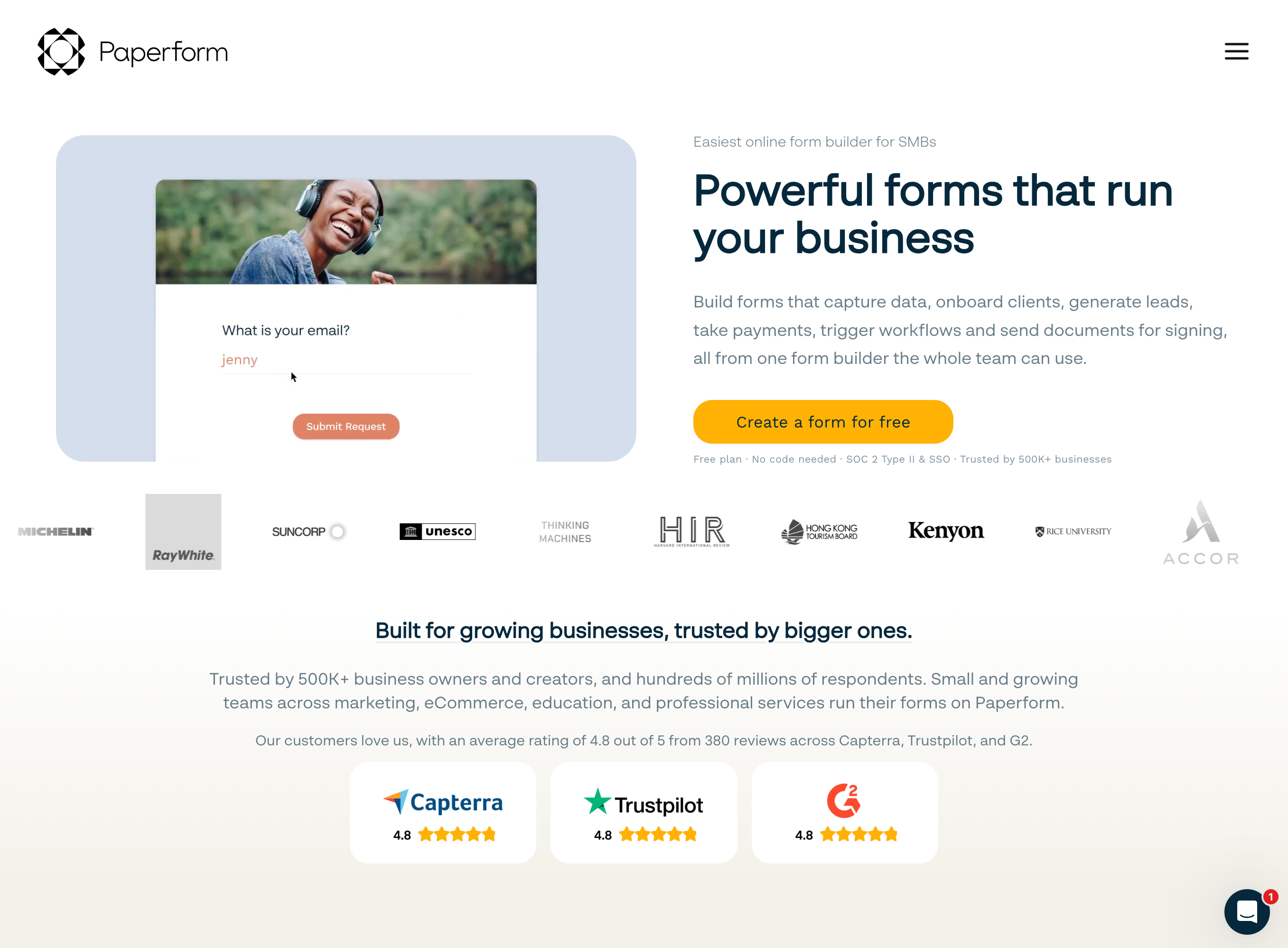
Airtable Forms has zero payment capabilities. No Stripe, no PayPal, no payment fields of any kind. Paperform connects Stripe, PayPal, Square, Braintree, and Google Pay on every plan, including free. Full eCommerce features — product management, subscriptions, coupons, discount codes, tax calculations, and refund processing — are included. If your form needs to collect money in any capacity, Airtable Forms simply cannot do it.
The Calculation Engine
Paperform's Excel-style calculations compute dynamic pricing, risk scores, quiz results, tax amounts, and conditional totals — driving logic across questions, pages, emails, integrations, and success pages. Airtable has formulas and rollup fields in its database, but forms cannot display calculated, lookup, or rollup fields. The calculation happens in the base after submission, not in the form during completion. For any form that needs live calculations visible to the respondent, Paperform is the only option.
Conditional Logic and Branching
Paperform supports advanced conditional logic — show/hide fields, skip pages, route respondents based on answers, pipe answers into later questions, and trigger different emails and success pages based on responses. Airtable Forms has no conditional logic, no branching, and no multi-step forms. Every respondent sees every field. There's no way to personalise the form experience based on previous answers.
Design and Customisation
Paperform's document-style editor creates forms that look like professionally designed landing pages. Text, images, videos, and fields coexist freely. Custom CSS, custom domains, Unsplash and Giphy integration, and advanced theming provide complete brand control. Airtable Forms offers a basic cover image, logo, and colour options. No custom CSS, no custom domains, no rich media embedding. Custom branding requires the Business plan at $45/user/month. For customer-facing forms where design matters, the gap is enormous.
Built-in E-Signatures and Workflow Automation
Paperform includes Papersign (e-signatures for contracts and consent forms) and Stepper (multi-step workflow automation) at no additional cost. Airtable Forms has no signature field, no e-signature capability, and no form-triggered workflow builder. Airtable automations exist as a separate feature but aren't integrated into the form experience.
Form-Specific Analytics
Paperform includes built-in analytics with drop-off tracking, partial submissions, conversion metrics, and AI report insights. Airtable Forms has no form analytics — no drop-off tracking, no partial submissions, no conversion tracking. You can build custom views in Airtable to analyse submitted data, but there's no insight into form abandonment or respondent behaviour during completion.
Templates
Paperform offers 30,000+ professionally designed templates spanning eCommerce, bookings, payments, education, healthcare, and professional services. Airtable has base templates (pre-built databases), but no form-specific templates. Starting a new Airtable form means starting from scratch every time.
E-Signatures
Paperform includes signature fields natively plus Papersign for standalone e-signature documents with audit trails. Airtable Forms has no signature field of any kind. If you need signed consent, contracts, or agreements collected through a form, Airtable Forms is not an option.
Where Airtable Forms Wins
Direct Airtable Base Population
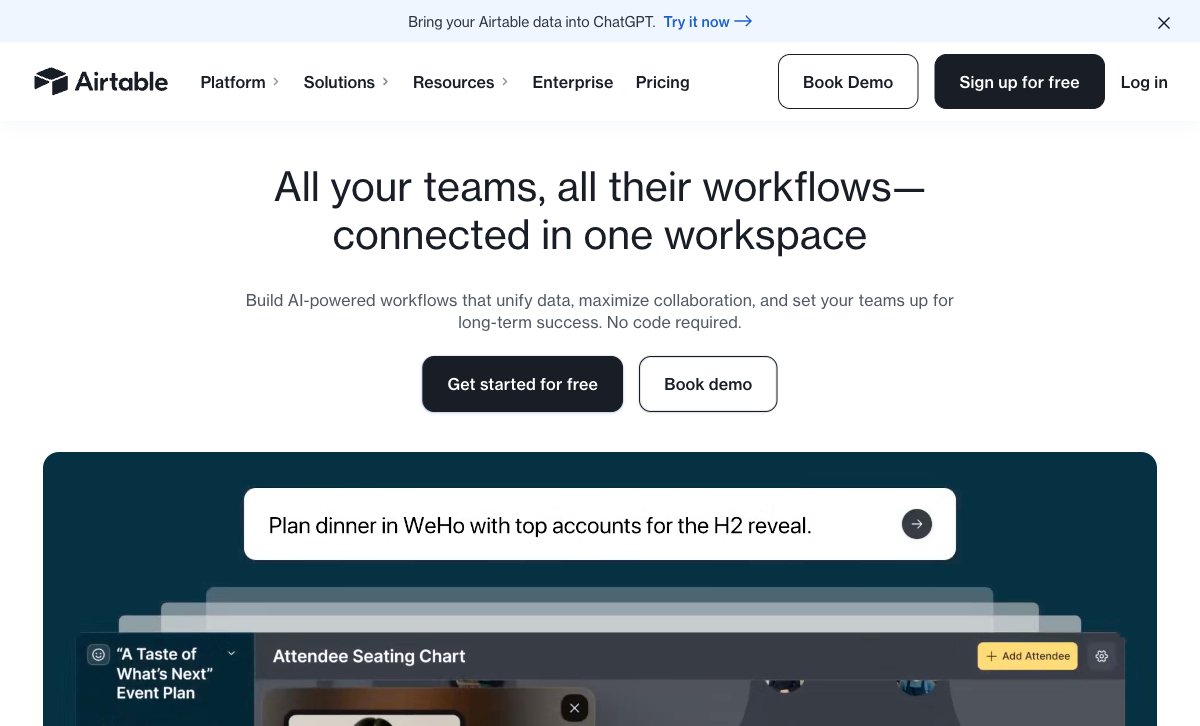
This is Airtable Forms' sole but genuine advantage. Submissions become Airtable records instantly — no integration, no middleware, no field mapping. Records appear in grid, kanban, calendar, gallery, and gantt views automatically. Linked records, automations, and formulas apply immediately. For teams that live in Airtable and need a simple intake mechanism, the zero-configuration data flow eliminates an entire integration layer.
Free With Existing Airtable Account
If your organisation already pays for Airtable, forms are included at no additional cost. There's no separate form builder subscription to manage. For budget-conscious teams that already have Airtable and need basic data entry forms, the marginal cost is zero. Paperform's free plan is more capable, but it's an additional tool in the stack.
Simple for Internal Data Entry
For basic internal use cases — project request intake, bug report submissions, inventory tracking, employee onboarding checklists — Airtable Forms' simplicity is a feature, not a limitation. No learning curve, no configuration, no design decisions. Create a form view, share the link, and submissions flow into the base. When design, logic, and payments don't matter, simplicity wins.
Database Backend Power
While the forms themselves are basic, the Airtable backend is powerful. Once data is in Airtable, you get relational databases, linked records, formulas, rollups, automations, AI agents, and portals. The form is just the intake; the real value is the structured database behind it. Paperform's submission data is tabular, not relational — for complex data modelling, Airtable's backend is stronger.
Where Paperform Falls Short
- No native Airtable integration: Paperform connects to Airtable via Zapier, Make, and webhooks — functional but adds an integration layer that Airtable Forms eliminates entirely.
- No relational database backend: Paperform stores submissions as flat records. For complex data relationships (linked records, rollups across tables), Airtable's database structure is more powerful.
- Separate tool in the stack: If your team already uses Airtable, adding Paperform means managing another subscription, another login, and another tool. Airtable Forms adds zero overhead.
- No HIPAA compliance: Neither Paperform nor Airtable Forms on lower plans offers HIPAA, though Airtable has HIPAA on Enterprise Scale (custom pricing).
Where Airtable Forms Falls Short
- Zero payment capabilities: No payment gateways of any kind. Cannot collect money through forms. Paperform offers five gateways with full eCommerce on the free plan.
- No conditional logic or branching: Every respondent sees every field. No show/hide, no skip logic, no page routing. Single-page forms only — no multi-step experiences.
- Cannot display calculated fields: Forms cannot show computed, lookup, or rollup fields. The calculation happens in the base after submission — respondents never see computed values during form completion.
- Minimal customisation: Basic cover image, logo, and colours. No custom CSS, no custom domains, no rich media. Custom branding requires Business plan ($45/user/month).
- No form analytics: No drop-off tracking, no partial submissions, no conversion metrics. Must build your own reports in Airtable views after the fact.
- No e-signatures: No signature field available in form view. Cannot collect signed agreements, consent forms, or contracts.
- No form templates: Airtable has base templates but no form-specific templates. Every form starts from scratch.
- Record limits: Free plan: 1,000 records per base. Team: 50,000. Each submission creates a record, so form volume is capped by database limits. Paperform has no per-record caps.
- Per-user pricing: Airtable charges per user ($20-45/user/month), which means costs scale with team size. Paperform's pricing is per-account, not per-user (until Business tier at 5 users).
- No save and resume: Respondents cannot save a partially completed form and return later. Long forms must be completed in a single session.
Pricing Comparison

These pricing models are fundamentally different — Airtable charges per-user for the whole platform; Paperform charges per-account for forms:
| Tier | Paperform | Airtable (forms included) | Key Difference |
|---|---|---|---|
| Free | Unlimited forms, 30 subs, 5 gateways, calculations | Basic forms, 1K records/base, 5 editors | Paperform: more form features. Airtable: database backend. |
| ~$20-24/mo | Essentials: $24/mo — payments, eCommerce, scoring | Team: $20/user/mo — 50K records, 25K automations | Airtable is per-user; 5 users = $100/mo vs Paperform $24/mo |
| ~$45-49/mo | Pro: $49/mo — CSS, analytics, API, 1K subs | Business: $45/user/mo — custom branding, SSO, 100K records | Airtable Business for 5 users = $225/mo for basic forms |
| Enterprise | Business: $99/mo — SSO, 10K subs, S3 | Enterprise Scale: Custom — HIPAA, 500K records | Airtable Enterprise adds HIPAA; Paperform adds advanced form features |
Paperform prices are annual billing, per-account. Airtable prices are annual billing, per-user — costs multiply with team size.
Paperform
Airtable Forms
| Product | Plan | Monthly Price | Annual Price (per month) | Free Plan | Free Trial | Limits |
|---|---|---|---|---|---|---|
| Paperform | Free | Free | Free | Yes | 14 days | forms: Unlimited, submissions: 30/month, storage: 100 submissions, users: 1, file uploads: 100 MB |
| Paperform | Essentials | $29/mo | $24/mo billed annually | forms: Unlimited, submissions: 100/month, storage: 1,000 submissions, users: 1, file uploads: 1 GB | ||
| Paperform | Pro | $59/mo | $49/mo billed annually | forms: Unlimited, submissions: 1,000/month, storage: 10,000 submissions, users: 3, file uploads: 10 GB | ||
| Paperform | Business | $129/mo | $99/mo billed annually | forms: Unlimited, submissions: 10,000/month, storage: 100,000 submissions, users: 5, file uploads: 100 GB | ||
| Airtable Forms | Free | Free | Free | Yes | 14 days | None listed |
| Airtable Forms | Team | $24/mo | $20/mo billed annually | None listed | ||
| Airtable Forms | Business | $54/mo | $45/mo billed annually | None listed | ||
| Airtable Forms | Enterprise Scale | Custom | Custom | None listed |
What Users Say
Paperform averages 4.8/5 across ~498 reviews with high marks for customer support, design flexibility, and calculation capabilities. Airtable as a platform is well-reviewed, but form-specific feedback is consistently critical. Feathery's analysis notes Airtable Forms have "only basic logic — no advanced branching or multi-step workflows" and "basic data storage, but no built-in reporting or advanced analytics." Community forums regularly request more form customisation options. The forms are a feature, not a product.
See Them in Action
The Best Approach: Paperform + Airtable Together
For many teams, the smartest approach isn't choosing between Paperform and Airtable Forms — it's using Paperform as the form frontend and Airtable as the data backend. Here's what this looks like:
- Build forms in Paperform: Design beautiful, branded forms with conditional logic, calculations, payments, and e-signatures. Customer-facing forms look professional and collect data intelligently.
- Connect to Airtable via Zapier or Make: Map form fields to Airtable columns. Submissions create records in your Airtable bases automatically, with field mapping handling the translation.
- Manage data in Airtable: Use Airtable's grid, kanban, calendar, and gallery views to process, analyse, and act on the data. Run automations, link records across tables, and build reports.
This combination gives you Paperform's form-building power (which Airtable Forms lacks) plus Airtable's database power (which Paperform's flat submission storage doesn't match). It's more capable than either tool alone for form-to-database workflows.
Who Should Switch from Airtable Forms to Paperform?
If you're currently using Airtable Forms and hitting any of these limitations:
- You need payments: Airtable Forms can't collect money. Period. Paperform handles five gateways with full eCommerce.
- You need conditional logic: Every respondent sees every field in Airtable Forms. If you need branching, show/hide, or skip logic, Paperform is necessary.
- Your forms are customer-facing: Airtable Forms' basic design is acceptable for internal use but looks unprofessional for customer-facing forms. Paperform creates forms that match your brand.
- You need form analytics: Airtable has no form-specific analytics. If you need to track drop-off rates, conversion, or partial submissions, Paperform provides those insights.
- You need e-signatures: Airtable Forms has no signature field. Paperform includes signature fields and Papersign for standalone e-signature documents.
Who Should Stay on Airtable Forms?
Airtable Forms remains the right tool if all of these are true:
- Your forms are internal (project requests, bug reports, inventory intake)
- The data destination is always an Airtable base
- Design, conditional logic, and payments don't matter
- You want zero additional tools or subscriptions
- Simplicity trumps capability for your specific use case
The Verdict
Paperform wins this comparison decisively as a form builder. It offers payment processing (5 gateways vs 0), conditional logic (vs none), calculations (vs none visible on forms), design customisation (vs minimal), e-signatures (vs none), analytics (vs none), and 30,000+ templates (vs none). The capability gap is the widest of any comparison in this category.
Airtable Forms serves a different purpose entirely. It's not competing with form builders — it's a convenient intake mechanism for teams already operating inside Airtable. For internal project request forms, bug report intake, and simple data collection where the destination is an Airtable base, the zero-configuration setup is its value. The best approach for many teams is actually both: Paperform for customer-facing forms with payments, logic, and design, connected to Airtable via Zapier or Make for structured data storage.
From a company perspective, Airtable has raised $735M at an $11B valuation and serves 500,000+ organisations including OpenAI, Amazon, and Netflix. Paperform is bootstrapped and profitable with 500,000+ businesses. Airtable is a larger company, but its forms are a minor feature — not its core product. Paperform's entire focus is forms, which is why the form builder comparison is so lopsided. For more options, see our complete Airtable Forms alternatives analysis or the full best form builders ranking.
Frequently Asked Questions
Is Airtable Forms a real form builder?
Not in the traditional sense. Airtable Forms is a "view type" within Airtable — a way to create a data entry interface for an Airtable base. It's single-page only, has no conditional logic or branching, cannot display calculated or lookup fields, has no payment processing, no e-signatures, no save and resume, and no form-specific analytics. It's useful for simple internal data collection where the goal is populating an Airtable base. For anything customer-facing, payment-related, or requiring form logic, a dedicated form builder like Paperform is significantly more capable.
Can Paperform send data to Airtable?
Yes. Paperform integrates with Airtable via Zapier, Make, and webhooks. Form submissions can create or update records in any Airtable base with field mapping. You get the best of both worlds: Paperform's powerful form building (calculations, payments, conditional logic, design) on the front end, and Airtable's structured database on the back end. This combination is more capable than Airtable's built-in forms for nearly every use case.
Is Airtable Forms free?
Airtable Forms is included with every Airtable plan, including the free tier. However, the free Airtable plan limits you to 1,000 records per base, 1GB of attachment storage, and 100 automation runs per month. Since each form submission creates a record, you're capped at 1,000 total submissions before needing to upgrade or delete records. The Team plan ($20/user/month) raises the limit to 50,000 records. Paperform's free plan allows unlimited forms with 30 submissions/month that don't count against a record cap.
Why would someone choose Airtable Forms over Paperform?
The only compelling reason is if you already use Airtable as your primary database and need a simple way for people to submit records into a specific base. Airtable Forms eliminates the integration step — submissions become Airtable records instantly with zero configuration. For internal intake forms (project requests, bug reports, inventory submissions) where the data destination is an Airtable base and design/logic/payments don't matter, Airtable Forms is the path of least resistance. For anything else, Paperform is the better tool.
Can Airtable Forms collect payments?
No. Airtable Forms has zero payment capabilities — no Stripe, no PayPal, no payment fields of any kind. If you need to collect payments through a form, Airtable Forms is not an option. Paperform connects five payment gateways (Stripe, PayPal, Square, Braintree, Google Pay) on all plans including free, with full eCommerce features: product management, subscriptions, coupons, tax calculations, and refunds.
Sources & References
- Airtable Forms: Limitations and Better Alternatives — Feathery, 2025
- Best Online Form Builder to Use in 2026 — Top 20 Tools — EmailToolTester, 2026
- Airtable Pricing — Airtable, 2026
Last updated March 21, 2026
Ready to try Paperform?
Create beautiful forms, payment pages, and workflows — no code required.