Jotform vs Typeform: Which Is Better in 2026?
Jotform and Typeform embody two opposing philosophies in form building. Jotform does everything: 20,000+ templates, 40+ payment gateways, HIPAA compliance, e-signatures, PDF generation, a mobile app, and hundreds of widgets. Typeform does one thing beautifully: conversational, one-question-at-a-time forms that look stunning and keep respondents engaged. Jotform is the Swiss Army knife. Typeform is the scalpel.
The tension matters because most businesses need both breadth and polish -- features they can rely on and experiences that represent their brand. Jotform gives you every feature but the design output looks like a form. Typeform gives you gorgeous design but a narrower feature set that may leave you reaching for workarounds. Choosing between them forces you to decide what matters more: having every capability available, or having fewer capabilities executed with exceptional design quality.
Both are established platforms with substantial user bases. Jotform, founded in 2006, is bootstrapped and profitable with $144.9 million in annual revenue and 35 million users -- 20 years of continuous operation without venture capital. Typeform, founded in 2012 in Barcelona, has raised significant venture funding and serves millions of users. Jotform's bootstrapped profitability makes it the safer long-term platform bet; Typeform's VC backing means it's under pressure to grow revenue, which can influence pricing decisions.
Quick Verdict
Choose Jotform if:
- You need maximum feature breadth (payments, HIPAA, e-signatures, PDF, mobile)
- You want a generous free plan (5 forms, 100 submissions)
- You need 40+ payment gateway options including regional processors
- You want 20,000+ templates for quick starts
- You prefer traditional drag-and-drop form building
Choose Typeform if:
- Form design and brand experience are top priorities
- Completion rates directly impact your revenue (lead gen, research)
- You want conversational one-question-at-a-time formatting
- You need AI-powered adaptive questions
- Your forms are client-facing and aesthetics matter
Feature Comparison
Jotform has more features in nearly every category. Typeform has fewer features but executes them with better design. The table below shows the raw feature comparison -- but remember that "feature available" and "feature beautifully implemented" are different things.
| Feature | Jotform | Typeform |
|---|---|---|
| Form Building | ||
| Document-style editor | No | No |
| AI form creation | Yes starter | Yes |
| Field types | 30+ (starter) | 20+ |
| Multi-page forms | Yes starter | Yes basic |
| Guided mode (one question at a time) | Yes starter | Yes |
| Conditional logic | Yes starter | Yes basic |
| Calculations field | Yes starter | Yes plus |
| Scoring | Yes starter | Yes plus |
| Answer piping | Yes starter | Yes basic |
| Pre-filling and hidden fields | Yes starter | Yes basic |
| Save and resume | Yes starter | No |
| Auto-close by number | Yes starter | Yes basic |
| Auto-close by date | Yes starter | Yes basic |
| Appointment/booking field | Yes starter | Yes basic |
| Signature field | Yes starter | No |
| Color picker field | No | No |
| File uploads | Yes starter | Yes basic |
| Drag-and-drop builder | Yes starter | No |
| Form widgets | Yes starter | No |
| Template gallery | 20,000+ (starter) | No |
| AI follow-up questions | No | Yes business |
| Video questions | No | Yes basic |
| Payments | ||
| Stripe payments | Yes starter | Yes basic |
| PayPal payments | Yes starter | No |
| Square payments | Yes starter | No |
| Braintree payments | Yes starter | No |
| Google Pay | Yes starter | No |
| 40+ payment gateways | Yes starter | No |
| Product sales (eCommerce) | Yes starter | No |
| Subscriptions | Yes starter | Yes basic |
| Coupons and discounts | Yes starter | No |
| Custom pricing rules | Yes starter | No |
| Tax calculations | Yes starter | No |
| No transaction fees | Yes starter | No |
| Quotes/invoices | No | No |
| Refunds | No | No |
| 3D Secure | No | Yes basic |
| Design & Customization | ||
| Template gallery | 20,000+ (starter) | 1,500+ |
| Rich media (images, GIFs, videos) | Yes starter | Yes |
| Form themes | Yes starter | No |
| Language translation | Yes starter | Yes basic |
| Advanced theming | Yes starter | Yes plus |
| Custom form URL | No | Yes plus |
| Custom domains | Yes enterprise | No |
| Custom HTML & CSS | Yes starter | Yes business |
| Remove branding | Yes bronze | Yes plus |
| Custom email domains | No | No |
| Unsplash and Giphy integration | No | Yes |
| Analytics | ||
| Submission results and reports | Yes starter | Yes |
| Form analytics | Yes starter | No |
| Google Analytics integration | Yes starter | No |
| Partial submissions | No | Yes plus |
| AI report insights | No | Yes business |
| Drop-off analysis | No | Yes business |
| Google Analytics & Facebook Pixel | No | Yes basic |
| Custom analytics scripts | No | Yes basic |
| Collaboration | ||
| Multi-user accounts | Yes bronze | Yes plus |
| User permissions and management | Yes enterprise | Yes plus |
| Advanced permissions & admin | Yes enterprise | Yes enterprise |
| Form sharing | Yes starter | No |
| Assign forms | Yes enterprise | No |
| Form sharing (templates) | No | Yes |
| Workspace organization | No | Yes |
| Security | ||
| SOC 2 Type II | Yes enterprise | Yes |
| GDPR compliant | Yes starter | Yes |
| HIPAA compliant | Yes gold | Yes enterprise |
| SSL encryption | Yes starter | Yes |
| 256-bit SSL | Yes starter | No |
| Two-factor authentication | Yes starter | Yes |
| SSO (SAML) | Yes enterprise | Yes enterprise |
| reCAPTCHA | Yes starter | Yes business |
| Data residency | Yes enterprise | No |
| Form encryption | Yes starter | No |
| PCI DSS | Yes starter | Yes |
| ISO 27001 | No | Yes |
| Integrations & API | ||
| Native integrations | 150+ (starter) | 120+ (basic) |
| Zapier | Yes starter | Yes basic |
| Make (Integromat) | No | Yes basic |
| Webhooks | Yes starter | Yes basic |
| API | Yes starter | Yes basic |
| WordPress plugin | Yes starter | Yes |
| Salesforce AppExchange | Yes starter | No |
| Embed options | Yes starter | Yes |
| Mobile apps | Yes starter | No |
| Additional Products | ||
| Jotform Tables | Yes starter | No |
| Jotform Sign | Yes starter | No |
| Jotform Apps | Yes starter | No |
| Jotform Workflows | Yes starter | No |
| Jotform Report Builder | Yes starter | No |
| Jotform AI Agents | Yes starter | No |
| Jotform Store Builder | Yes starter | No |
Where Jotform Wins
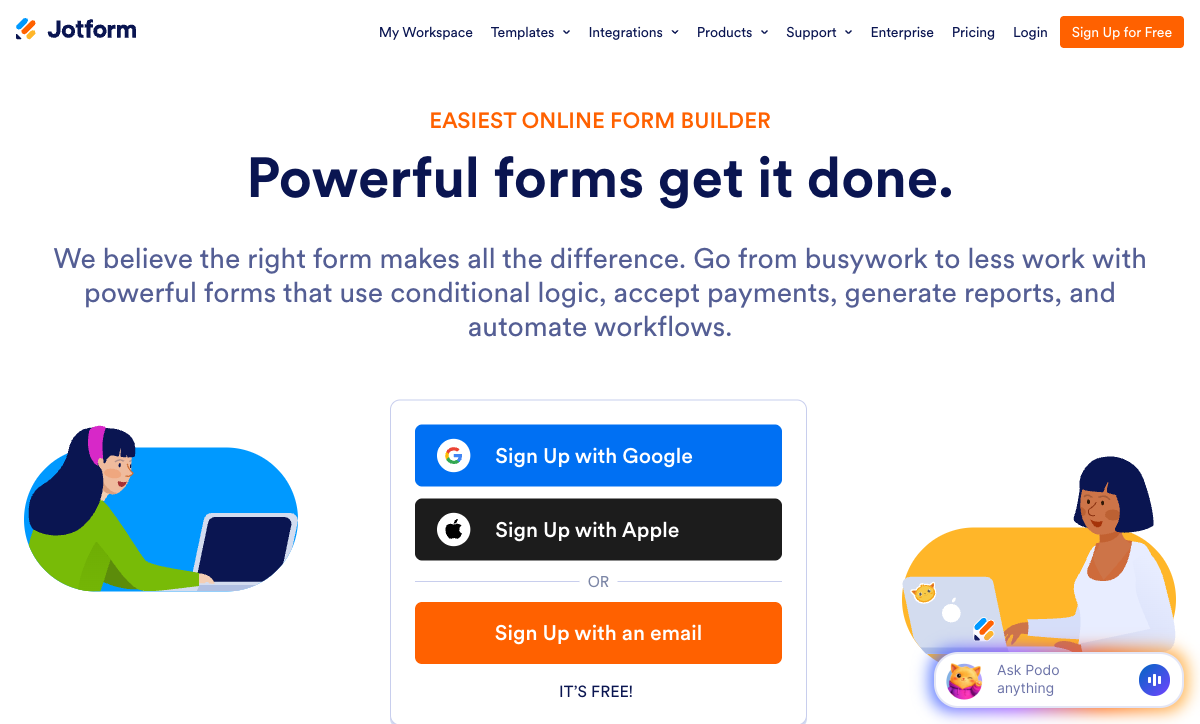
20,000+ Templates
Jotform's template library is the largest in the form builder space. With 20,000+ templates spanning industries from healthcare to hospitality, you can find a starting point for virtually any use case. Typeform has a smaller template library (hundreds, not thousands) with higher average design quality but far less variety. For niche use cases -- specific industry intake forms, regional compliance forms, uncommon survey types -- Jotform's breadth means you're more likely to find something close to what you need. The quality is inconsistent (community-submitted templates vary), but the sheer variety saves time for users who need industry-specific starting points.
40+ Payment Gateways
Jotform supports 40+ payment processors: Stripe, PayPal, Square, Mollie, Payfast, iyzico, PayJunction, and dozens of regional options. Typeform supports Stripe only. For businesses operating in markets where Stripe isn't dominant (parts of Asia, Africa, Eastern Europe, Latin America), or businesses that need PayPal, Square, or specific regional processors, Jotform is the only viable option between these two. The payment integration is widget-based rather than deeply integrated (limited eCommerce features around the transactions), but the gateway breadth is unmatched.
More Generous Free Plan
Jotform's free plan offers 5 forms, 100 monthly submissions, and 100 MB storage. Typeform's free plan offers 10 responses per month total. The difference is enormous: Jotform's free tier is genuinely usable for small businesses, students, and personal projects. Typeform's free tier exhausts itself in a day of moderate traffic. For anyone evaluating both platforms, Jotform lets you build and test real forms with real users before committing to payment. Typeform essentially requires a paid plan to do anything meaningful.
HIPAA Compliance (at a Lower Price)
Both Jotform and Typeform offer HIPAA compliance with Business Associate Agreements, but Jotform makes it available starting at the Bronze tier ($49/month) while Typeform requires the Business plan ($83/month). For healthcare organisations, medical practices, and therapists who need HIPAA-compliant web forms, Jotform delivers the same regulatory compliance at a lower price point. The $34/month gap ($408/year) is meaningful for small practices and independent healthcare providers.
E-Signatures and PDF Generation
Jotform includes Jotform Sign for legally binding e-signatures and built-in PDF generation for creating formatted documents from form submissions. Typeform has no native e-signature capability and limited PDF functionality. For contracts, consent forms, waivers, intake documents, and any workflow requiring a signature, Jotform provides the tooling within the platform. Typeform users need to connect to a separate signing service (DocuSign, HelloSign) via integration, adding cost and complexity.
Mobile App
Jotform offers dedicated iOS and Android apps for managing forms, viewing submissions, receiving push notifications, and collecting data offline. Typeform has no dedicated mobile app for form management. For field workers, event staff, trade show teams, or anyone who needs to check form responses on the go, Jotform's mobile app is a practical advantage that Typeform doesn't offer.
Where Typeform Wins
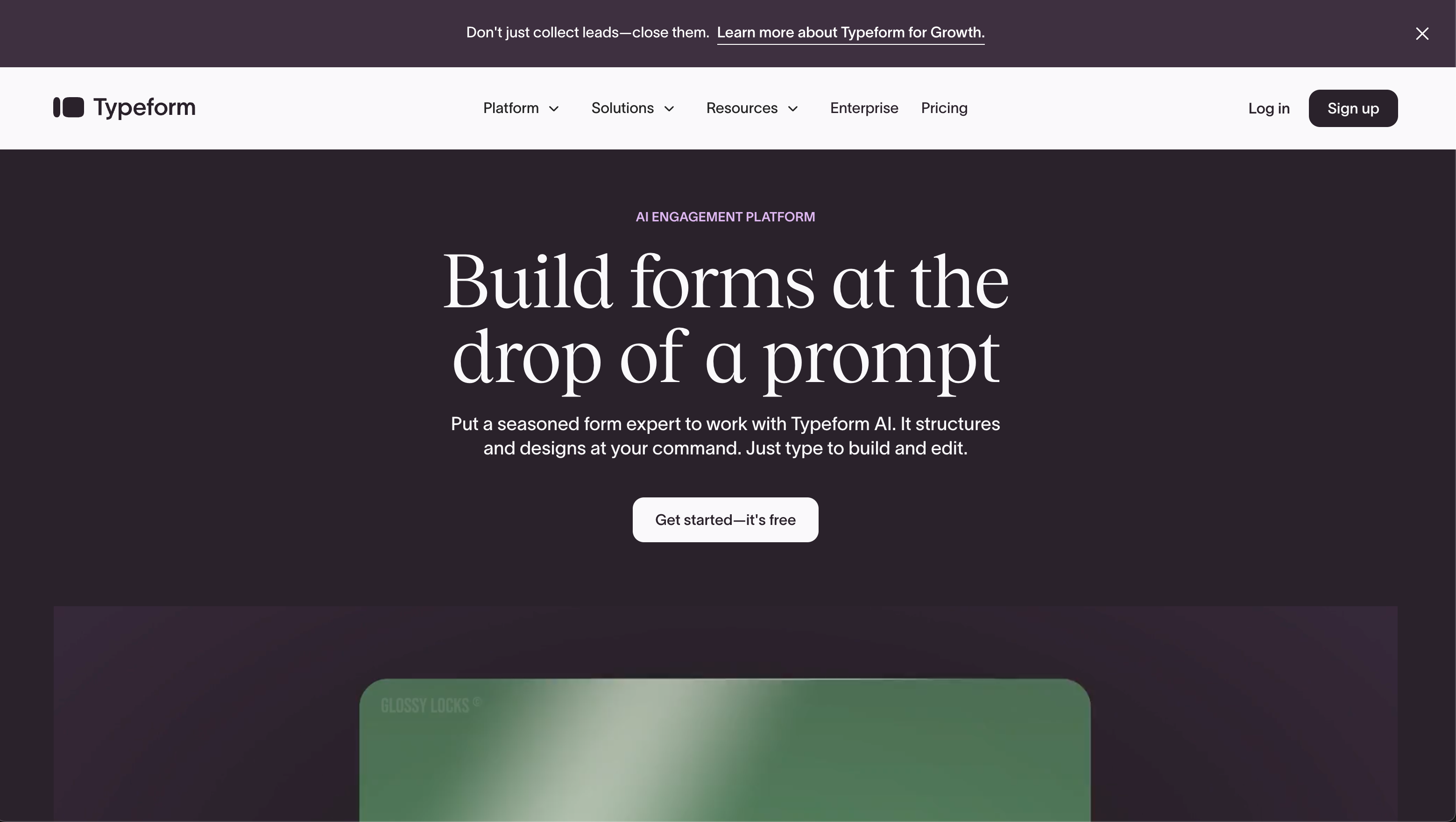
Conversational UX and Completion Rates
Typeform's one-question-at-a-time format is the core differentiator, and it genuinely works. By showing one question with smooth animations and transitions, Typeform reduces cognitive load and keeps respondents engaged through longer forms. The result is measurably higher completion rates, particularly on forms with 10+ questions. For lead generation, customer research, and any form where each completion has direct business value, Typeform's UX advantage translates to more conversions. Jotform's traditional list layout is efficient for short forms but causes higher abandonment on complex multi-page experiences.
Design Quality
Typeform produces the best-looking forms in the industry. Custom fonts, full-bleed background images, branded colour schemes, video backgrounds, micro-animations, and a cohesive design system create forms that feel like premium web experiences. Jotform's drag-and-drop editor offers more layout flexibility -- you can position elements precisely -- but the visual output looks like a form: grid-based, widget-heavy, and utilitarian. For agencies, consumer brands, and any business where form aesthetics reflect brand quality, Typeform's design ceiling is significantly higher.
AI-Powered Adaptive Questions
Typeform has invested heavily in AI features, including adaptive questions that generate contextual follow-ups based on respondent answers. Instead of pre-building every possible branch, the AI creates personalised questions in real time. This is a genuinely novel capability that no traditional form builder -- including Jotform -- can replicate. For research surveys, customer feedback, and any use case where deeper follow-up questions improve data quality, Typeform's AI questioning is a meaningful innovation.
Respondent Experience
Beyond completion rates, the qualitative experience of filling out a Typeform is noticeably different. The conversational format, keyboard navigation, progress indicators, and smooth transitions make forms feel respectful of the respondent's time. Jotform forms work fine functionally but don't create the same sense of a crafted experience. For customer-facing surveys where you want respondents to feel positive about the interaction (brand perception surveys, NPS, customer satisfaction), Typeform's experience quality matters.
Integration Quality
Typeform's native integrations with HubSpot, Salesforce, Slack, Mailchimp, Google Sheets, Airtable, and Notion are well-maintained and deeply configured. Data mapping is clean, and the integrations feel like first-class features rather than afterthoughts. Jotform connects to hundreds of tools through its own integrations plus Zapier and Make, but the quality varies -- some integrations are basic webhook connections while others are fully configured. For marketing and sales teams that need clean data flowing into CRM pipelines and email sequences, Typeform's integration polish reduces friction.
Brand Removal on Lower Tiers
Typeform removes its branding on the Plus plan ($50/month) and above. Jotform removes branding on the Starter plan ($39/month) and above. For businesses where white-labelling matters -- agency client forms, professional surveys, branded lead capture -- Jotform offers brand removal at a lower price point. However, Typeform's branding ("Powered by Typeform") is subtle and arguably carries positive brand associations given Typeform's reputation for design quality, while Jotform's branding may not carry the same design-quality signal.
Where Jotform Falls Short
- Cluttered interface: 20 years of features create an editor packed with menus, widgets, and nested settings. Multiple reviewers note the learning curve. Finding specific options requires navigating deeply into configuration panels.
- Design output ceiling: Jotform forms look like forms -- grid-based layouts with standard field styling. Achieving Typeform-level visual polish requires extensive CSS customisation on premium plans.
- Performance on complex forms: Reviews consistently mention lag and slow rendering on forms with many fields, heavy conditional logic, or extensive widget usage. Typeform's single-question format avoids this by only rendering one question at a time.
- Inconsistent feature quality: Jotform builds broadly rather than deeply. Features like the PDF editor, approval workflows, and e-signatures exist but don't always feel as polished as dedicated tools.
- No calculation engine: Despite its feature breadth, Jotform lacks an Excel-style formula system for dynamic pricing, scoring, or computed values across form elements. Basic math widgets exist but can't compute dynamically across an entire form workflow.
Where Typeform Falls Short
- Extremely restrictive free tier: 10 responses/month is essentially a demo. Jotform's 100 submissions/month on 5 forms is 10x more generous.
- Expensive at scale: Basic at $25/month (100 responses), Plus at $50/month (1,000 responses), Business at $83/month (10,000 responses). For high-volume forms, costs escalate quickly.
- Stripe-only payments: No PayPal, Square, Mollie, or regional processors. Businesses needing non-Stripe payment options must look elsewhere.
- No e-signatures: Contracts, consent forms, and waivers require external tools. Jotform includes Jotform Sign natively.
- Conversational format isn't always ideal: For order forms, data entry, registration forms, and scenarios where respondents want to see all fields at once, the one-question-at-a-time format adds unnecessary friction and clicks.
- No mobile app: No dedicated mobile app for form management. Jotform's mobile app handles form creation, submission viewing, and offline data collection.
See Them in Action
The philosophical difference between Jotform and Typeform is immediately visible when you use both editors. Jotform's drag-and-drop canvas presents a grid where you place widgets, configure properties, and build complex layouts with precise control over positioning. Typeform's editor is a sequential question list where you configure each step of the conversation -- the focus is on flow rather than layout.
From the respondent's perspective, the difference is even more dramatic. A Jotform form presents all fields (or a page of fields) simultaneously in a traditional layout. A Typeform reveals one question at a time with animations and transitions. For short forms (3-5 questions), the difference is subtle. For longer forms (10+ questions), Typeform's progressive disclosure keeps respondents engaged while Jotform's full-page display can feel overwhelming. The best approach depends entirely on your form's length and complexity.
Pricing Comparison
Both are paid platforms with limited free tiers, but their pricing structures differ significantly. Jotform is generally cheaper per submission and more feature-inclusive at each tier.
| Tier | Jotform | Typeform | Key Difference |
|---|---|---|---|
| Free | 5 forms, 100 submissions, 100 MB | 10 responses/month total | Jotform's free tier is 10x more generous on responses. |
| ~$25-39/mo | Starter: $39/mo, 100 submissions, 100 MB, payments | Basic: $25/mo, 100 responses, logic jumps, Stripe | Typeform is cheaper at entry level. Jotform includes more payment gateways. |
| ~$49-50/mo | Bronze: $49/mo, 250 submissions, 1 GB, HIPAA | Plus: $50/mo, 1,000 responses, no Typeform branding | Similar price. Typeform offers 4x responses; Jotform adds HIPAA. |
| ~$83-99/mo | Silver: $99/mo, 1,000 submissions, 10 GB, HIPAA | Business: $83/mo, 10,000 responses, priority support | Typeform offers 10x responses at a lower price. Jotform includes more storage. |
Jotform
Typeform
| Product | Plan | Monthly Price | Annual Price (per month) | Free Plan | Free Trial | Limits |
|---|---|---|---|---|---|---|
| Jotform | Starter | Free | Free | Yes | No | forms: 5, submissions: 100/month, storage: 100 MB, users: 1 |
| Jotform | Bronze | $39/mo | $34/mo billed annually | forms: 25, submissions: 1,000/month, storage: 1 GB, users: 1 | ||
| Jotform | Silver | $49/mo | $39/mo billed annually | forms: 50, submissions: 2,500/month, storage: 10 GB, users: 1 | ||
| Jotform | Gold | $129/mo | $99/mo billed annually | forms: 100, submissions: 10,000/month, storage: 100 GB, users: 1 | ||
| Typeform | Free | Free | Free | Yes | No | forms: 10, submissions: 10/month, users: 1 |
| Typeform | Basic | $39/mo | $28/mo billed annually | forms: Unlimited, submissions: 100/month, users: 1 | ||
| Typeform | Plus | $79/mo | $56/mo billed annually | forms: Unlimited, submissions: 1,000/month, users: 3 | ||
| Typeform | Business | $129/mo | $91/mo billed annually | forms: Unlimited, submissions: 10,000/month, users: 5 | ||
| Typeform | Growth Pro | $379/mo | $266/mo billed annually | forms: Unlimited, submissions: Expanded, users: Expanded |
What Users Say
Jotform carries tens of thousands of reviews across G2, Capterra, and Trustpilot, averaging 4.6-4.7/5. Users praise template variety, payment gateway breadth, and the generous free tier. The consistent criticism: interface complexity, performance issues on large forms, and inconsistent feature quality. As EmailToolTester's 2026 review noted, Jotform offers "everything but the kitchen sink" -- the challenge is finding what you need.
Typeform earns strong ratings (4.5-4.7/5) with particular praise for design quality, respondent experience, and the conversational format. The recurring criticism is pricing: users consistently describe Typeform as expensive for its feature set, and the 10-response free tier is a frequent complaint. Zapier's 2025 review praised Typeform's UX innovation but noted its narrow feature set relative to competitors at similar price points.
Who Is Each Platform Best For?
Jotform is ideal for: businesses that need a comprehensive form toolkit -- payments across multiple gateways, HIPAA compliance, e-signatures, PDF generation, mobile management, and maximum template variety. Teams that prioritise feature availability over design polish, and organisations with formal compliance or procurement requirements that benefit from Jotform's 20-year track record and scale. Healthcare providers, event businesses, educational institutions, and enterprises with complex procurement processes.
Typeform is ideal for: businesses where form aesthetics and respondent experience directly impact outcomes. Marketing teams running lead generation campaigns, agencies creating branded client experiences, researchers who need high completion rates on long surveys, and any organisation where the form is the brand touchpoint. Teams that value design quality over feature breadth. SaaS companies building onboarding flows, product teams running user research, and consumer brands where every touchpoint reflects brand quality.
Neither platform is ideal for: businesses that need an Excel-style calculation engine for dynamic pricing, scoring, or conditional totals. Neither Jotform nor Typeform can compute values dynamically across form elements -- a capability that platforms like Paperform offer natively. Teams that need both Typeform-level design and Jotform-level features without compromise should evaluate Paperform as a middle ground.
Consider Paperform: Design Quality Meets Feature Depth
If you want Typeform's design quality and Jotform's feature depth, Paperform combines both at a lower price than either. Paperform's document-style editor produces forms that look like designed landing pages (matching Typeform's aesthetic standard), while including 5 integrated payment gateways, built-in e-signatures (Papersign), workflow automation (Stepper), and an Excel-style calculation engine that neither Jotform nor Typeform offers.
Starting at $24/month -- less than Typeform's Basic ($25/month) and Jotform's Starter ($39/month) -- Paperform includes features that cost extra or don't exist on either competitor: dynamic pricing calculations, conditional totals, subscription management, and computation that flows into emails, integrations, and payment amounts. The calculation engine alone is a deciding factor for businesses that need forms to compute rather than just collect.
Paperform also offers a Guided Mode that delivers Typeform-style conversational one-question-at-a-time experiences within the same editor, giving you both traditional and conversational formats without choosing between platforms. See our Paperform vs Jotform comparison and best form builders ranking for the full breakdown.
The Verdict
Jotform is the better choice for feature-driven teams. If your requirements list includes specific payment gateways, HIPAA compliance, e-signatures, PDF generation, mobile form management, or maximum template variety, Jotform checks more boxes. The 20-year track record and bootstrapped profitability make it a safe long-term bet. The free tier is genuinely usable. The trade-off is design quality -- Jotform forms work, but they don't dazzle.
Typeform is the better choice for experience-driven teams. If completion rates directly impact revenue, if your forms represent your brand to customers, or if you need beautiful conversational experiences that stand out, Typeform delivers a respondent experience that Jotform can't match. The AI-powered adaptive questions are a genuine innovation. The trade-off is cost (especially for high-volume usage), a restrictive free tier, and a narrower feature set that may leave gaps for complex workflows.
Neither platform truly combines the other's strengths. Jotform won't match Typeform's design quality without extensive customisation. Typeform won't match Jotform's feature breadth without external tools and integrations. For teams that need both design polish and feature depth, a platform like Paperform that builds fewer features beautifully may be the better middle ground. For more options, see our Jotform alternatives, best form builders ranking, or our detailed breakdowns of each platform.
Frequently Asked Questions
Which has a better free plan: Jotform or Typeform?
Jotform, by a wide margin. Jotform's free plan includes 5 forms, 100 monthly submissions, and 100 MB storage -- enough for a small business to run several active forms. Typeform's free plan allows 10 responses per month total across all forms -- barely enough to test the platform. If you need a free form builder with usable limits, Jotform is the only realistic option between these two. Typeform's free tier is effectively a demo that pushes you toward paid plans almost immediately.
Does Typeform really get better completion rates than Jotform?
Generally yes, particularly on longer forms. Typeform's one-question-at-a-time format reduces cognitive load and creates a sense of progress that keeps respondents engaged. For forms with 10+ questions, the conversational approach measurably reduces abandonment compared to traditional list-based forms. However, the advantage diminishes for short forms (3-5 questions) where the full-page format adds unnecessary clicks. Jotform's traditional layout actually performs better when respondents want to see everything at once -- like order forms, registration forms, or data entry where seeing all fields simultaneously is more efficient. The completion rate advantage is real but context-dependent.
Can Jotform match Typeform's design quality?
Not easily. Typeform's design system -- custom fonts, full-bleed backgrounds, smooth animations, video embeds, branded colour schemes -- produces forms that look like polished web experiences. Jotform's drag-and-drop editor produces functional forms with more layout flexibility, but the visual output tends to look like traditional forms: grids, rows, and input fields. You can customise Jotform extensively with CSS injection on higher plans, but achieving Typeform-level polish requires significant effort. For brand-conscious businesses where form aesthetics matter (agencies, luxury brands, consumer-facing companies), Typeform's design quality is noticeably superior out of the box.
Which is better for collecting payments?
Jotform wins on gateway breadth with 40+ payment processors including Stripe, PayPal, Square, Mollie, Payfast, and dozens of regional options. Typeform supports Stripe only on paid plans. For businesses operating in markets where Stripe isn't dominant, or those needing PayPal, Square, or regional processors, Jotform is the only option. However, neither platform offers the deep eCommerce integration (subscriptions, coupons, tax calculations, product management) that dedicated eCommerce form builders like Paperform provide. If you just need to accept payments, both work. If you need eCommerce, look beyond both.
Is Jotform or Typeform better for HIPAA compliance?
Jotform offers HIPAA compliance with Business Associate Agreements on paid plans (Bronze and above), making it suitable for healthcare organisations collecting Protected Health Information. Typeform also offers HIPAA compliance on its Business plan ($83/month). Both platforms can serve healthcare use cases, but Jotform's HIPAA tier is more accessible -- available starting at $49/month versus Typeform's $83/month. If HIPAA compliance is a requirement, both platforms support it, but Jotform offers it at a lower price point.
Sources & References
- Best Online Form Builder to Use in 2026 -- Top 20 Tools — EmailToolTester, 2026
- The Best Online Form Builders for 2025 — Zapier, 2025
- Jotform vs Typeform: Which Form Builder Is Best? — Zapier, 2025
Last updated March 21, 2026
Ready to try Paperform?
Create beautiful forms, payment pages, and workflows — no code required.