Google Forms vs Zoho Forms: Google Ecosystem vs Zoho Ecosystem in 2026
Google Forms and Zoho Forms are both ecosystem plays — form builders designed to work best within their parent platform's suite of tools. Google Forms is the simplest, most widely used form builder in the world: completely free, unlimited, and deeply integrated with Google Workspace. Zoho Forms is a more capable form builder that connects natively to Zoho's 50+ business applications — CRM, helpdesk, accounting, project management, and more.
For most teams, the choice comes down to which ecosystem you already inhabit. Google Workspace users get a free, familiar form tool that feeds into Sheets, Drive, and Classroom with zero friction. Zoho ecosystem users get a form builder with payment processing, conditional logic, approval workflows, and native CRM integration that Google Forms can't match on features. This comparison breaks down exactly where each platform excels and where each one leaves you wanting more.
Quick Verdict
Choose Google Forms if:
- You need unlimited forms and responses at zero cost
- Your team uses Google Workspace and needs Sheets/Drive integration
- Your forms are simple: surveys, quizzes, feedback, RSVPs
- Speed matters — create and share a form in under two minutes
- Real-time co-editing with teammates is important
Choose Zoho Forms if:
- Your organisation uses Zoho CRM, Zoho Desk, or other Zoho apps
- You need payment collection (PayPal, Stripe, and more)
- Your forms require conditional logic, approval workflows, or file uploads
- You want custom branding, custom domains, and form-level analytics
- You need subforms, repeating sections, or multi-page logic
Feature Comparison
Side-by-side across every feature category.
| Feature | Google Forms | Zoho Forms |
|---|---|---|
| Form Building | ||
| Document-style editor | No | No |
| AI form creation | Yes | Yes basic |
| Field types | 11 | Yes |
| Multi-page forms | Yes | Yes |
| Guided mode (one question at a time) | No | No |
| Conditional logic | Yes | Yes |
| Calculations field | No | Yes basic |
| AI calculations assistant | No | No |
| Scoring | Yes | No |
| Answer piping | No | Yes basic |
| Pre-filling and hidden fields | Yes | Yes |
| Save and resume | No | Yes basic |
| Auto-close by number | Yes | Yes |
| Auto-close by date | Yes | Yes |
| Appointment/booking field | No | No |
| Signature field | No | Yes |
| Color picker field | No | No |
| API-powered dropdowns | No | No |
| Google address search | No | No |
| File uploads | Yes | No |
| Payments | ||
| Stripe payments | No | No |
| PayPal payments | No | No |
| Square payments | No | No |
| Braintree payments | No | No |
| Google Pay | No | No |
| Product sales (eCommerce) | No | No |
| Subscriptions | No | No |
| Coupons and discounts | No | No |
| Custom pricing rules | No | No |
| Tax calculations | No | No |
| Quotes/invoices | No | Yes standard |
| Refunds | No | No |
| 3D Secure | No | No |
| Stripe | No | Yes |
| PayPal | No | Yes |
| Square | No | No |
| Braintree | No | No |
| Product sales | No | Yes basic |
| Coupons | No | No |
| Custom pricing | No | Yes basic |
| Design & Customization | ||
| Template gallery | 20+ | Yes |
| Rich media (images, GIFs, videos) | Yes | No |
| Unsplash and Giphy integration | No | No |
| Image editor | No | No |
| Adobe Creative Cloud | No | No |
| Language translation | No | Yes standard |
| Advanced theming | No | Yes basic |
| Custom form URL | No | No |
| Custom domains | No | No |
| Custom HTML & CSS | No | No |
| Remove branding | No | Yes basic |
| Custom email domains | Yes Business Starter | No |
| Rich media | No | Yes |
| Unsplash/Giphy | No | No |
| Adobe CC | No | No |
| Custom HTML/CSS | No | Yes standard |
| Analytics | ||
| Submission results and reports | Yes | No |
| AI report insights | No | No |
| Paperform analytics | No | No |
| Google Analytics & Facebook Pixel | No | No |
| Custom analytics scripts | No | No |
| Partial submissions | No | No |
| Submission results | No | Yes |
| AI insights | No | No |
| Form analytics | No | Yes standard |
| GA/FB Pixel | No | No |
| Custom scripts | No | No |
| Collaboration | ||
| Multi-user accounts | Yes | No |
| User permissions and management | Yes | No |
| Advanced permissions & admin | Yes Business Starter | No |
| Form sharing (templates) | Yes | No |
| Spaces and tag management | No | No |
| Multi-user | No | Yes standard |
| Permissions | No | Yes standard |
| Advanced permissions | No | Yes professional |
| Form sharing | No | Yes |
| Spaces/tags | No | No |
| Security | ||
| SOC 2 Type II | Yes | No |
| GDPR compliant | Yes | No |
| SSL encryption | Yes | No |
| Two-factor authentication | Yes | No |
| Enforce 2FA for all users | Yes Business Starter | No |
| SSO (SAML) | Yes Business Plus | No |
| reCAPTCHA | No | Yes |
| Local data residency | Yes Business Plus | No |
| Custom S3 storage (BYO) | No | No |
| SOC 2 | No | Yes |
| GDPR | No | Yes |
| SSL | No | Yes |
| 2FA | No | Yes |
| Enforce 2FA | No | No |
| SSO SAML | No | Yes professional |
| Data residency | No | Yes |
| Custom S3 | No | No |
| Integrations & API | ||
| Native integrations | No | No |
| Zapier | Yes | Yes basic |
| Make (Integromat) | Yes | No |
| Webhooks | No | Yes standard |
| Standard API | Yes | Yes basic |
| Business API | No | No |
| WordPress plugin | No | No |
| oEmbed support | No | No |
| 2000+ | No | No |
| WordPress | No | Yes |
| oEmbed | No | Yes |
Where Google Forms Wins
Completely Free With No Limits
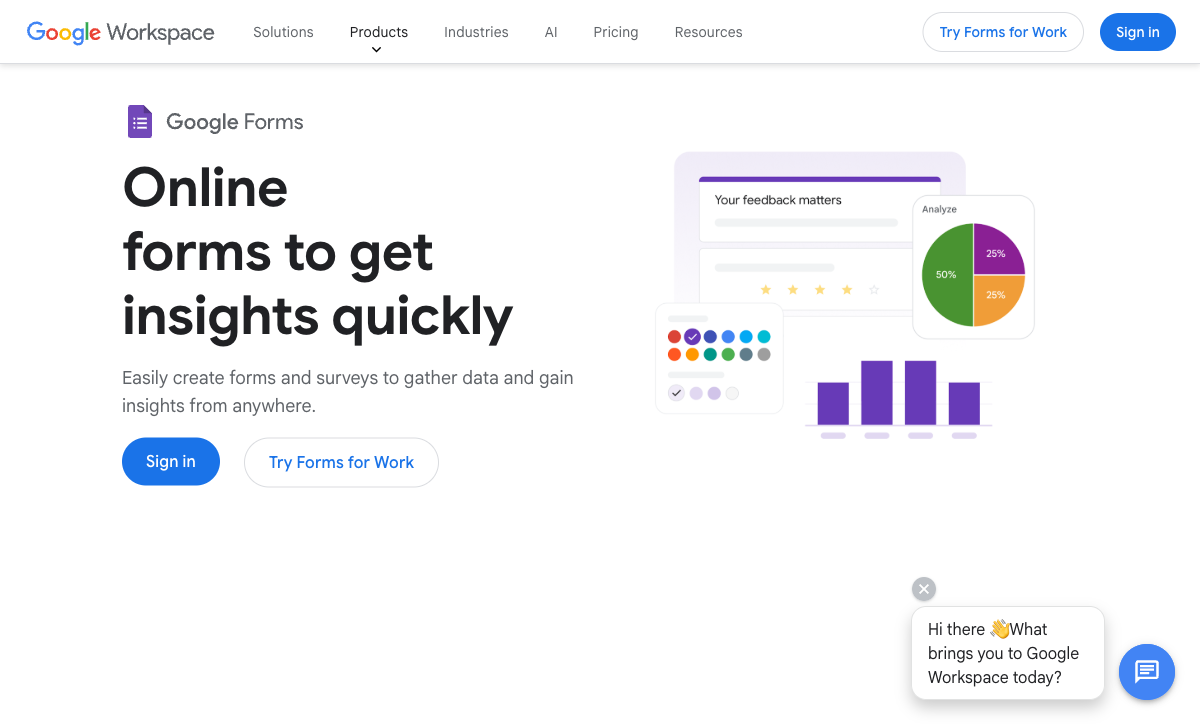
Google Forms is free with no submission caps, no form limits, and no feature gates. You get unlimited forms, unlimited responses, unlimited collaborators, and unlimited storage (within Google Drive's 15GB quota). Zoho Forms' free plan limits you to 3 forms and 500 submissions per month. For organisations collecting thousands of responses — student surveys, employee feedback, event RSVPs, research data — Google's unlimited free tier eliminates any volume anxiety.
Google Workspace Integration
Google Forms connects to the Google ecosystem with zero configuration. Responses flow into Google Sheets in real time with one click. Forms can be shared via Google Classroom, embedded in Google Sites, stored in Google Drive, and sent through Gmail with pre-filled links. For organisations already running on Google Workspace, this native integration is seamless in a way that no third-party form builder can replicate. Zoho Forms connects to the Zoho ecosystem equally well — but if you're in Google's world, that doesn't help.
Speed and Simplicity
Google Forms is the fastest way to create and share a form. Open the app, type your questions, hit send. No account creation needed (if you have a Google account). No plan selection, no trial period, no feature discovery. The interface is stripped to essentials — question types, section breaks, and a settings panel. For quick internal polls, meeting feedback, team surveys, and simple data collection, Google Forms' lack of complexity is its greatest strength.
Real-Time Collaboration
Multiple users can edit a Google Form simultaneously — the same real-time co-editing experience as Google Docs and Sheets. Changes appear instantly, comments can be added, and edit history is preserved. Zoho Forms supports team collaboration on paid plans with role-based access, but the real-time co-editing experience isn't as smooth or instant. For teams that build forms together, Google's collaboration model is unmatched.
Built-In Quiz Mode
Google Forms includes a one-click quiz mode with auto-grading for multiple choice, checkbox, and dropdown questions. Respondents see their score immediately with correct/incorrect feedback per question. It's simple, effective, and free — perfect for classroom assessments, training quizzes, and knowledge checks. Zoho Forms doesn't have a dedicated quiz mode, though you can build quizzes manually with conditional logic and calculations.
Universal Recognition
Google Forms is used by hundreds of millions of people. Respondents trust it instantly — they recognise the interface, know their data is going to Google, and feel comfortable filling it out. Zoho Forms is respected in the business software space but far less recognised by the general public. For public-facing surveys where respondent trust affects completion rates, Google's brand carries weight.
Where Zoho Forms Wins
Payment Processing
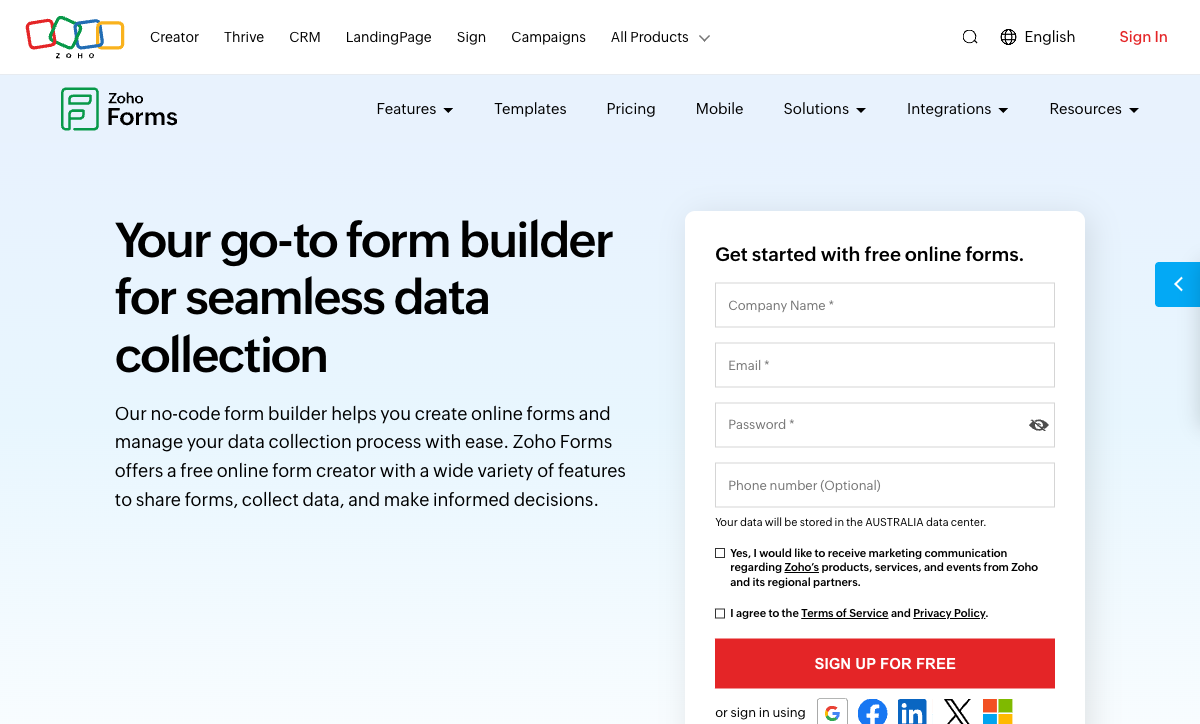
Zoho Forms supports payment collection via PayPal, Stripe, Authorize.Net, PayFlow, 2Checkout, and Razorpay — even including one payment form on the free plan. Paid plans add multi-currency support, recurring payments, and additional payment forms. Google Forms has absolutely no payment capability. For order forms, event registrations with fees, donations, service bookings, or any form that collects money, Zoho Forms is the only option between the two.
Native Zoho Ecosystem Integration
Zoho Forms connects natively to Zoho's 50+ business applications. Form submissions can create contacts in Zoho CRM, tickets in Zoho Desk, tasks in Zoho Projects, entries in Zoho Books, records in Zoho Creator, and rows in Zoho Sheet — all without third-party integrations. For organisations running on the Zoho suite, this native connectivity is as seamless as Google Forms' integration with Google Workspace. The difference is that Zoho's ecosystem covers CRM, helpdesk, accounting, HR, and project management — a broader operational scope than Google Workspace.
Conditional Logic and Advanced Fields
Zoho Forms includes field-level conditional logic (show/hide fields based on answers), page-level branching, formula fields with calculations, and subforms (forms within forms for repeating data). Google Forms has basic section branching but no field-level conditions, no calculations, and no subforms. For forms that need dynamic behaviour — showing different fields based on selections, calculating totals, or collecting variable-length data — Zoho Forms is significantly more capable.
Approval Workflows
Zoho Forms includes built-in approval workflows on paid plans. Form submissions can be routed through an approval chain — manager review, department head sign-off, final approval — with email notifications at each step. This is valuable for leave requests, purchase orders, expense reports, and any internal process requiring multi-level approval. Google Forms has no workflow capability — submissions go to a spreadsheet and that's it. Building approval processes on Google Forms requires external tools (Google Apps Script, third-party add-ons).
Custom Branding and Domains
Zoho Forms supports custom themes, CSS customisation, logo placement, custom domains, and branding removal on paid plans. Forms can look like your brand, hosted on your domain. Google Forms offers a header image, colour choice, and three font options — every form is immediately recognisable as a Google Form. For businesses where brand consistency matters in customer-facing forms, Zoho provides meaningfully more control.
Form Analytics
Zoho Forms includes form-level analytics: submission trends, drop-off rates, geographic distribution, device breakdown, and UTM tracking on paid plans. Google Forms shows a basic summary of responses (charts and percentages) but no engagement analytics, no drop-off tracking, and no source attribution. For teams optimising form performance, Zoho's analytics provide actionable insights that Google Forms doesn't offer.
Where Google Forms Falls Short
- No payment processing: Zero capability. Order forms, donations, and paid registrations require external tools.
- No conditional field logic: Section branching exists, but you can't show/hide individual fields based on answers. Dynamic forms aren't possible.
- No calculations: No formula engine, no dynamic pricing, no computed fields. Basic quiz scoring is the only computation available.
- No approval workflows: Submissions go to a spreadsheet. Multi-step review, routing, and approval require external tools.
- Minimal branding: A header image, a colour, and a font. No custom CSS, no custom domain. Every form looks like a Google Form.
- No analytics beyond response summaries: No drop-off tracking, no source attribution, no device analytics.
- No CRM integration: Google Forms feeds into Sheets, not a CRM. Creating CRM contacts from submissions requires Zapier or Apps Script.
Where Zoho Forms Falls Short
- Limited free plan: 3 forms and 500 submissions/month. Google Forms is unlimited. High-volume free usage isn't viable on Zoho.
- No Google ecosystem integration: Zoho and Google are competitors. Native Google Sheets, Drive, and Classroom integration doesn't exist. Zapier bridges the gap but adds friction and cost.
- Less intuitive for simple tasks: Zoho Forms has more features, which means more interface complexity. For a quick 5-question survey, Google Forms is faster to set up.
- Smaller brand recognition: Google is the most recognised technology brand on earth. Zoho is well-known in business software but not among general respondents. Public-facing forms may see slightly lower trust/completion on Zoho.
- Storage limits on lower tiers: Free plan includes 200MB storage; paid plans increase this but it's still limited compared to Google's generous Drive quota.
Pricing Comparison
Google Forms is free. Zoho Forms has a limited free tier and affordable paid plans:
| Tier | Google Forms | Zoho Forms | Notes |
|---|---|---|---|
| Free | Unlimited forms, unlimited responses, Sheets integration | 3 forms, 500 submissions/mo, 1 payment form | Google wins on volume; Zoho wins on features |
| Basic | N/A (no paid tier for Google Forms alone) | $10/mo — 10 forms, 10,000 submissions, payments, logic | Zoho's entry price is low for significant feature upgrades |
| Standard | N/A | $25/mo — unlimited forms, 50,000 submissions, custom domain | Unlimited forms with branding control and CRM integration |
| Professional | Google Workspace Business ($14/user/mo) — still basic forms | $50/mo — 100,000 submissions, approval workflows, analytics | Google Workspace adds storage and admin tools, not form features |
Google Forms
Zoho Forms
| Product | Plan | Monthly Price | Annual Price (per month) | Free Plan | Free Trial | Limits |
|---|---|---|---|---|---|---|
| Google Forms | Free (Personal) | Free | Free | Yes | 14 days | forms: Unlimited, submissions: Unlimited, storage: 15 GB (shared across Google Drive), users: 1, file uploads: Included in 15 GB storage |
| Google Forms | Business Starter | $7/mo | $7/mo billed annually | forms: Unlimited, submissions: Unlimited, storage: 30 GB per user, users: Up to 300, file uploads: Included in storage | ||
| Google Forms | Business Standard | $14/mo | $14/mo billed annually | forms: Unlimited, submissions: Unlimited, storage: 2 TB per user, users: Up to 300, file uploads: Included in storage | ||
| Google Forms | Business Plus | $22/mo | $22/mo billed annually | forms: Unlimited, submissions: Unlimited, storage: 5 TB per user, users: Up to 300, file uploads: Included in storage | ||
| Zoho Forms | Free | Free | Free | Yes | 15 days | forms: 3, submissions: 500/month, storage: 200 MB, users: 1 |
| Zoho Forms | Basic | $12/mo | $10/mo billed annually | forms: Unlimited, submissions: 10,000/month, storage: 500 MB, users: 1 | ||
| Zoho Forms | Standard | $30/mo | $25/mo billed annually | forms: Unlimited, submissions: 25,000/month, storage: 2 GB, users: 10 | ||
| Zoho Forms | Professional | $60/mo | $50/mo billed annually | forms: Unlimited, submissions: 75,000/month, storage: 5 GB, users: 25 | ||
| Zoho Forms | Premium | $110/mo | $90/mo billed annually | forms: Unlimited, submissions: 150,000/month, storage: 10 GB, users: 100 |
What Users Say
Google Forms benefits from its ubiquity — it's the form tool people default to because it's free and already in their Google account, not because they evaluated alternatives. Reviews consistently praise simplicity and Google integration while wishing for more features. Zoho Forms reviews highlight the Zoho ecosystem integration, payment processing, and value for money, with complaints centring on the learning curve for advanced features and occasional performance issues. Both platforms have loyal user bases, largely along ecosystem lines.
The Verdict
Google Forms wins on simplicity and volume. Unlimited free forms, unlimited responses, and seamless Google Workspace integration make it the obvious choice for teams that need basic data collection at scale. For surveys, quizzes, feedback forms, and internal polls, Google Forms is the fastest path from question to answer.
Zoho Forms wins on capability and ecosystem depth. Payment processing, conditional logic, approval workflows, CRM integration, and custom branding give it real business-grade form functionality. For organisations already in the Zoho ecosystem — or any team that needs forms to collect payments, route approvals, or feed a CRM — Zoho Forms delivers meaningful functionality that Google Forms cannot.
The ecosystem question is decisive for many teams: if you're in Google Workspace, Google Forms is free and frictionless. If you're in the Zoho suite, Zoho Forms connects natively to your CRM, helpdesk, and accounting tools. If you're in neither ecosystem — or outgrowing both — look at standalone form builders that integrate with everything without locking you in.
Consider Paperform: Beyond Ecosystem Lock-in
If you're choosing between Google Forms and Zoho Forms based on your existing ecosystem, consider that you don't have to be locked into either. Paperform integrates with both Google Workspace and Zoho CRM — plus 2,000+ other tools — without tying you to a single platform. It connects to Google Sheets, Zoho CRM, Salesforce, HubSpot, Slack, and virtually any tool your team uses.
Beyond integration flexibility, Paperform delivers capabilities neither Google Forms nor Zoho Forms can match: a document-style editor that produces forms as polished as designed landing pages, an Excel-style calculation engine that powers dynamic pricing and scoring across questions, pages, emails, and integrations, five payment gateways (Stripe, PayPal, Square, Braintree, Google Pay), built-in e-signatures via Papersign, and 30,000+ templates. Where Google Forms gives you simplicity and Zoho Forms gives you ecosystem depth, Paperform gives you both design and power without ecosystem dependency.
Paperform has been bootstrapped and profitable since 2016 — an independent, stable company that's not chasing growth metrics or ecosystem lock-in. Starting at $24/month (Essentials), it costs more than both free options but delivers dramatically more value for any form that needs to look professional, collect payments, or handle complex logic. See the full Google Forms alternatives analysis or explore Zoho Forms alternatives.
Frequently Asked Questions
Is Google Forms or Zoho Forms better for free users?
Google Forms is better for free users who need volume — unlimited forms and unlimited responses at zero cost. Zoho Forms' free plan limits you to 3 forms with 500 submissions per month. However, Zoho's free plan includes payment collection (via PayPal and Stripe), conditional logic, and email notifications — features Google Forms lacks entirely. If you need unlimited basic forms, Google wins. If you need 3 feature-rich forms, Zoho wins.
Can Zoho Forms integrate with Google Workspace?
Zoho Forms integrates with Google Sheets via Zapier, but there's no native Google Workspace integration. Zoho is a direct competitor to Google Workspace (via Zoho Workplace), so deep native integration between the two ecosystems is unlikely. If your organisation runs on Google Workspace, Google Forms' native Sheets, Drive, and Classroom integration is seamless. If you're in the Zoho ecosystem (Zoho CRM, Zoho Desk, Zoho Books), Zoho Forms connects natively to all of those instead.
Does Zoho Forms support payment collection?
Yes. Zoho Forms supports payment collection via PayPal, Stripe, Authorize.Net, PayFlow, 2Checkout, and Razorpay — even on the free plan (limited to one payment form). Paid plans remove restrictions and add features like recurring payments and multi-currency support. Google Forms has no payment processing capability at all. For order forms, donations, event fees, or any form collecting money, Zoho Forms is the only option between the two.
Which is better for team collaboration?
Google Forms has a slight edge on real-time collaboration — multiple users can edit the same form simultaneously using Google's familiar co-editing model. Zoho Forms supports team collaboration with role-based access and approval workflows on paid plans, but the real-time co-editing isn't as smooth. For quick team collaboration on form creation, Google's model is simpler. For structured workflows with approval chains and role assignments, Zoho's team features are more robust.
Can I use Zoho Forms without other Zoho products?
Yes. Zoho Forms works as a standalone product — you don't need Zoho CRM, Zoho Desk, or any other Zoho tool. However, Zoho Forms delivers the most value when connected to the Zoho ecosystem. Form submissions can create CRM contacts, support tickets, project tasks, and accounting entries — all natively. Similarly, Google Forms works standalone but is most valuable within Google Workspace. The question for both is whether you're already in their ecosystem or willing to adopt it.
Sources & References
- Google Forms vs Zoho Forms — G2 Comparison — G2, 2026
- Best Online Form Builders Compared — EmailToolTester, 2026
Last updated March 21, 2026
Ready to try Paperform?
Create beautiful forms, payment pages, and workflows — no code required.