Google Forms vs Typeform: Which Is Better in 2026?
Google Forms and Typeform sit at opposite extremes of the form builder spectrum. Google Forms is free, functional, and visually generic -- it collects data efficiently but every form looks like a Google Form. Typeform is expensive, beautiful, and built around a conversational one-question-at-a-time experience that feels more like a conversation than a survey. One costs nothing and looks like it. The other costs $25-83/month and looks like a million dollars.
The tension here is real: most people start with Google Forms because it's free and familiar, then switch to Typeform when they need professional presentation, better completion rates, or a branded experience. But Typeform's pricing -- especially the 10-response free tier -- creates significant sticker shock for anyone accustomed to Google Forms' unlimited free usage. This comparison breaks down when the upgrade is worth it and when free is genuinely good enough.
Both are established and reliable. Google Forms is backed by Alphabet and isn't going anywhere. Typeform, founded in 2012 in Barcelona, has raised significant venture funding and serves millions of users. Neither platform is at risk of disappearing, though their business models create different incentive structures around pricing and feature development.
Quick Verdict
Choose Google Forms if:
- You need a completely free tool with no response limits
- You're collecting data internally (team surveys, feedback, polls)
- Design and branding don't matter for your use case
- You need Google Sheets integration with zero setup
- You want quizzes with auto-grading for education
Choose Typeform if:
- Completion rates directly impact your business (lead gen, research)
- You need beautiful, branded form experiences
- Conversational one-question-at-a-time format suits your use case
- You need advanced conditional logic and branching
- You want AI-powered adaptive questions
Feature Comparison
The feature gap between Google Forms and Typeform is wide but follows a predictable pattern: Google Forms offers basics for free while Typeform charges for design and experience upgrades. The table below highlights where each platform excels.
| Feature | Google Forms | Typeform |
|---|---|---|
| Form Building | ||
| Document-style editor | No | No |
| AI form creation | Yes | Yes |
| Field types | 11 | 20+ |
| Multi-page forms | Yes | Yes basic |
| Guided mode (one question at a time) | No | Yes |
| Conditional logic | Yes | Yes basic |
| Calculations field | No | Yes plus |
| AI calculations assistant | No | No |
| Scoring | Yes | Yes plus |
| Answer piping | No | Yes basic |
| Pre-filling and hidden fields | Yes | Yes basic |
| Save and resume | No | No |
| Auto-close by number | Yes | Yes basic |
| Auto-close by date | Yes | Yes basic |
| Appointment/booking field | No | Yes basic |
| Signature field | No | No |
| Color picker field | No | No |
| API-powered dropdowns | No | No |
| Google address search | No | No |
| File uploads | Yes | Yes basic |
| AI follow-up questions | No | Yes business |
| Video questions | No | Yes basic |
| Payments | ||
| Stripe payments | No | Yes basic |
| PayPal payments | No | No |
| Square payments | No | No |
| Braintree payments | No | No |
| Google Pay | No | No |
| Product sales (eCommerce) | No | No |
| Subscriptions | No | Yes basic |
| Coupons and discounts | No | No |
| Custom pricing rules | No | No |
| Tax calculations | No | No |
| Quotes/invoices | No | No |
| Refunds | No | No |
| 3D Secure | No | Yes basic |
| Design & Customization | ||
| Template gallery | 20+ | 1,500+ |
| Rich media (images, GIFs, videos) | Yes | Yes |
| Unsplash and Giphy integration | No | Yes |
| Image editor | No | No |
| Adobe Creative Cloud | No | No |
| Language translation | No | Yes basic |
| Advanced theming | No | Yes plus |
| Custom form URL | No | Yes plus |
| Custom domains | No | No |
| Custom HTML & CSS | No | Yes business |
| Remove branding | No | Yes plus |
| Custom email domains | Yes Business Starter | No |
| Analytics | ||
| Submission results and reports | Yes | Yes |
| AI report insights | No | Yes business |
| Paperform analytics | No | No |
| Google Analytics & Facebook Pixel | No | Yes basic |
| Custom analytics scripts | No | Yes basic |
| Partial submissions | No | Yes plus |
| Drop-off analysis | No | Yes business |
| Collaboration | ||
| Multi-user accounts | Yes | Yes plus |
| User permissions and management | Yes | Yes plus |
| Advanced permissions & admin | Yes Business Starter | Yes enterprise |
| Form sharing (templates) | Yes | Yes |
| Spaces and tag management | No | No |
| Workspace organization | No | Yes |
| Security | ||
| SOC 2 Type II | Yes | Yes |
| GDPR compliant | Yes | Yes |
| SSL encryption | Yes | Yes |
| Two-factor authentication | Yes | Yes |
| Enforce 2FA for all users | Yes Business Starter | No |
| SSO (SAML) | Yes Business Plus | Yes enterprise |
| reCAPTCHA | No | Yes business |
| Local data residency | Yes Business Plus | No |
| Custom S3 storage (BYO) | No | No |
| HIPAA compliant | No | Yes enterprise |
| ISO 27001 | No | Yes |
| PCI DSS | No | Yes |
| Integrations & API | ||
| Native integrations | No | 120+ (basic) |
| Zapier | Yes | Yes basic |
| Make (Integromat) | Yes | Yes basic |
| Webhooks | No | Yes basic |
| Standard API | Yes | No |
| Business API | No | No |
| WordPress plugin | No | Yes |
| oEmbed support | No | No |
| API | No | Yes basic |
| Embed options | No | Yes |
Where Google Forms Wins
Free With No Limits
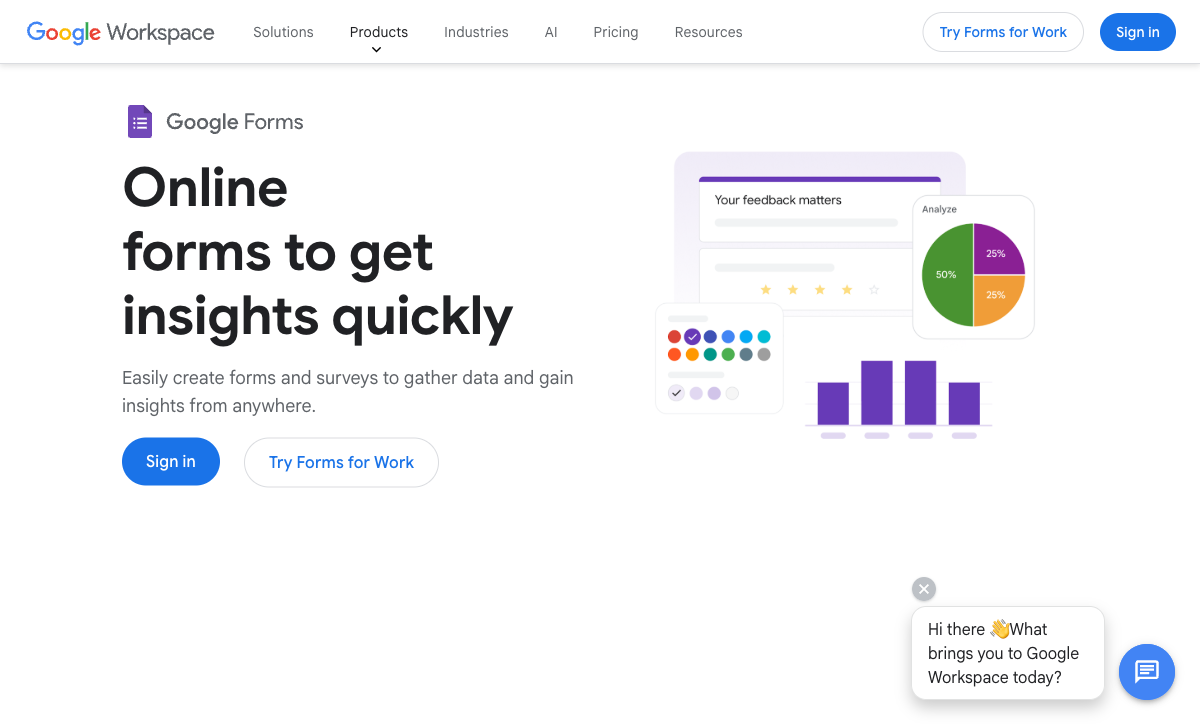
Google Forms offers unlimited forms, unlimited responses, and unlimited respondents at zero cost. Typeform's free plan caps you at 10 responses per month -- barely enough to test the platform. The pricing gap is the largest in the form builder space. If budget is a primary concern, Google Forms wins by default because there's nothing to budget for. For educators, students, nonprofits, and bootstrapped startups, this difference alone often decides the comparison.
No Learning Curve
Google Forms is the simplest form builder on the market. Open it, type questions, share the link. There's no editor to learn, no design system to navigate, no template library to browse. Typeform's conversational builder is intuitive by form-builder standards, but it still requires understanding Logic Jumps, design tokens, and the one-question-per-screen paradigm. For teams where non-technical staff regularly create forms, Google Forms' instant familiarity eliminates training entirely.
Google Ecosystem Integration
Responses flow directly into Google Sheets with zero configuration. Quiz scores integrate with Google Classroom. Files upload to Google Drive. The entire experience lives within Google's ecosystem, authenticated through the same account your team already uses. Typeform connects to Google Sheets through Zapier or its own integration, but it's a configured connection rather than a native one -- it requires setup, authentication, and occasional maintenance. For Google Workspace organisations, native integration saves meaningful time over the lifecycle of a form.
Quiz and Assessment Mode
Google Forms' built-in quiz mode offers auto-grading, point values, answer explanations, question shuffling, and timed release of results. It's deeply integrated with Google Classroom, making it the default assessment tool in thousands of schools and universities. Typeform can build quizzes using its Calculator feature and Logic Jumps, but it requires manual configuration rather than a dedicated mode. For education and training use cases, Google Forms' quiz functionality is more mature and purpose-built.
Where Typeform Wins
Conversational UX and Completion Rates
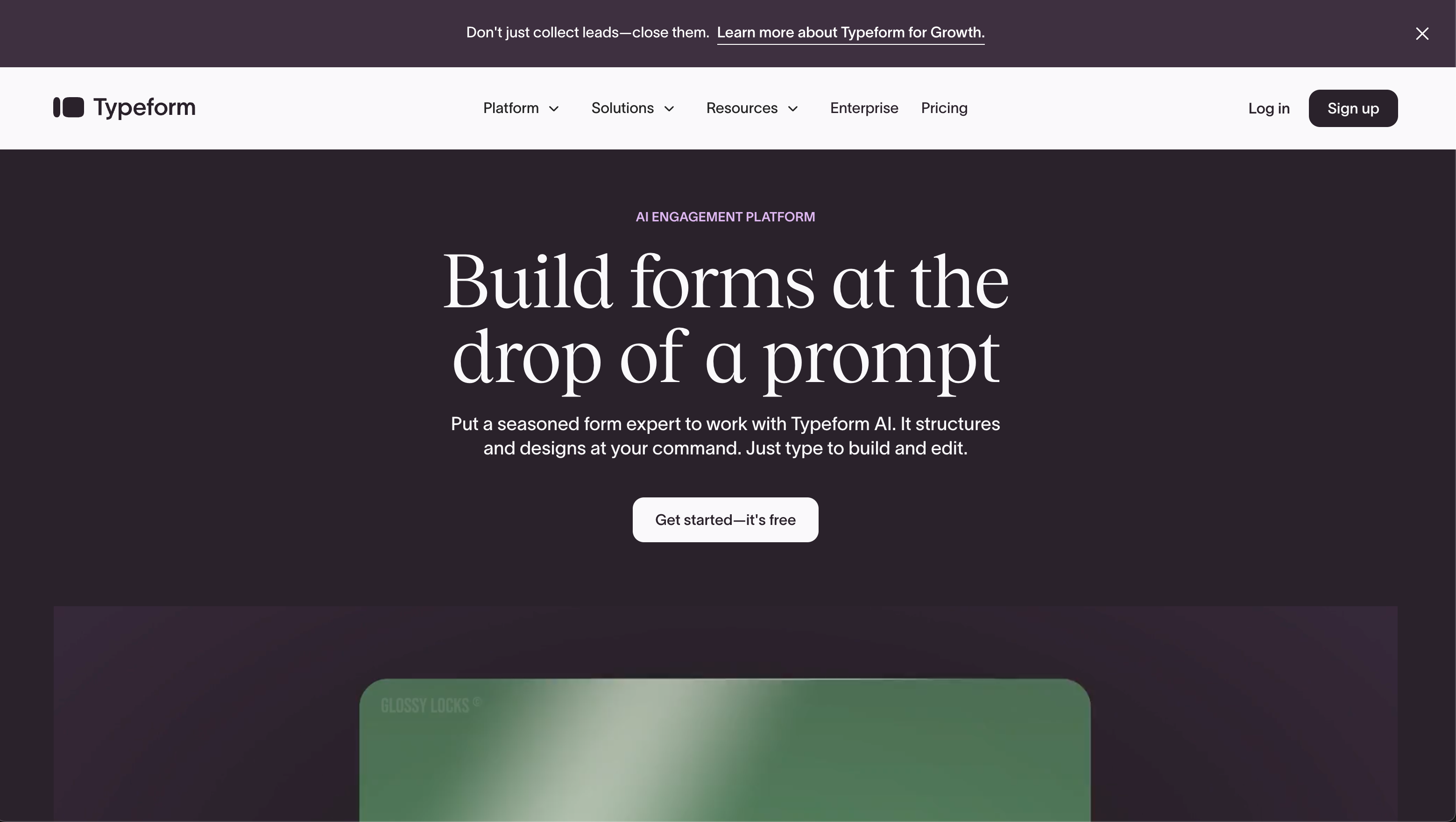
Typeform's defining feature is the one-question-at-a-time format. Instead of presenting a wall of fields, Typeform shows one question with smooth animations and transitions. This reduces cognitive load, creates a sense of progress, and keeps respondents engaged. The result: higher completion rates, particularly on longer forms. For lead generation forms where each completion has direct monetary value, Typeform's UX advantage translates directly to revenue. Google Forms' list-based layout works fine for simple surveys but causes higher abandonment on longer or more complex forms.
Beautiful Design and Branding
Typeform produces the best-looking forms in the industry. Custom fonts, full-bleed background images, branded colour schemes, video backgrounds, and responsive animations create an experience that feels like a polished web app rather than a form. Google Forms lets you change the header image and accent colour -- that's it. Every Google Form is instantly recognisable as a Google Form. For client-facing forms, brand experience, and professional presentation, Typeform is in a completely different category.
Advanced Conditional Logic (Logic Jumps)
Typeform's Logic Jumps allow field-level branching: skip questions, show different paths, calculate scores, and create personalised experiences based on any previous answer. Combined with the conversational format, this creates forms that feel like intelligent conversations rather than static questionnaires. Google Forms only supports section-level branching -- crude by comparison. Typeform also offers AI-powered adaptive questioning that generates contextual follow-ups in real time, a capability no traditional form builder matches.
Payment Collection
Typeform supports payment collection through Stripe integration on paid plans. Google Forms has no payment capability whatsoever. For lead generation forms that convert directly to sales, donation forms, or event registration with fees, Typeform can handle the transaction within the conversational flow. The payment integration is less extensive than dedicated eCommerce form builders (Typeform supports Stripe; others support 5-40+ gateways), but it exists -- which is more than Google Forms can say.
Integration Ecosystem
Typeform connects natively with hundreds of tools -- HubSpot, Salesforce, Slack, Mailchimp, Google Sheets, Airtable, and more -- plus thousands of additional connections through Zapier and Make. Google Forms integrates natively with Google Workspace (Sheets, Drive, Classroom) but requires third-party add-ons for CRM, email marketing, and automation connections. For marketing and sales teams that need form submissions flowing into CRM pipelines, email sequences, or project management tools, Typeform's integration breadth saves setup time and maintenance effort.
Video and Media Embeds
Typeform lets you embed videos, images, and GIFs directly within the conversational flow -- a video question followed by a response, an image that sets context before a rating question, or a GIF that adds personality to a thank-you screen. Google Forms supports image attachments and YouTube video links, but they feel bolted on rather than integrated into the experience. For product demos, onboarding surveys, or branded experiences where media is part of the story, Typeform's rich media handling creates a more engaging respondent journey.
Where Google Forms Falls Short
- Zero design customisation: Header image and accent colour are your only options. No custom fonts, no layout control, no branding. Every form screams "Google Form."
- No payment processing: Cannot collect payments, sell products, or handle any financial transaction.
- Basic logic only: Section-level branching is the ceiling. No field-level show/hide, no calculations, no dynamic content.
- No conversational format: All questions display in a list. No one-question-at-a-time option, no animations, no progressive disclosure.
- Limited integrations: Data flows to Google Sheets natively, but connecting to CRMs, email tools, or other platforms requires third-party add-ons with limited reliability.
- No e-signatures: Cannot collect legally binding electronic signatures for contracts, consent forms, or waivers.
Where Typeform Falls Short
- Extremely limited free tier: 10 responses per month is barely a trial. Any real usage requires a paid plan starting at $25/month.
- Expensive at scale: The Plus plan ($50/month) for 1,000 responses and Business plan ($83/month) for 10,000 responses make Typeform one of the priciest form builders. High-volume use cases become costly.
- One-question format isn't always ideal: For quick surveys, data entry forms, or situations where respondents want to see all questions at once, the conversational format adds unnecessary friction and time. Order forms, registration forms, and data entry workflows are slower in Typeform's format than in a traditional list layout.
- Limited payment options: Stripe only. No PayPal, Square, or regional payment processors. Businesses needing multiple gateway options need to look elsewhere.
- No calculation engine: Typeform has a basic Calculator feature for scores, but it lacks the Excel-style formula engine that platforms like Paperform offer for dynamic pricing, conditional totals, and computed values across form elements, emails, and integrations.
- No e-signatures: Contracts, consent forms, and waivers require connecting to external tools like DocuSign, adding cost and workflow complexity.
See Them in Action
The design philosophy difference between Google Forms and Typeform is immediately visible when you see both in use. Google Forms presents all questions in a scrollable list with minimal styling. Typeform reveals one question at a time with animations, transitions, and full-screen visual design. The respondent experience is so different that they barely feel like the same category of tool.
For form creators, the workflow is equally different. Google Forms can be set up in under 2 minutes -- open, type, share. Typeform requires more investment upfront: selecting a design theme, configuring Logic Jumps, adding media, and testing the conversational flow. The extra setup time pays off in respondent experience, but it's worth understanding the trade-off before committing.
Pricing Comparison
The pricing contrast is the most dramatic in the form builder space. Google Forms is unlimited and free. Typeform is one of the most expensive form builders available.
| Tier | Google Forms | Typeform | Key Difference |
|---|---|---|---|
| Free | Unlimited forms, unlimited responses | 10 responses/month total | Google Forms is genuinely free. Typeform's free plan is a demo. |
| ~$25/mo | N/A (still free) | Basic: $25/mo, 100 responses, logic jumps, payments | Typeform's entry tier unlocks design and logic. Google Forms is still free. |
| ~$50/mo | N/A | Plus: $50/mo, 1,000 responses, custom branding, no Typeform logo | Removing Typeform branding costs $50/month alone. |
| ~$83/mo | N/A | Business: $83/mo, 10,000 responses, priority support | Typeform's top tier costs $1,000/year for what Google Forms does free (minus the design). |
Google Forms
Typeform
| Product | Plan | Monthly Price | Annual Price (per month) | Free Plan | Free Trial | Limits |
|---|---|---|---|---|---|---|
| Google Forms | Free (Personal) | Free | Free | Yes | 14 days | forms: Unlimited, submissions: Unlimited, storage: 15 GB (shared across Google Drive), users: 1, file uploads: Included in 15 GB storage |
| Google Forms | Business Starter | $7/mo | $7/mo billed annually | forms: Unlimited, submissions: Unlimited, storage: 30 GB per user, users: Up to 300, file uploads: Included in storage | ||
| Google Forms | Business Standard | $14/mo | $14/mo billed annually | forms: Unlimited, submissions: Unlimited, storage: 2 TB per user, users: Up to 300, file uploads: Included in storage | ||
| Google Forms | Business Plus | $22/mo | $22/mo billed annually | forms: Unlimited, submissions: Unlimited, storage: 5 TB per user, users: Up to 300, file uploads: Included in storage | ||
| Typeform | Free | Free | Free | Yes | No | forms: 10, submissions: 10/month, users: 1 |
| Typeform | Basic | $39/mo | $28/mo billed annually | forms: Unlimited, submissions: 100/month, users: 1 | ||
| Typeform | Plus | $79/mo | $56/mo billed annually | forms: Unlimited, submissions: 1,000/month, users: 3 | ||
| Typeform | Business | $129/mo | $91/mo billed annually | forms: Unlimited, submissions: 10,000/month, users: 5 | ||
| Typeform | Growth Pro | $379/mo | $266/mo billed annually | forms: Unlimited, submissions: Expanded, users: Expanded |
What Users Say
Google Forms' reputation is built on ubiquity rather than reviews -- hundreds of millions of people use it because it's free and bundled with Google accounts. The universal praise: it's free and it works. The universal criticism: it looks generic and lacks advanced features.
Typeform earns strong ratings (4.5-4.7/5 across G2 and Capterra) with particular praise for design quality, respondent experience, and the conversational format. Common criticism centres on pricing -- users frequently note that Typeform is expensive for what it offers, especially compared to competitors with more features at lower price points. The 10-response free tier is a recurring complaint. As Zapier's 2025 review noted, Typeform excels at one thing (beautiful conversational forms) but charges a premium for a narrower feature set than competitors.
Who Is Each Platform Best For?
Google Forms is ideal for: anyone who needs free, fast, no-frills data collection. Internal surveys, classroom quizzes, event RSVPs, feedback forms, and quick polls. If design and completion rates don't matter -- and they genuinely don't for many use cases -- Google Forms is the pragmatic choice. Educators, nonprofits, small teams, and bootstrapped startups that need data collection without adding to their budget.
Typeform is ideal for: businesses where form completion directly impacts revenue (lead generation, customer research, product feedback). Marketing teams, agencies, and brands that need forms matching their visual identity. Anyone who values respondent experience and is willing to pay for higher completion rates and more thoughtful responses. SaaS companies building onboarding flows, product teams running user research, and HR teams crafting candidate experience surveys.
Neither platform is ideal for: businesses needing deep eCommerce (product variants, subscriptions, tax calculations), organisations requiring an Excel-style calculation engine for dynamic pricing or scoring, or teams needing built-in e-signatures and workflow automation. For those use cases, dedicated form builders like Paperform or Jotform provide the feature depth that neither Google Forms' simplicity nor Typeform's design focus covers.
Consider Paperform: Conversational Design at a Fair Price
If Typeform's design appeals to you but its pricing doesn't -- or if Google Forms' price appeals but its design doesn't -- Paperform offers a compelling middle ground. Paperform's Guided Mode delivers a conversational one-question-at-a-time experience similar to Typeform, while its document-style editor produces beautifully branded forms that leave Google Forms in the dust.
At $24/month (Essentials), Paperform costs less than Typeform's Basic plan while including features neither competitor offers: an Excel-style calculation engine for dynamic pricing and scoring, 5 integrated payment gateways (vs Typeform's Stripe-only), built-in e-signatures (Papersign), and workflow automation (Stepper). Paperform also offers a free tier with unlimited forms and 30 submissions -- more usable than Typeform's 10-response limit.
For businesses that need Typeform's conversational experience with Google Forms-level affordability and features that go beyond both, Paperform is worth evaluating. See our Google Forms alternatives and best form builders comparisons for the full picture.
The Verdict
Google Forms wins on accessibility and price. It's the only form builder that's truly unlimited and free. For basic data collection, internal surveys, and educational use, nothing beats free-and-works. The Google Workspace integration, quiz mode, and collaborative editing make it particularly strong for organisations already in the Google ecosystem.
Typeform wins on experience and design. If your forms are client-facing, revenue-generating, or brand-critical, Typeform's conversational format and design quality justify the premium. Higher completion rates on lead generation forms can easily offset the monthly cost. The AI-powered adaptive questioning is a genuine innovation that puts Typeform ahead of every traditional form builder for research-quality conversational data collection.
The gap between these two platforms mirrors a broader question in business software: when is "free and good enough" genuinely good enough, and when does paying for quality produce measurably better outcomes? For internal data collection, free wins. For external-facing, revenue-impacting forms, quality wins. The honest assessment: most organisations need both -- Google Forms for internal use and a professional tool for external-facing forms.
The remaining question isn't whether to upgrade from Google Forms -- it's whether Typeform, Paperform, or another platform offers the best value for your specific needs. Typeform excels at design; Paperform excels at combining design with feature depth; Jotform excels at feature breadth. For more options, see our Google Forms alternatives or the full best form builders ranking.
Frequently Asked Questions
Is Typeform worth the price compared to free Google Forms?
It depends entirely on what you're building. If you need basic surveys, feedback forms, or quizzes, Google Forms does the job for free and there's no reason to pay. But if completion rates, design quality, and respondent experience matter -- client-facing forms, lead generation, branded surveys -- Typeform's conversational format consistently outperforms traditional form layouts. Studies and Typeform's own data suggest their one-question-at-a-time approach can improve completion rates by 20-30% compared to standard forms. For lead generation where each completion has monetary value, the $25/month cost can pay for itself quickly.
Can Google Forms do one-question-at-a-time like Typeform?
Not natively. Google Forms always displays questions in a list format (or grouped by sections). You could technically create a separate section for each question and use section-based navigation, but it's a clunky workaround -- no animations, no transitions, and a visible "Next" button between every question rather than Typeform's fluid conversational flow. If the one-question-at-a-time format is important to your use case, Google Forms can't replicate the experience. Paperform offers a Guided Mode that provides a similar conversational experience with more design flexibility.
Which has better conditional logic: Google Forms or Typeform?
Typeform, by a significant margin. Google Forms only supports section-level branching (send respondents to different sections based on a multiple-choice answer). Typeform offers field-level Logic Jumps -- show or skip individual questions based on any previous answer, create branching paths, and build dynamic conversational flows. Typeform also recently added AI-powered adaptive questions that generate follow-up questions based on respondent answers. For surveys, quizzes, or intake forms that need to adapt in real time, Typeform is far more capable.
Does Typeform have a free plan?
Yes, but it's extremely limited. Typeform's free plan allows 10 responses per month across all forms -- essentially a trial rather than a usable free tier. Google Forms has unlimited responses for free. Typeform's paid plans start at $25/month (Basic, 100 responses). If you need a free tool, Google Forms is the only realistic option between these two. If you need more than Google Forms offers but find Typeform's pricing steep, Paperform offers a free tier with unlimited forms and 30 submissions including payment processing.
Which is better for surveys: Google Forms or Typeform?
For simple internal surveys (employee feedback, team polls, quick questionnaires), Google Forms is faster to set up and free. For external surveys where response quality and completion rates matter (customer research, market surveys, brand perception studies), Typeform's conversational format elicits more thoughtful responses. The one-question-at-a-time approach reduces cognitive load and survey fatigue. The trade-off is cost: Google Forms is free for unlimited responses, while Typeform charges $25-83/month depending on response volume. Choose based on whether the survey is internal (Google Forms) or external-facing where quality of responses matters (Typeform).
Sources & References
- Best Online Form Builder to Use in 2026 -- Top 20 Tools — EmailToolTester, 2026
- The Best Online Form Builders for 2025 — Zapier, 2025
- Typeform vs Google Forms: Which Should You Use? — Zapier, 2025
Last updated March 21, 2026
Ready to try Paperform?
Create beautiful forms, payment pages, and workflows — no code required.